This week there’s been debate again
about the legality of the free camping on Eristos beach, so it seems a good
time to address Mark Hill’s questions about the kantina. Mark wrote:
"I want to know about this cantina!
Seriously. I want to know everything about it. I want to know why you opened
it. I want to know what it's made of. Where you bought it? I want to know what
food you sell and where you get it and how much it costs and how you figured
out how to cook it. I want to know who comes there to eat and when and why. Are
they locals or tourists or a mix of both? That damned cantina
fascinates the hell out of me!"

There’s been a kantina on Eristos beach every summer since around the year 2000. The first one, I think, was painted red and run by
Stelios’s cousins. After that, it was Vangelis – otherwise known as Zorba – who
ran the kantina, with his daughter Martina. I remember Vangelis telling me
about it when I first met him, how he used to like meeting the people who
visited the island. I think I only visited the kantina once when Martina ran it,
during my first summer on Tilos in 2011; Vangelis was by then working with his
son Nikos at his new restaurant in Livadia. I remember my first visit to the kantina well,
as it wasn’t long after the first koupa dance in the village where I’d briefly
first met Stelios; he was playing cards there with Apostolis when I
strolled up in my bikini to order a toasted sandwich. A week or so later, I met
Stelios again at the second koupa, and by September we were together.

When her father died in early 2012,
Martina decided to sell the kantina, and she offered it to Stelios.
Stelios spent his summers growing up on Eristos beach, partied there through
his twenties when he invariably came back to the island for the summer, and he
knows all the people who come to camp at Eristos every year. What he bought from
Martina was the physical trailer along with all its fixtures and fittings – a
fridge, a water tank, a tostiera etc.
But there’s also much more expense and paperwork involved than you’d expect.
You have to apply to the municipality for the grant to use the piece of land on
the beach (which they could have granted to another applicant, but he was at an
advantage as the municipality must favour permanent residents of the island who
need work). He had to have a licence to sell food, and insurance (I’m not
allowed to work there, but I run errands and of course get to hang out there and help clear the stones off the beach at the start of the summer...). He needed a tax number and cash
register and accountant – all very expensive in Greece. But none of that would
put Stelios off. He’d wanted to run that kantina for years.

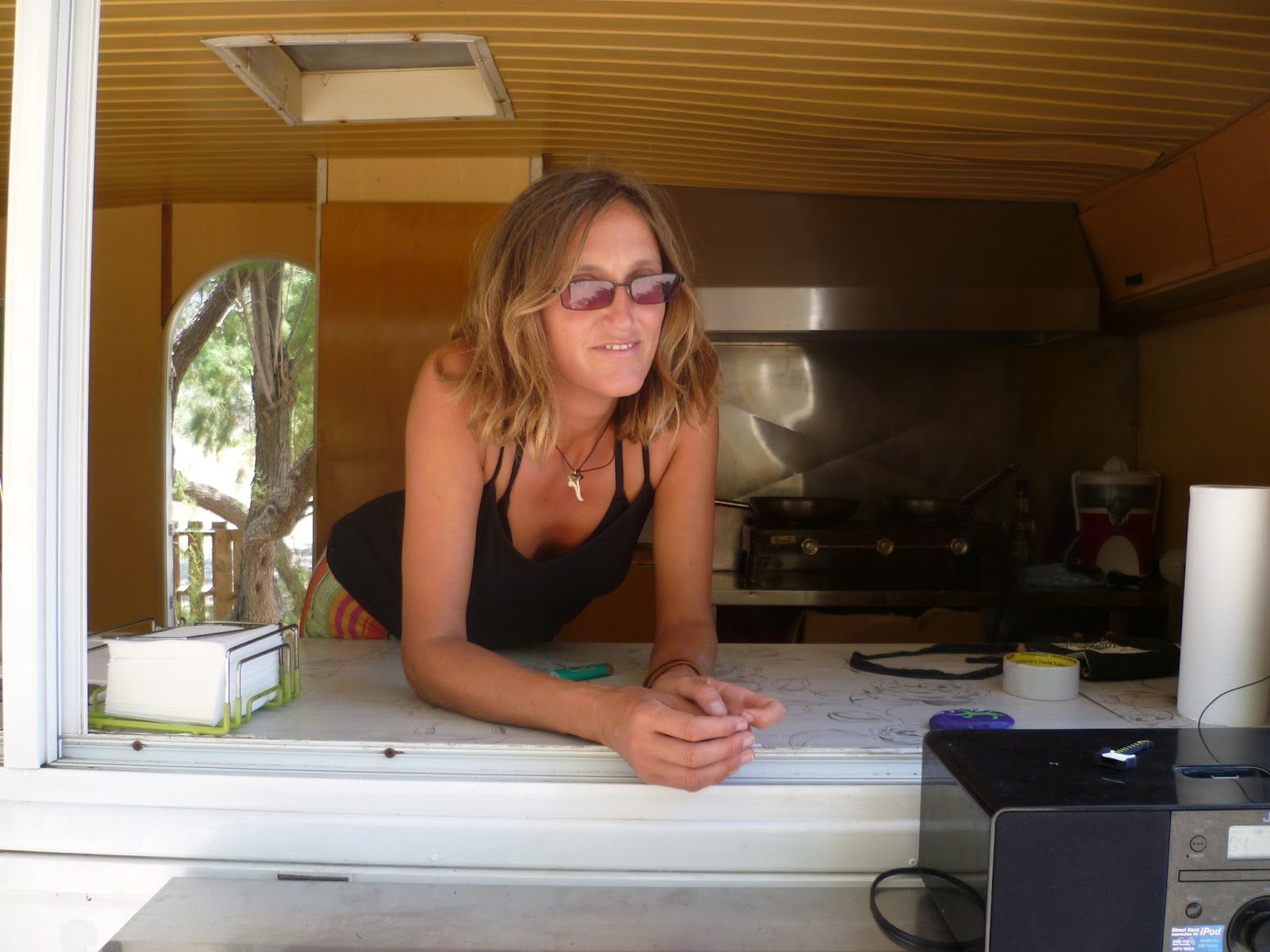
There are also restrictions on the kind
of food that can be sold. It’s a kantina, not a restaurant, so nothing can be
served on a plate with cutlery – it has to be in sandwich form. There are three
nearby tavernas, and he can’t offer food similar to theirs. So the kantina
offers cheap fast food, drinks and ice creams. But the hamburgers are freshly
made from good quality meat. Most people order ‘tost’ – a cheese and ham toasted sandwich with tomato – with a
Greek coffee or a frappe in the mornings, maybe an omelette sandwich, and take
away cold bottles of water or ice with them, and gradually as the day goes on
people order burgers and village sausages and tuna salad sarnies with beer or
wine.
Food is supplied by Antonis, who’s also
deputy mayor and one of the stars of the Tilos football team. When you live on
an island with only one boat a day during the summer, you need a reliable
supplier. Cousin Popi also regularly gets roped in to picking up odd supplies
from Rhodes – her luggage for the weekend suspiciously heavy with backgammon
boards, extra pairs of shorts and plastic bags for making ice.
The kantina doesn’t serve traditional
food, you wouldn’t want to eat it all the time – but importantly it’s cheap (sandwiches
2–3 euros, drinks under 2 euros), it’s quick and easy; there’s service with a
smile, and a friendly, hippy sort of vibe.

The customers include locals –Marios and Apostolis
and Antonis and Angelos – who come for the company, and people who are staying
elsewhere at Eristos, or like American/New Zealanders Bob and Joanie have
arrived on their yacht, or have come up on the bus from Livadia for the day. We
currently have a couple of successful French authors who are doing a bit of
work from the kantina during the days, brushing shoulders with Greek guys with
tattoos and girls with dreadlocks. It’s a fantastic mix of nationalities, families
and couples and groups of friends.
Most of the customers are from the free
camping, though; the hundreds of people who set up their tents and canopies
under the trees along the beach through July and August. Free camping is
actually illegal in Greece, but Tilos, like a dozen other islands, allows it to
happen. As our mayor, Maria Kamma-Aliferis, wrote in a Greek newspaper this
week, the campers on Eristos have been coming for years (some twenty years or
so) and contribute to the island, and they respect the place and clean up after
themselves, and they’ve become friends of the island. They mostly bring business
to the local shops and restaurants. But every year, the existence of the free
camping is contended by one of the nearby hotels. So it’s a precarious thing.
Last week, two lovely English guys came to camp at Eristos, and bought my book along with the drinks and sandwiches from the kantina. They went up to the festival at Harkadio Cave on the Saturday night to watch the traditional dancing and they bought souvlakis from the stand we were running. And they said they'd only decided to come to Tilos because they read an article I'd written for Wanderlust about the camping on Eristos last year.


Stelios loves running the kantina. It’s
his life for a few months, and we don’t really have a conversation that doesn’t
revolve around the kantina – pick up some oranges, pay the bakery, wash the
hammock, bring some new music… And for many people, making new friends or
meeting up with old
ones at the kantina really makes their summer holiday complete.
ones at the kantina really makes their summer holiday complete.
(Did you know... Kantina has its own Facebook page, 'Kantina Eristos Tilos' - feel free to join!)


