Showing posts with label Crisis. Show all posts

Tales from the Tilos Kantina - 'Dromografos'


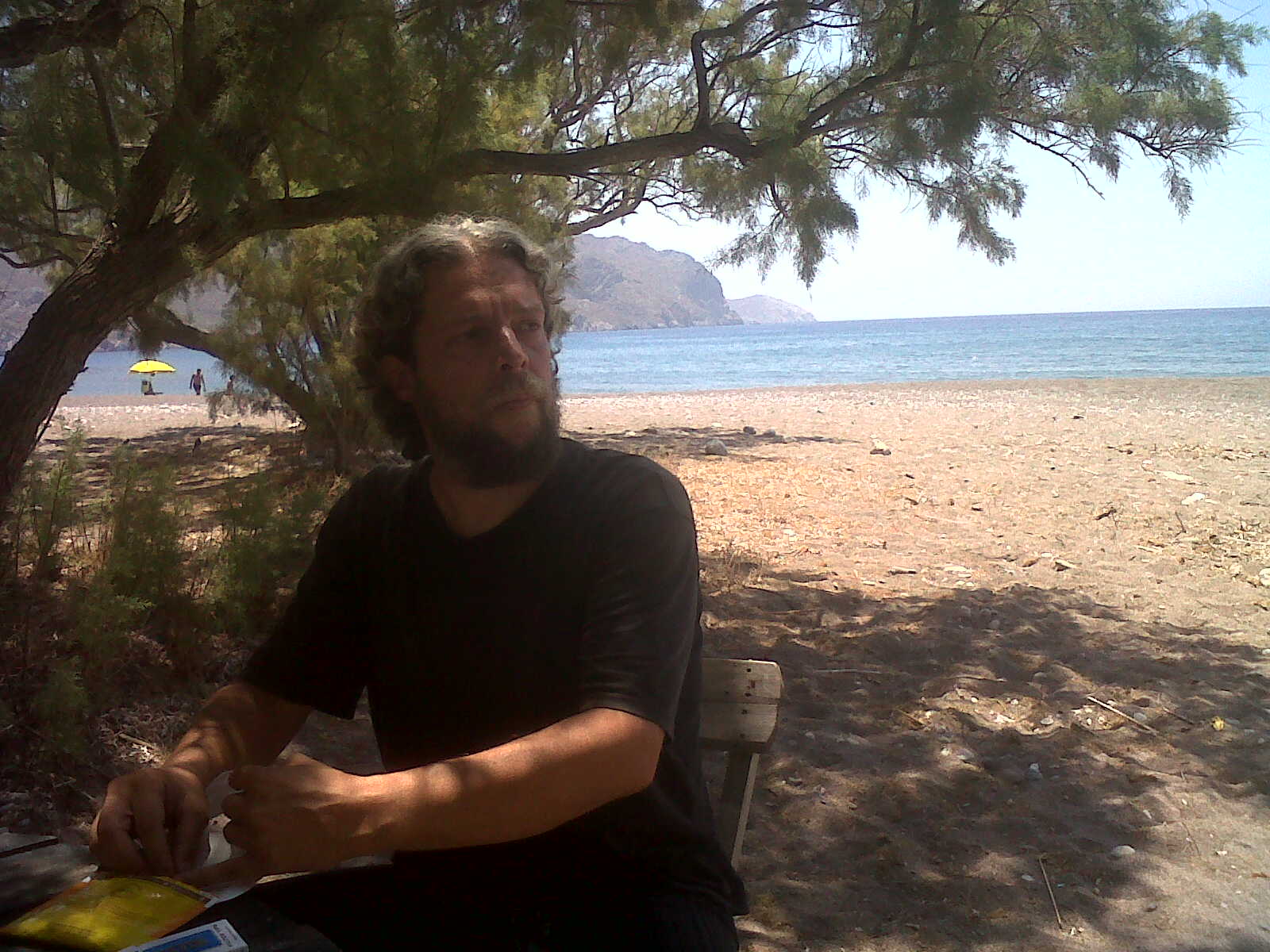
One evening in early June, Stefanos was in his tent on Eristos beach in Tilos as usual, where he’s come to camp every summer for the last ten years from his home in Athens. But on that evening, he wasn’t just enjoying the peace and quiet, the sound of the sea, the stars above. From his little tent, he was involved in a group effort to keep the signal of the Greek national television station alive.

The softly-spoken 43-year-old tells me over coffee that he was working last year as a computer and website programmer, but the work dried up as a result of the economic crisis. ‘I was politically active before but I felt I had to do something more. When I didn’t have a job anymore, I had the urge to do something about it.’ So he started taking photographs, recording what he saw happening on the streets, and posting them online. He calls himself Dromografos, a play on words meaning something like street reporter.

'It’s an ugly situation in Athens, worse every day, thousands without work. People are tired - so much has happened, it leaves them in a state of shock, they're being hit from every direction. 

'The protests have achieved something but the state is fighting back with such force… Four thousand municipal police have been transferred to the main police department, giving them the power to have guns. It’s like a police state in Athens, the police being used like an army, similar to a junta. The constitution means nothing; the government has passed over 20 laws without going through parliament, saying it’s a “unique situation” so they only need the president’s approval – parliament is just decorative.'

One of those laws, says Stefanos, was the shutting down of public television. The Greek government claimed ERT, the state channel, was a ‘haven of waste’, and to save money they were going to shut it down.

'And sure, it was wasteful. But TV is the most powerful weapon. Public television is the only medium that’s unbiased. The government announced at 6pm they were shutting it down at midnight.'

Stefanos, along with other journalists protesting about what this meant for the country, tried to maintain the signal of the TV station online.

'For young people it was very important. The signal never went down on the internet.'

The journalists who have banded together during this time call themselves Media from the People (in Greek, Media Apo To Kato). Their main target is to form a news agency that’s not controlled by anyone, and to set up a website by the autumn that will be the most reliable source for learning what’s happening in Greece; European news media have expressed interest in using it, and they have the technology for web TV. The team of around a dozen groups of people includes some currently employed by mainstream press, working anonymously through social media.

‘What happened with ERT was actually a chance to promote what we are doing. We were interviewed three times on television. Whatever happens with ERT in the future, whether they do put it back on air in a different form, it’s a good thing that all these TV and newspaper guys came together to build something new.’

If they manage to make it happen, he says, people won’t have to search twenty or thirty sites to find out what’s really happening. As Stefanos sees the current Greek government acting more like a junta, it’s important for people to have access to real information, unfiltered by the controls of the privately owned media, in the lead-up to new elections.

What does he see in the future for Greece?

‘There are two possibilities. The first is continuing the current route with the IMF, Troika and so on. Most economists, even the capitalist ones, think this is leading to destruction, that there’s no way Greece can develop in a way it can pay back the loans. The new loans just pay the interest on the previous loans.

‘Then there's the other scenario. The main opposition party, Syriza, if they managed to make a government, would have to agree to co-operate with the communist party, which wouldn’t be easy but it could happen. They would try to re-negotiate with the EU so Greece could not pay the interest on the loans for 20 years until we can grow the economy. It would put money back into the market. If the EU didn’t agree to this and Greece left the EU, it could trigger an exodus from other countries in similar positions – Ireland, Spain, Portugal.

‘The next years in Greece will be hard – but most people think there is nothing to lose, that the situation can’t get any worse. At the beginning of this crisis, Papandreou said "we will do our best so that every family has one working person…" We thought at the time it was a mistake – how could there only be one person in a family working?! But now it’s come true. People who’ve lost their jobs receive welfare from the state for six months only, then they have to go back to their villages to live off a parent’s pension to survive. Properties are left empty, shops close, streets are deserted.’

As for Stefanos, although he sells his photos whenever he can to foreign media (usually when something major makes international news), he offers them for free within Greece – ‘for the cause’ – as long as others don’t use them for profit. And he’s found his new way of life incredibly rewarding, even though he’s surviving on a minimal income.

‘There was something missing before. So many people were struggling and there was no-one to cover it, to say what they wanted; no-one knew the people who lost their jobs were demonstrating and asking for something. I’ve learned many things I didn’t expect. I’m on the streets from morning til night, and try to post photos immediately.

‘There’s stress, but I feel great about it – when I get up I think wow, what do I have to do today, and when I go back at eleven or twelve at night I feel very tired but very happy, it fulfils me.’

In the meantime, he's monitoring the news from Eristos Beach, Tilos.


Find Stefanos at www.dromografos.org, @dromografos

'Life is Short - Enjoy your Coffee' on a Small Greek Island


Mytha the Cat is back and ready to be fed, please


In two weeks’ time, Greece will vote again in elections that could create monumental change, deciding not only on a government but whether they are more or less likely to be able to stay in the Eurozone.

Well, I spent two weeks in England this month, and spent enough time talking and thinking about that. Here’s what Tilos looked like on the morning I left:

And here’s what England looked like when I arrived:

Anyone who thinks the Greeks are lazy – as one London cabbie made clear he did, while I pretended to check messages on my phone to avoid getting into a discussion – should consider dolmades. Would you make something so fiddly for an ordinary mid-week lunch? I went to buy eggs the other day and was directed into Eleftheria’s kitchen, where she was hidden behind a mound of vine leaves and a pan of rice stuffing, preparing lunch for her extended family of ten.

Megalo Horio
Anyone who thinks the Greeks don’t want to work should meet the lovely cabbie who drove me and a Swedish couple from Rhodes airport into town on my return. A tall, skinny guy (unlike his London counterpart). We were heading for the bus stop when he came over and offered to drop us off exactly where we wanted to go for less than three-quarters of the normal cab fare, only just more than the bus. He was fed up with waiting at the back of a long line of taxis. ‘Better for me to keep working,’ he said.

He chatted to us all the way and threw in tips for the tourists when they asked where to eat. The subject of The Crisis came up and the young Swedish guy made a gauche comment about how the Greeks now will ‘have to work’. There was a quiet pause, while the driver wondered if the young guy was joking, then he just shrugged and said he worked twelve hours a day, though takings were down 50%.
As for the vote ahead, he said: ‘It’s crazy we have elections in the summer, though, the tourist season. And who can we vote for? This one steals, the other steals more. I’ll vote for who steals the least! Anyway, I think is better to go back to the drachma. Sure it will be hard for years, but not as bad. People will go back to the villages – life is easier in the villages – and make things again.’

Spring figs!

Seva in aerobics class this week was talking about how when she came to Tilos around thirty years ago (only from the next island over, Nisyros), it was behind in a lot of ways, but it also had more life, more young people.
Yes, I am back at aeroviki and loving it, and back at Greek dance class too although that’s a bit more difficult. ‘Irthes, you came?!’ commented Anna, our teacher, as it has been a while. I got my feet in a bit of a twist a few times, and my hands: when you hold hands across the people next to you, one hand faces upwards and the other down. (I ask you, would a lazy people really invent those complicated Greek dances?) ‘You remembered that one?’ joked Anna when I finally managed a full dance without getting mixed up.

Oleander was out in full bloom at the roadside when I arrived back in Tilos
Funny, it creates the opposite of road rage. As do the goats that loll around,
not really bothered that you're approaching.
So, will Greeks from Athens be able to afford the trip to Tilos this summer? The seafront restaurants in Livadia – including Irina, which has been opened up again by a Tilian/Cretan family – already have customers from England and Germany, France and Scandinavia. The sun is shining, the sea is blue; the island waits to see what the summer will bring.
And none more than the new owners of the Kantina on Eristos beach.
For the last several years, a Kantina among the trees serving drinks and snacks to people on the beach was run by Vangelis and his daughter, Martina; though last year, Vangelis was helping his son Nikos get set up in his new restaurant, Gorgona.
Last summer, I remember one day grabbing myself a cold lemonade and a sandwich at the Kantina, and Martina in a quiet moment was playing cards with Apostolis and Stelios, two new friends I’d met at the panayiri or festival in the village (little did I know…). Stelios, I later learned, has pretty much spent every summer on Eristos since he was a boy, and knows everyone. (Which is why, after he and I met again at another panayiri in the village, he invited me to the little bar on the beach…)
After the lovely Vangelis passed away in the winter, Martina decided Nikos would need help in the restaurant. So she put the Kantina up for sale, and offered it first to her friend Stelios. Why is why, a few days ago, he and I came to be clearing rocks from the beach.

And Stelios, after months of talking to people, procuring the tax documents, seeking permission from the local council, having tests done for a health certificate and doing all sorts of other expensive, stressful and time-consuming things (who knew that the till alone would cost hundreds of euros? and how many tourists see the hard work that goes into making their holiday feel laid-back?), is now preparing to open. The least I can do is shift a few of the stones the winter storms washed up on the beach, so that folks can relax in soft, sandy comfort as they sip their cool drinks.
(Little will they know that literally a stone’s throw away, a fisherman from Tilos and an editor from England got to know one another...)

The Kantina itself is now in place, but Stelios looks very worried about all the work he still has to do. He has to find an anthropos to help him haul the drinks fridge and the ice cream fridge into place and the wooden tables and chairs. Then he’s got to see if he can teach me to make a decent Greek coffee while he’s out fishing in the morning.
He’s so worried that he’s thinking about taking up smoking again. For the stress. ‘I was much less stressed when I smoked,’ he says. ‘And the doctor says I’ve got to be careful about my stress.’ It seems a shame to go back to the kapno after a few months without it; he smells a lot nicer and I don’t have to sweep up bits of tobacco every day. Not to mention the debatable health benefits.
‘There are some Angli, English people, next to the Kantina having a party,’ said Stelios on Saturday when I was preparing to go for a swim. I glimpsed Ian and Barbara as I passed by, and went to say hello. At once I was invited in to meet the crowd.

‘Are you the lady who writes the blog? We’ve brought you a book,’ said Rosie, who had read my post about using an illustrated story book to teach English to the little kids, and thought I might be able to use a book she’d found in England.
‘Come over here, there’s someone else who’d like to meet you…’ Here was a group of long-term Tilos-lovers who in their search online for things Tilos-related had found my ramblings and liked following the life of the island from afar. ‘Keep it up!’ they said. I’d met two other couples in Livadia the other night who said the same. Well, now I’d better. If only for the nicest group of people you’d ever expect to find having a Queen’s Jubilee Party on Eristos Beach in Tilos.

It’s dusk, and it’s warm out on the terrace. I’ve watered the garden – the potatoes which Stelios has been frying up, the onions and rocket for salad, the last of the radiccia with its blue flowers in the morning that disappear in the evening, our fledgling tomato and courgette plants. In the distance, in the deep blue sea, a big cruise ship crosses the horizon. I spot a donkey down in the field by the church. The bees are buzzing in the garden and a bat flits by. There is nowhere quite like this place.
These islands survived hundreds of years of Turkish occupation; then Italian occupation; followed by German army occupation during World War II, which decimated local farms. When finally the islands became independently Greek again, they suffered under the years of the military junta. There have been a few good decades since. Let’s hope Greece can get through this next challenge.
Meanwhile, as the saying goes: life is short – enjoy your coffee. Preferably at Eristos beach, at the Kantina… opening soon.