Showing posts with label spring. Show all posts

Hoopoes and Swallows, Asparagus and Taramosalata...


When Lisa wants to go for a morning walk, all winter I’ve been used to piling on whatever warm clothes come to hand, a woolly hat over unbrushed hair. But this morning I ran into several neighbours, two of them dressed smartly in black for church. It’s the start of Easter week and more people are back on the island.

Also back are the lovely hoopoes – I’ve seen several, not noticing the medium-sized brown birds until they take off in flight and show their flamboyant black-and-white-striped tail feathers. I’ve heard the whistling sound of bee-eaters – it seems early for them – but not seen one yet. Much more evident are the swallows, swooping low and fast, midnight-blue plumage on top and snow-white underneath, tail like two long, fine tines of a carving fork.

Yesterday morning, four young goats were playing on the old drystone wall in front of my house, two of them trotting over the rocks and head-butting each other. Despite the abundance of fresh vegetation everywhere, they stand at my fence and look greedily at the garden.

Goat farmers are much in evidence too, guarding their stock and fattening them up. ‘Don’t let the dog out of the car here!’ snarled one when, having seen him with his flock, I stopped to ask where it was OK to walk. We’re avoiding Plaka and Lethra until Easter is over, when there’ll be a lot of confused mother goats saying, ‘I haven’t seen young Johnny for days…’ ‘Meh, and my Matilda’s disappeared too… And what’s happened to that nice man who kept bringing treats?’

Livadia and Megalo Horio will also be off-bounds for the next week while firecrackers are exploding – I heard the first yesterday, while in between downpours we walked along Livadia seafront. More rocks had been washed up by powerful wind and waves from the south recently. As we walked around the bay, the pebbles looked brilliant white against a clear aquamarine sea and a brooding sky. Lisa, of course, went in for a swim.

We’ll stick to places far from firecrackers, the fields in the Eristos valley where Lisa loves to sniff for rabbits, occasionally making one leap out of a bush and safely away, while I keep an eye out for other prizes. Perhaps because we’ve had plenty of rain, or perhaps I’ve got better at looking for them, I’ve found more fresh wild asparagus than ever before, and more exquisite orchids – sending photos to my orchid-ID gurus Eleftheria and Gerry. And in the hillside terraces closer to home, I look out for tiny fragments of old pottery with an unusual pattern or glaze. Yesterday afternoon, I found a little of everything so didn’t mind that my feet were squelching in my boots from walking through wet grass. Lisa had a wonderful time, enjoyed a huge dinner and watched neighbours walk by while I pulled up weeds from the garden, enjoying the evening sunshine. By the time I lit a fire for a cosy evening, she was in a deep sleep.


I’ve been using the excuse of Lent and long walks to eat halva every day. My favourite from Drapetsona in Piraeus was made with carob syrup. During the ‘fasting’ periods leading up to Easter when some give up meat, certain traditional foods appear. After eating delicious white taramasalata at tavernas in Rhodes and then Astypalea during trips last month, I decided to try making my own. The pink packaged stuff is terrible in Greece compared to good supermarket taramosalata in the UK. For the first time, I bought the salted roe from the minimarket and got instructions: mashed potatoes (or bread), olive oil, lemon. Mine tasted bland until I added finely chopped onion. The ladies at the minimarket said not everyone likes it with onion.

Before this last rainy week, we had weeks of dry weather, good swims, even lying in warm sun. But the heavy rainfall this winter has been a blessing for the island.


Now big leaves have now grown back on my fig trees, and sparrows are knocking down the hard green figs, discarding them when they find they can’t eat them, looking instead for other things to eat in the soil, taking baths in Lisa’s water bowl.

For the last months, I’ve been working on revisions of the new manuscript. It’s something I was writing on and off for ages, and finally felt driven to finish last year. With the help of an excellent editor, I hope I’ve knocked it into shape. It’s about my adventures on Tilos with Lisa since we moved to this house at Ayios Antonis with its fig trees and vines, surrounded by mountains and sea, life in an amazing place with an amazing dog, woven in with stories of island life past and present. Maybe AN ISLAND HOME AND A SALTY DOG?

Ahem, says Fishbags, aren’t you forgetting someone?

The amazing salty dog just came to look at me through the open kitchen door, suggesting it might be time for another walk or another breakfast. Ah, and the power’s just gone off again – for about the tenth time in two days – so this will have to wait until later…


Happy Easter

Today’s been a lazy, quiet day, after a splendid Easter Sunday here at Ayios Minas – around a year since I first came here. 
In the last six weeks, much has happened. In March we spent a hot, sunny day in Avlona, Lisa and I walking the footpath from Olympos while Minas and his uncle trimmed their vines, then we all drove on to a valley beyond there to see the peonies.


One of the first guests of the year staying at our studios in Olympos arrived at the end of March just as a huge thunderstorm came with a deluge of rain. It knocked out the power temporarily, and left roads broken and covered in rockslides. I was amazed by the noise of streams rushing down the mountains in Olympos. The riverbed turned to a gushing river, which changed the colour of the sea. Gorgeous waterfalls appeared in the valley. When the sun came out again, the air was so clear and the light intense. Thankfully, Juliette had chance that week to sit in sunshine on the terrace.
Here down at Ayios Minas, the riverbed also turned into a river, the banks thick with flowers, bordered by fragrant pine trees and olive trees. Lisa loved the rock pools and I sat and listened with happiness to little temporary waterfalls. Thanks to all the rain this winter, the abundance of flowers has been breath-taking. So many flowers, different types every day in every colour in the lush green fields and deeper green hills.

In early April, we took the opportunity to visit some places in the south of the island where I’d not been yet, including Amoopi with its pretty pale sand beaches. 
Lately we’ve seen the occasional hoopoe, Bonelli’s eagle, peregrine or kestrel. One day, Lisa barked at something in the next field. We looked and there was what looked like a heron, but more colourful than the grey herons I'd seen before. It seemed tired and didn’t fly far. That day, I walked down to the beach for a swim, and I hadn’t got very far out when a fishing boat appeared around the headland. I thought it was probably passing but it turned into the bay, and lo and behold it was Stamatis, his first visit to us since September. He handed us a keep-net full of flapping menoula. We put some tables together and grilled the fish on the barbecue. It was another sign that summer’s almost here.
On Easter Saturday, I went up to Olympos with Minas, who was helping his uncle Nick for a few evenings at Geia Mas taverna. Immediately I arrived, I said hello to a French man and an English man sitting at a table and they invited me to drink some wine with them. They were visiting Olympos for the first time and had just met that evening in one of the other hostelries. We all got along, the evening flying by. We could hear traditional music coming from next door at Parthenon taverna, and see the people going into church, and hear the firecrackers, and when the service ended we went outside to greet friends with Christos Anesti.
Over the course of the evening we’d met a young woman from Athens who came in looking for a cigarette, and when she said she and her partner were off to Kafeneio Kriti to meet some other friends, Minas and I decided to join them to give Easter greetings to Archontoula and Philippas too. We all sat down to eat together.
Greeks are used to eating mayeiritsa on the night of Easter Saturday. A soup made with green vegetables and the intestines of the goat, it’s the first meat dish to break the fast of Lent, intended to prepare you for the goat feast the next day. But this was patsa, morsels of goat’s stomach cooked in an egg-and-lemon broth, and they nervously pushed bits of tripe around the plate. Something about seeing the city folk squirm – plus, to be fair, the large quantity of wine I’d drunk – made me dig in with gusto. Minas did too, and we found it pretty tasty. 
And so, after being up until 3 a.m. drinking wine and eating goat-stomach soup, I was feeling not quite at my best the next morning when we got up not long after 7 to start preparing for the day. But no matter. The weather couldn’t have been more beautiful: not a breeze or a cloud to bother the blue sky. I kneaded bread dough and left it to rise while Minas lit the charcoal and attached the whole goat to the spit. It had been slaughtered at the top of the valley a couple of nights earlier when he went to pick up the goat’s cheese. He’d made tzatziki and melitzanosalata, aubergine salad. We cleaned and organised, then relaxed as the meat roasted. I went to the beach for a swim, and the pebbles and sand were too hot to walk on – first time this year.
Lisa announced the first guests with some loud barking. Over the winter so few people come down to Ayios Minas, it’s handy to have a Distant Early Warning Signal when a vehicle appears. But yesterday, Lisa’s vocal cords and our ears were tested. Our Swiss visitors were walking down the track, and her barks accompanied them all the way.
By early afternoon, the sea was flat calm, and everyone seemed happy to enjoy the beach while waiting for the meat to be ready. After a long swim, I went for a walk up the riverbed and noticed the little yellow pom-poms of the overhanging trees had overnight been shed, leaving the ground dusted with gold, and to compensate, the yellow broom flowers were now smelling so sweet – I picked a few, and we decided to decorate the tables with them.

The food was ready just as the sun began to drop towards the hilltops, and everyone joined the tables together to eat.

Sea Captains, Sea Bream and Swimming in Lovely Lindos


On my first afternoon in Lindos, I’d arranged to meet Karen and Claire from Exclusively Lindos at the relaxed Skala taverna on the edge of the sandy beach. Looking out across the little bay, we spent the afternoon laughing and swapping stories over a superb lunch that included fried calamari and tzatziki and a Greek salad with capers, plus three excellent cooked dishes: a spicy sausage dish called spetsofai, aubergine in rich tomato sauce, baked in the oven and topped with cheese, and one of my favourites, peas cooked with potatoes, carrots and herbs in olive oil. 
As the afternoon wore on we made our way through this feast and drank wine and the sun gleamed on the bay. We thanked chef Giorgos and the team at Skala, sending greetings to owner Sotiris who was working on his new restaurant in Lardos. I waved goodbye to my new friends for now and couldn’t resist slipping into the sea that lapped at the shore. As I swam, a light spring rain began to fall and the soft sunlight that emerged through the clouds afterwards was beautiful.


Just as New York isn’t really America, Lindos isn’t really Rhodes; it’s got a charm and magic all of its own. The village and its immediate surroundings have been protected from development because of the archaeological significance: it was a major trading and shipping centre as far back as the 8th century BC, pre-dating Rhodes town and sending a contingent of ships to the Trojan War. The Acropolis of Lindos with its temple of Athena may be older than the one in Athens, overlooking St Paul’s bay where the Apostle took shelter from a storm; the fortress around it was built by the medieval Knights of St John. The buildings are all in traditional ‘sugar-cube’ style and contained within the old village limits. Built around the edges of a hill with ancient ruins atop it and the sea on three sides, from the 1960s it attracted artistic types from all over the world.

I first stayed in a villa in Lindos in the 1980s with my family; a few years ago I returned in midsummer and sampled the restaurants and bars with my friend Hari. This time, Exclusively Lindos had offered me a stay in a ‘Captain’s House’ in the heart of Lindos for a few days in April. It would be a quiet time, I expected, since the season doesn’t really start until 1 May; and Lindos looked very pretty, the surroundings tinged with green.
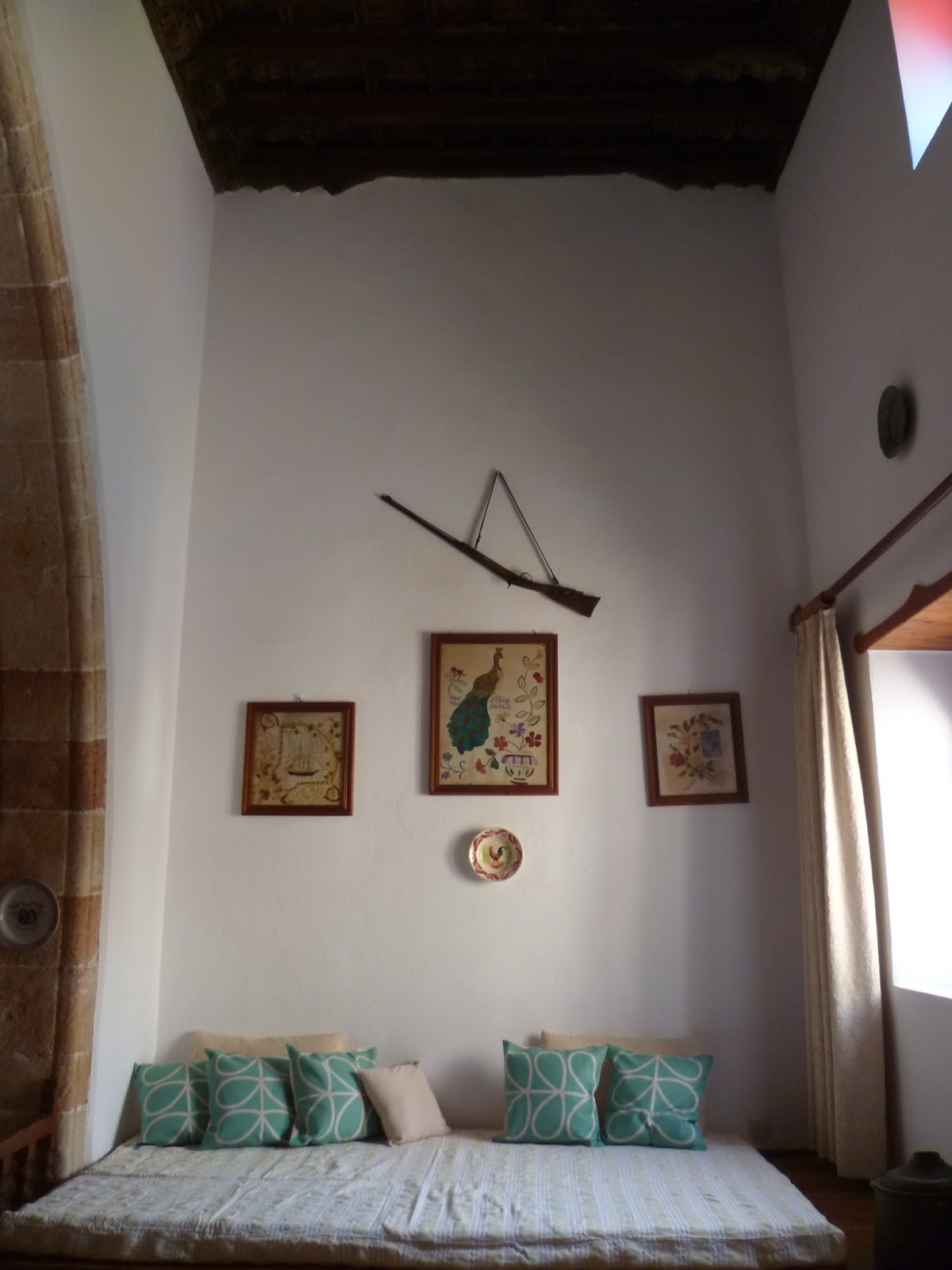
The Captain’s Houses were the homes of the affluent merchant seamen of Lindos in the 16th and 17th centuries. Hidden behind high walls and grand doorways, they housed sizeable families and were decorated with Byzantine and Arabesque features and pebble mosaic courtyards. On my previous visit I’d seen the Papakonstandis Mansion. The Captain’s House accommodation offered through Exclusively Lindos is owned by a local family who handcrafted the interior woodwork. Off the courtyard are two bedrooms, a kitchen and the tall, magnificent sala, with its painted wooden ceiling and traditional raised platforms for sleeping and relaxing. To stay in such a place, part of the heart and history of the village, was very special.


The next morning I had Ayios Pavlos (Saint Paul’s) Bay to myself for a morning swim. 

My mum was flying over to join me at the Captain’s House so we would make the most of the few days. When she arrived, we went straight down to the bay for lunch at Tambakio, a stylish restaurant on the water’s edge. The tambakio was a tannery (‘tambak’ being the Turkish word for leather, apparently); they would slaughter the sheep or goats there and it had been used until World War Two; then converted into a restaurant thirty years ago, and owned by the same man who has two of the most popular summer clubs in Lindos, Antika in the village and Amphitheatro up on the hill. We ate tsipoura, a type of bream which was grilled and tasted delicious with salad and wine.


Later, we were invited to join a wedding reception at Yannis’ bar, and after dinner at Symposio – where we ate excellent lamb kleftiko (and Joanna, the chef, recognised me from my appearance on the Tilos episode of 60 Lepta Ellada!) – we were invited by new friends Giannis and Michalis for drinks and dancing at Socrates Bar, which usually has rock music except for Saturday nights when they play Greek music. It was a warm welcome to Lindos and by the early hours, it seemed it wouldn’t be such a quiet few days after all.


After a late start next day, we spent the day lazing on loungers and swimming across St Paul’s Bay and had lunch this time at the opposite side, the ‘kantina’, where the tiered patches of land around were planted with vegetables and herbs, and the olive oil, coarse salt and oregano were all local. It was another beautiful setting. In the evening as we availed ourselves of the internet connection over a lovely glass of wine at Giorgios’ bar, Joanna, the chef from Symposio, came by to offer us some of her home-made, delicious chocolates. We ate dinner at Calypso: another bream, this time with horta and dolmades. After a few intense days of walking in Embona, I was making up for it with plenty of dinners and drinks...
On Monday morning, I sauntered around the village just as little kids were walking to school, and bread was being delivered, hanging in plastic bags from door handles. Like the donkeys grazing in the car park, it was a nice reminder that in spite of the style and glamour, Lindos is also a simple Greek village. Once again, I had St Paul’s Bay to myself. In spite of a cool spring breeze and some clouds, the sun was warm and the sea beautifully clear. 


The weather turned rainy again in the afternoon, but Mum and I felt like stretching our legs so we walked around the coast towards Pefkos, up to the little church of Profitis Ilias and then to the thirteenth-century monastery of Ayios Giannis Meroglitis. 


It gave us an excuse to live large again in the evening, with a return visit to Symposio for a wonderful dinner: olives crushed with lemon; succulent kalamari fried whole; bread with tapenade and taramasalata; a salad of lettuce, rocket, tomato, cucumber, pomegranate, avocado and honey-roasted walnuts; a sea bream with a very light lemon-herb sauce; and fresh potatoes with sea salt. We’d had three days of sheer enjoyment in lovely surroundings, eating and drinking, swimming and dancing, with a peaceful Captain’s House to call home, and new friends to visit again.


A Walking Holiday in Embona, Rhodes

In early April, I had three days in the traditional mountain village of Embona. The weather was warm but not too warm. The flowers were all out and spring was at its best, and yet there was no-one around. I would spend my afternoons walking around Embona.


Attaviros

Attaviros (or Atavyros) mountain is 1,215 metres, the highest peak on the island of Rhodes. I didn’t have a map, but in the Attaviros Hotel they said it was easy to find the way up. I’d scouted out the first section the evening before, up a semi-paved road that twisted and turned amid tiny vineyards and wildflowers to a gate. I noticed quite a few shells from hunting rifles; in Tilos there’s a hunting ban, but here the hunting of hare and partridge and smaller birds was allowed in certain seasons. 
Having found a blog with directions, I set out around midday with cheese and halva, oranges and tomatoes and paximadia in my backpack. I followed the path over an iron ladder straddling a fence. From there, it was pretty much a question of following a shingle gulley with a steep gradient up the mountain.

Stopping for a rest in the shade of a tree, I looked down to see red earth and vineyards; then a patchwork of pine forest and olive groves from Embona to Kritinias Castle on the coast, then all the little islands towards Halki; there was a clear view of the port at Halki and the road winding up from it; and I could make out the steep triangle at the south end of Tilos, and beyond that Profitis Ilias.
Higher, the path began to level out and the terrain became lush with grass and flowers. Sitting on a rock ledge, I could still hear the kids playing in the school in Embona; but could also hear so many birds, see hawks gliding overhead and goats scrambling over the rocks. The view was panoramic along the northwest coast of the island.


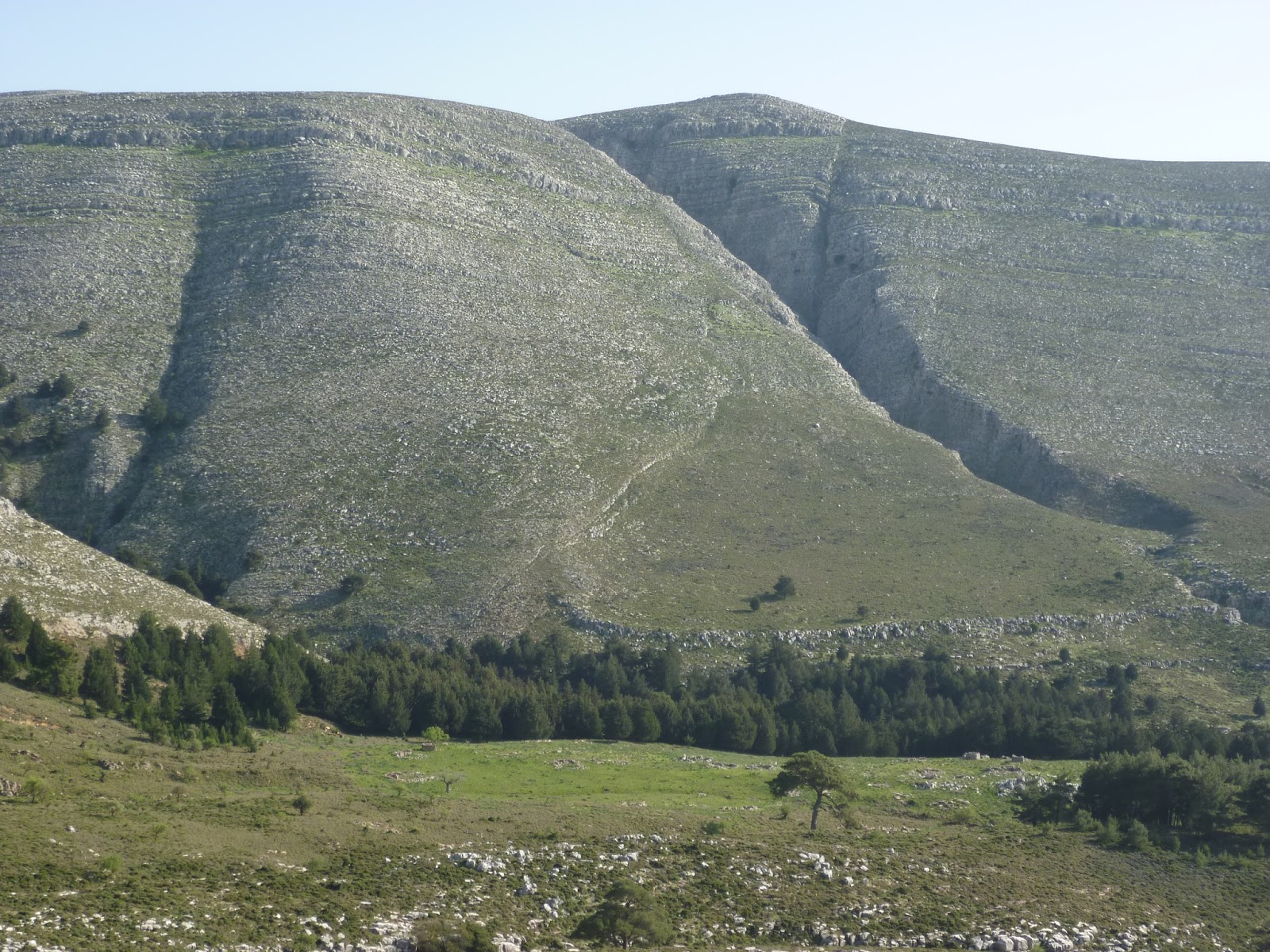
Further on and up, the smooth, flat tops of the mountain peak were green, pasture-like, dotted with trees; then they fell away in layers of rock. Embona disappeared from sight and sound, too far below the steep mountainside. It was still and peaceful, just birds and buzzing insects. It had taken two and a half hours, with lots of stops to enjoy the views. I walked around the empty crown of the mountain to find the massively impressive ancient site of the temple of Zeus. Most beautiful of all to me was the view to the south – the mountain falling away into smooth ridges and a river valley, green and grey with grass and rocks and the dark green of the trees, and the musical clattering of the sheep’s bells.


A lovely footpath descends gently from here to Ayios Isidoros. I followed it for a little while, then joined the dirt track road that wound down the mountain – a long way home, but easier than the near-vertical shingle gully and it took me towards the coast as the sun was descending.  


When a truck drove past I realised I’d seen no-one else the whole afternoon on the mountain. Another truck drew up as I was leaving the pine forest and an old farmer offered me a lift; I was completely exhausted but it was only another five or so kilometres back to Embona, and a lovely evening, so I chose to continue walking, making a final stop at the little chapel of Ayios Georgios Sarantari and feeling very happy about my adventure. 


Kameiros Skala, Kopria Beach and Kritinia

I passed a very old woman doing her washing by hand in a sink in her front yard around 7am. I wandered around the village looking for a place with internet, and ended up at Anamnisis café, which looked fancy from outside but was nicely full of middle-aged men loudly discussing the price they get for their wine.
Picking up a traditional spinach pie from the bakery, I looked up at the steep, rocky mountain which bellied out into an inverse amphitheatre of rich soil divided into fields above the village. The people of Embona and Kritinias came originally from Kriti, or Crete. Maybe that’s why they picked a place with the pastures on the high mountain, fertile highland plains.
‘Is it possible to walk to the sea?’ I asked at the hotel. They said yes, it wasn’t far, directing me to start from between the sports ground and the cemetery. From there, beyond some ambiguous signage, a well-marked, wide track meandered gently down through pine forest. It was a little dull but easy walking for an hour or so, luckily as my legs were still a little weary from the day before. At what I reckoned must be the dam, the fragma, though it was dry and looked like a quarry, were piles of thin branches with string attached - trimmed vines, I realised. The path met the road and I turned left past farms along the coast.

Around 2pm, less than an hour and a half from Embona, I reached Kameiros Skala where vehicles were making their way to the Nissos Halki ferry, which sat beside small wooden fishing boats. The water in the tiny, pretty harbour was blue and clear, and I thought how nice it would be another time to travel from Tilos to Halki and then on to here, and up to Embona. A triangular carving in the cliff and a few cave-like hollows I recognised as the ancient Lycian tomb, similar to the one in Kastellorizo.
There was a bus back to Embona leaving soon but I hadn’t yet had a swim. Just around the headland I was back at pretty Kopria beach, busier today. After an invigorating dip and a refreshing nap on the sand, I headed out, weighing the pros and cons of taking the same route back or risking a longer but more interesting alternative. Naturally opting for the latter – because one thing I’ve realised about myself is that I’d rather get a few scratches and scrapes than be bored – I wandered on and off the road for a little while, enjoying the late afternoon spring sunshine, a glorious view of the medieval Kritinias Castle perched on a rock overlooking the sea, the fields around all lush and green and lovely.


At the entrance to the village of Kritinias, a sign said Embona was 8km straight ahead. There wasn’t any particular reason to detour to Kritinias, but it seemed a shame to pass right by without taking a look. Maybe I’d get a frappe for energy. A dog lounged in front of a mechanic’s garage. Past a run-down square with an abandoned house was a café where a group of men and one woman were sitting. I shouted out ‘Yeia sas!’ and people waved and invited me over.
Well, I can’t now remember all the things we talked about but suffice it to say, I was welcomed like a long-lost friend. I was given tiny local calamari and fried cod, tomato with sea salt and bread, and a couple of glasses of home-made wine. We laughed and chatted. The lady who ran the taverna (‘Spyros’) gave me a swift lesson in preparing thick stalks of caper leaves for salad, which she first soaked in hot water from the tap overnight, pressing the capers down with a bowl to keep them underwater, before changing to cold water for another day, and then adding one dessertspoon of salt per litre jar of water for preserving them, with a touch of vinegar. Someone gave me a slice of lemon to eat, dipped in sea salt – wonderful.


The people were proud of their village and I thought again how sociable this country is and how much people care about the good things in life – meeting people and eating good, natural, local food.
When eventually I forced myself back onto the road, all payment was refused. And about a kilometre up the road, a truck pulled up and there was one of the guys, offering to drive me to Embona.

Around Embona

It was funny to be back in Embona seeing people I recognised from my visit a few years before, people I’d written about. I wished I had a copy of An Octopus in my Ouzo to show them. The next morning at the café, the owner – a big man wearing the biggest T-shirt I’d ever seen – asked about my work, and we discussed his interest in collecting books about beekeeping and honey in different regions. Here in Embona, I think he said, each bee can produce 25 kilos of honey per season.
The friendly old ladies in the tiny house next to the hotel were always busy; this morning the white-haired lady was cleaning and had sat some just-washed teddy bears on the front wall to dry, which looked rather surreal. Swallows had built a nest above the light fixture at the electrical goods shop, and flocks of swallows or martens swooped at the edges of the village. Lovely light spilled over the mountain as morning progressed. The group of cyclists staying at the hotel were getting ready to set out.
I was due in Lindos the next day and although some mad idea of walking and hitch-hiking there had entered my head, I had work to do in the morning that prevented such an epic adventure; I’d wander around the side of Attavyros instead. I enjoyed taking photos of all the different flowers, wandering along tracks through the fields; bees were going crazy on the sage flowers. 

  
I stopped at St Raphael and Nicholas church, whose unpromising exterior gave away nothing of the beautiful icon paintings within. Then, having reached a dead end at a fence, I cut through an overgrown area and – whoops – twisted my ankle a little. It didn’t seem serious but it did swell a little and there was a jarring pain when I put weight on it in a certain way. A sign to take it easy. I made my way carefully down to the road.
Two men by a truck shouted hello and we exchanged a few friendly words. ‘These are our sheep,’ one man said, indicating a flock under the trees. ‘Come back at Easter and we’ll make a barbecue!’
I loved watching the mountain change colour and shape as I walked along the road around it, passed only very occasionally by a pickup truck. I loved the smell of pine trees in the hot sun, and the clattering bells and complaining noises of the sheep as they noisily gathered in the valley below. I sometimes saw an eagle above, or hoopoes, and some big lizards. I’d come back another time and walk to Ayios Isidoros from Embona, maybe then all the way down the spine of south Rhodes to Prasonisi… For now, I turned back, resting for a while in the shade of a pergola over a spring, or sitting on a bed of pine needles, listening to the sound of the wind whooshing wave-like through the forest, building up and then dying off.
I reached the truck I’d passed earlier, but no sign of the two men, even though the radio was playing music. Then I looked into the olive grove and saw them sitting in the shade at a little table laid out with food and glasses. They beckoned me over, and thus I got to know Philippas and Christotomos. I sat on the earth by the roots of a tree and they poured me souma and gave me cheese and cucumber and salt to go with it, and I laughed at the wonderful scene.


‘They can’t take this away from us – not even Merkel!’
Philippas, the owner of the sheep and the olive trees, had left Embona to work with metals in Belgium and Austria; when he left around 1967, Embona had no electricity so he was amazed to see electric lights – ‘Not just in the house, but on the road!’ And he’d never seen a train before. But eventually he returned to Greece, for the good life, where you sit in an olive grove in the sunshine and wait for friends to stop by. At first he’d got a few sheep just to graze and keep the fields clear of grass, but when the flock grew he started to keep them professionally. He was zealous about getting a fair price for Embona lamb, and had even tried to set up a co-operative at one point. He was against the supermarkets taking too much, when it’s the farmers who have to be up on the mountain in the middle of the night if it’s freezing cold or it there are hunting dogs about that can kill baby lambs.
Christotomos, or Tommy, wore a brown tracksuit and traffic-cop shades. He was convinced I must smoke drugs because I seemed so happy. ‘A little wine’s enough for me,’ I said. ‘Ah, as the song goes: Wine, moonlight, and my boy…’ Eventually he got a call and had to leave, and we heard him say, ‘I’m busy, working…’
I stayed with Philippas and asked him if it was true that the EU had paid farmers to pull up their vines. He confirmed they had, four years ago, and that it seemed a pretty dirty thing to do during the economic crisis. People should have known there was something rotten about being offered money to do nothing, but many of the farmers were uneducated and simply took the offer. But a few families, whose children had been to school until the age of eighteen, had refused and were now doing well.
There was work for local people at the big hotels, he said; but he knew a couple who had worked all season and neither of them got paid. It reminded me of someone I know who worked for six months on new construction in Rhodes and didn’t get paid either. Times were tough; last time Philippas went to Rhodes town, he saw a friend who invited him for coffee at his home (instead of a café) and then sent his wife next door to borrow the coffee. In some parts of Rhodes, the local councils give out basic provisions to the poor families. At least in a village, one person might have potatoes that they’ll give to another in return for some goat, and so on.
Philippas’ grandson came by, and then another sheep farmer who wanted to discuss the prices for the animals they’d slaughter for Easter. Ilias had a village accent and lived up on the mountain and kept a pig and chickens too, and picked at food using the tip of his pen-knife, which he then stuck in the wooden table when he left for a while to feed his animals.
After sitting for a couple of hours, I continued back to Embona, thinking I should buy some honey from the café-owner. As I approached Anamnisis, the café seemed closed and he was occupied with unloading something from his truck, so I walked by. Then a girl ran after me and said her father was asking me to come and taste the honey.


They’d collected honeycomb and gave me pieces to eat. Stavros showed me and his daughter the eggs; the queen can lay 2,500 a day in spring when there’s a lot of food, he said. We tasted the pale honey, made from a variety of spring flowers, and the powdery orange yiri. I asked about the darker pine honey and learned that the white foamy substance I’d been seeing on the bark of pine trees is a kind of bacterium, and the droplets hanging from it a type of honey. I’d learned so much today. I bought a kilo of mixed pine and thyme honey, strong and fragrant, which Stavros gave me for a very good price, instructing his daughter to pack a box of honeycomb for me as a gift.
At a little café next to the petrol station, I enjoyed the last of the early evening light and received an email from Karen at Exclusively Lindos about lunch the next day. I would be heading to a different part of Rhodes in the morning. I paid a euro fifty for my coffee which seemed a little expensive compared to the other café and I laughed, thinking of the guys in the field earlier saying when they went to Rhodes town and were charged three euros for a coffee, it stuck in the throat, wouldn’t go down… 
For days I’d just had picnic meals but I wanted to try Maroullakis Taverna in the middle of the village; it had seemed fairly busy every night, and I was feeling a little down about leaving Embona. I ate very fresh salad with creamy feta and good bread, and a mix of meat and cheese fritters, with some semi-sweet red wine; locals tend to prefer it to dry, and it’s growing on me. The tyrokeftedes or cheese fritters were like spongy little doughnuts with melted cheese inside, and the others were very meaty and full of herbs – delicious. Suddenly a man with a wild Afro-style hairdo and a denim shirt half-open banged on the door and made a grand entrance, carrying a bag of broad beans, which he distributed to all the tables before sitting down to tell a story about catching an eel. When I went to pay, I got into conversation with the proprietress, Irini (the restaurant had been in her family for 95 years), who gave me cakes for my bus journey in the morning.
The sun was coming up through cloud over Embona as I made my way north by bus along the coast. By midday, I'd be in Lindos and had another adventure to come.

Attaviros Hotel, Embona, Rhodes: 0030 22460 41235, 0030 694 262 9556
Proprietress: Vassilia Antonaki 
www.ataviroshotel.gr

Maroullakis Traditional Taverna, Embona, Rhodes: 0030 22460 41215, 0030 694 820 1220