Showing posts with label island life. Show all posts

Delivery, Small Island-Style


A dozen years ago – can it really be? I’ve never lived in a place for so long! – Yorgos Orfanos showed up one day at the Honey Factory to deliver all my belongings I’d shipped from England.

Now I’ve been in my own house, equally unbelievably, for five years. When I bought it, I’d agreed to buy it with all the contents and I didn’t want to change too much about this authentic little island house by the sea. But my house is finally entering the twenty-first century – which feels OK now that it’s 2024 and all.

It started with a trip to Rhodes a few weeks ago to take the car for its MOT (KTEO), meet my mum at the airport, and take Lisa to the vet; then since I had the car, we went for a drive out of town. I’m pretty sure last time I visited the IKEA in Rhodes there wasn’t much of a showroom. That may have been several years ago.

This time, it was rather more impressive, and I’d been thinking a few of my old things really had to go. Maybe I was ready for a new couch (I have two, both second-hand, or maybe third-hand). And some new outdoor furniture. And a thick rug would be nice under my feet in the winter. Oh, and some lightweight, stackable chairs. And…

The sales assistant at IKEA at first insisted they didn’t deliver to Tilos. But luckily I knew that they did. We insisted. They checked. They did deliver to Tilos. We placed the order.

Back in Tilos a few days later, the next thing that happened was that another hotplate became unusable on my old cooker. This stove was also in the house when I bought it five years ago, and already very old, but two of the hotplates and the oven still worked. Why change it…? I even painted over the rust a couple of years ago with white enamel. Really. And painted little icons to show which knob was for which hotplate.

But recently it seemed the oven only had two settings, off or burning. And there were no numbers left on the knobs, so only I knew how to work it. To be fair, I have considered buying a new one, but the little hotplate for the briki, the Greek coffee pot, has been something of a sticking point – and not because it hasn’t been cleaned. Most new cookers don’t have them, and I didn’t want an extra appliance. I liked making my Greek coffee on my stove.

Then one night when my mum cooked dinner, one of the knobs came flying off onto the floor. An accident? I’m not sure… But I did go online and order a lovely new cooker.  

Anyway, so, a few days ago I was in Livadia when I saw Yorgos hanging out with a group of guys I knew, and as I said hello, I mentioned that I’d ordered some stuff, because Yorgos is still the man who transports large items by truck via the big ship from Rhodes to Tilos.

‘It might be here already,’ he said. ‘What is it, chairs?’

‘Yes, and other things… Call me!’ I said. I was excited; and then as several days passed, I figured it must have been someone else’s chairs that had arrived.

Delivery to Tilos is fairly haphazard, at the mercy of boat schedules plus mysterious other obstacles. Christmas cards from the UK arrive in February. Last year I ordered something from a company that refunded my money because it took so long to arrive, even though I told them that was normal. Yesterday I received an email from another company asking me for feedback on my recent purchase of a new bag. Don't you get tired of being asked for feedback on everything? But in any case, it hasn’t arrived yet.

This morning was Sunday morning, as peaceful as most Sunday mornings at this time of year. Lisa stayed in bed after a big walk to the monastery yesterday, so I made myself a Greek coffee and a little breakfast. Then I noticed someone standing at my gate, and heard my name shouted. It wasn’t Nikos the fisherman, and didn’t seem to be one of the farmers with vegetables…

It was Yorgos, with a truckload of boxes that he said were all for me.

‘Where d’you want it?’ he asked as he and his helper started unloading and carrying stuff in.

I suggested they just stack most of the stuff against the outside wall and I’d sort it out myself, but clearly the cooker at least would need to find a place in the kitchen to await the electrician.

‘If I’d known it was coming,’ I said to Yorgos, smiling, ‘if you’d called me, I could have made some space and cleaned…’

But Yorgos perhaps thought that most people would have their house already in some kind of order and cleanliness, i.e. as a general state of affairs. Whenever I clean, I think how nice it looks and that I should do it more often. But then I go for a walk instead, or into the garden to plant some seeds. And with my front door always open, the kitchen floor seems constantly covered in mud, dust, sand and bits of firewood.

I hurriedly moved boots, dog food, bags, socks, snorkel, sarongs, etc etc and swept a space for the cooker, and the guys carried it in.

Yorgos said, ‘Don’t stand on it,’ and grinning, pointed to the icon on the packaging on top of the cooker that did in fact show a pair of feet and an X over them.

‘Oh, I was hoping to dance on it!’

(And anyone who's been to a party in my kitchen knows that stranger things happen.)

The whole thing had taken maybe ten minutes and then they were gone, with everything piled neatly. I thought Yorgos probably doesn’t call people in advance because this way it all gets done quickly, or as they say in Greek, derived from the ancient Doric I believe, ‘taka-taka.’

It was a warm, sunny morning, but somehow it felt like Christmas. I retrieved my coffee and started opening my first package.


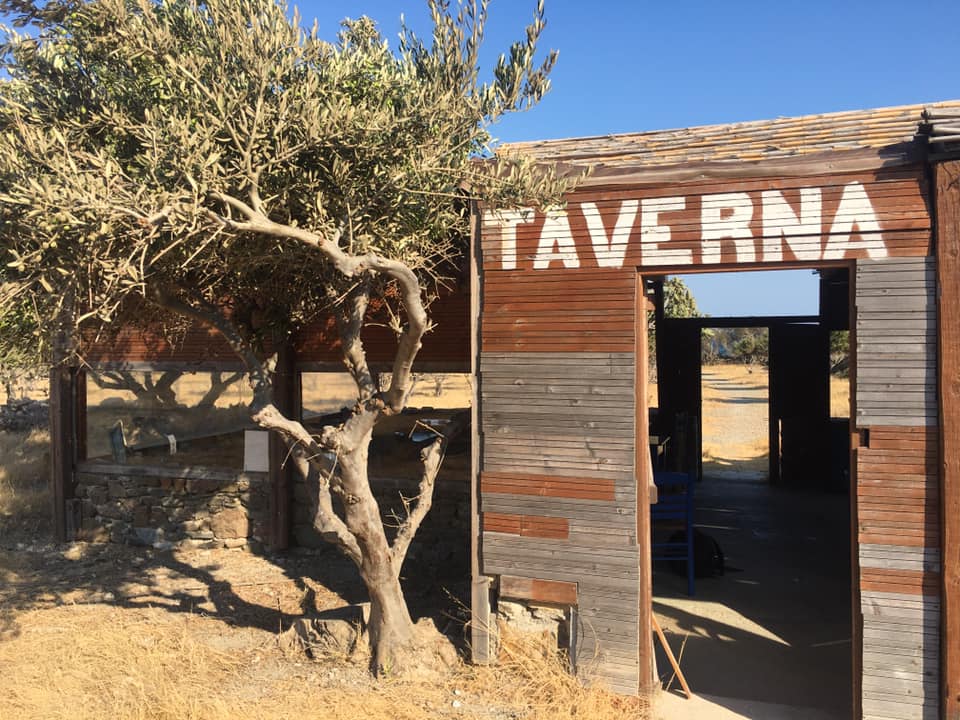
Tavernas by the sea

My new book, TAVERNA BY THE SEA: ONE GREEK ISLAND SUMMER, based on the time I spent living at lovely Ayios Minas in north Karpathos, is now at the printer, and I’m thrilled about it.


I started writing it during the winter in Karpathos in 2017 when the memories were still fresh but then ended up being diverted to focus on the more serious WILD ABANDON: THE DESERTED PLACES OF THE DODECANESE. I’m very glad I wrote that book, but I’m also happy that I went back to finish TAVERNA BY THE SEA last year and that Bradt decided to publish it.

The book shows the fun side of how I got stuck in rugged north Karpathos for longer than expected, but it also reveals what summer is like for the locals who work behind the scenes non-stop, while making it all look easy and relaxed.


When I posted something about it online recently, one of my Facebook friends told me he’d also had a fun summer working at a Greek taverna by the sea years ago, so I decided to interview him about it – and was delighted by his story. Here it is - complete with his pictures from the time!


Jen:

So, hello Paul! You ran a taverna on the island of Aegina in 1996 – wow, that’s interesting. How did the opportunity come up?


Paul:

I was working with a friend at a restaurant in Reigate, Surrey back in 1996 and her parents had received a small inheritance and decided that they would love to buy a little bar/restaurant in the sun and have a nice relaxing lifestyle. They had ideas of not doing much work: the wife would be swanning around with a glass of wine in her hand chatting to customers while the husband served a couple of beers at the bar to the one or two old local guys, and they’d spend a day or two at the beach.


The reality was to be completely different – it was very, very busy! The husband was stuck in the sweltering kitchen all day while the wife ran herself ragged around the restaurant. It was not the sort of relaxed retirement dream that they thought it would be. They ran it for two summers then realised how much work it was, and decided to rent it out.


Jen:

What made you take on the challenge?


Paul:

I find myself to be a rather restless soul and I have always wanted to do different things and not get bogged down into a routine. I like a challenge and to push myself out of my comfort zones and this opportunity was definitely something that was exciting and slightly scary. My mother is Maltese and I guess I have inherited her love of the Mediterranean sun and sea so as soon as I heard about the taverna I just knew I had to do it!


Jen:

So you set off for a summer on a Greek island.


Paul:

I bought a very cool VW camper van, then got two friends, a chef and a waitress, and we drove down through Europe to Agia Marina on the island of Aegina, to open the taverna and run it for the summer. It was a great road trip.


Jen:

What was the location like?


Paul:

The “Lanterns Taverna” was situated about a five-minute walk outside the main town of Agia Marina in a place called Alones which was just a sprinkling of houses, not even big enough to be called a village, nestled in between surrounding low hills and about 900 meters from the sea. Although it was a quiet area we were extremely busy throughout the summer mainly with tourists.


Jen:

Did you speak the language? What kind of food did you serve, and how did you learn how things worked there, where to order supplies and so on?


Paul:

I didn’t speak any Greek before I went out so had to learn very quickly. To start with I managed to get by with lots of gesticulation and a phrase book. By the end of the summer I found I could converse in Greek – as long as the conversation was all about catering!

The menu was small and mainly Greek but I did try to vary it by doing burgers, steaks, BLTs and different salads. We also did a Chinese night every Monday which surprisingly went down very well. 


I did have a little bit of help when I got there to learn how things worked. An old Scottish guy who lived on the island and was a friend of the owners met me when I arrived at the taverna with the keys and spent the day telling me where to buy most of the supplies and introduced me to a few of the suppliers. He was quite a bolshy and pushy character and right from the start tried to tell me how to run things and what to do – I guess he saw me as a naive young whippersnapper and maybe wanted to have a say (and some of the profits) in what went on. I “sacked” him after about two weeks.


Jen:

You said it was a great summer and you totally fell in love with Greece. If you were working such long days at the taverna, how did that happen?


Paul:

We worked all day seven days a week, as I'm sure you'll know. We didn't really have much money behind us and didn't save anything while we were there – we just lived off the daily profits paying for our accommodation and spending the rest on having fun.


We opened for breakfast, lunch and dinner and didn’t close until the last customers left – which, as they were on holiday, would normally be about 2 or 3am. After that the staff and I would walk down the hill back to our apartments – but due to the Greek custom of ‘philoxenia’ we found that we couldn’t simply walk past the other bars/tavernas without being called in to have a chat and a drink. It was a great way to meet the locals and make friends – long days, long nights but great, great fun!  


Philoxenia was one of the main reasons for falling in love with Greece. I did worry before I went that the Greeks may not like a foreigner in their midst running a taverna and that I might be shunned but I found that I was made welcome and felt relaxed from the first day I arrived. The scenery of low scrubby hills around me was beautiful, I loved the feeling of the heat all around me and of course the little bays and beaches with the flawless warm Mediterranean blue sea.


I closed the taverna at the end of the season and decided to go home as my job was still available at the restaurant in Reigate. I do still wonder why I decided to come back to England when I loved Greece so much. There wasn't much work on the island in the winter but I'm sure if I spoke to my Greek friends they could have helped me and I could have probably stayed and started a life in Greece.


Jen:

Thank you, Paul, for sharing a little of your story! Here's to tavernas by the sea... 


Meet the President

My life on the little Greek island of Tilos mostly revolves around my dog, the sea, my garden, walks, swims, nature and my island neighbours, writing and editing books – which is how I like it and I feel grateful that is the case. I’d never really paid much attention before to the role of the president of the Hellenic Republic. And while I used to do formal meetings for my job a lifetime ago, now I prefer underwater meetings with moray eels and octopus…

But for a few days last week, the first item on my to-do list read: ‘Saturday 1.30, meet the president.’

It started when a message arrived on Thursday morning from Stathis in the mayor’s office. ‘The president of Greece is coming.’

‘I know!!’ I replied, excitedly. I’d heard rumour of it, though maybe for reasons of security I hadn’t seen any announcement, just a brief mention. The reason seemed to be our official status as Greece’s first ‘zero-waste’ island, an initiative that aims to recycle and re-use nearly all the island’s rubbish.

Privately funded by PolyGreen working in collaboration with the municipality, the scheme seemed very ambitious when first announced in a meeting in the square. But much happened last year to prepare, and over recent months young people employed by PolyGreen visited every home on the island to explain how it works. The element of education is important, bearing in mind that in Greece, ‘recycling’ bins are regularly filled with normal rubbish.

Now on Tilos bins have been removed, electric vehicles collect from each household several times a week, and everything is sorted to be shipped away for ‘circular waste management’.

But Stathis didn’t mention this. What he said was that the president of Greece was coming and wanted to meet me. Strange things happen sometimes, I’ve found, when you write books on a small island. Still, it seemed very odd. He asked me to come to the square on Saturday where the president would have a ‘relaxed conversation with citizens of the island’, which sounded more realistic, although not particularly ‘relaxed’ from my point of view.

It was a good pretext for learning something about the president of the Greece a.k.a. the Hellenic Republic, however. The role of Proedros tis Ellinikis Dimokratias was established in 1975 when Greece became a presidential parliamentary democracy; elected by parliament but with mostly ceremonial powers, the president is the official head of state and the commander-in-chief of the Greek armed forces. Katerina Sakellaropoulou, a lawyer and judge, became the first woman president of Greece in March 2020. Photos showed her sometimes looking appropriately fierce and sometimes with a kind, wry, rather cute smile.

Amazing! I was looking forward to seeing her on Tilos, and joked to Ian that maybe she could make me an honorary citizen of Greece, like Victoria Hislop…

On Saturday, I woke up listening to the waves, and the birds; the wind of the last few days had dropped and the sky was a deep blue. It was a beautiful day. Then I received another message from Stathis saying I was invited to join the president at her table. I was honoured but petrified and wanted to learn more. ‘We’ll talk in the square,’ he said.

I tried to continue my morning in the usual way. In the garden, I cleared some more of the winter weeds that grew while we were away in Romania, and planted some seeds. It was hot and we went for a swim – I tried to read a few pages but couldn’t concentrate. When we came back a farmer’s red truck was by the gate, and I bought some vegetables. Then I put on a dress and sandals in lieu of my usual shorts and boots, and drove off to meet the president.

Other people were going about their day in the usual way too, it seemed, until I approached the helipad and saw a Chinook recently landed, a few locals standing around it.

In Livadia, the post office in the square had got a fresh lick of paint, a peach colour with burgundy trim, and the scruffy old noticeboard on the harbour sported a new ‘zero waste’ sign. People were dressed up and bagging tables in the shade – which were covered in the usual way, alas, with plastic water bottles and plastic frappe cups…

Time ticked on, and the youngsters chosen to make a presentation wearing the full traditional dress of Tilos, long layers of embroidered wool, looked listless… Then dark cars drew up and, accompanied by a security man and important-looking personages in full military regalia, there was the petite figure of the president of Greece in a stylish white jacket. Everyone clapped as she strolled through the square greeting and talking to people.

Half an hour later, at Michaili’s Taverna, with butterflies in my stomach, I was ushered to a place at a long table next to our mayor Maria Kamma, and then the president of Greece, Katerina Sakellaropoulou. I was even introduced to her, and although I was too nervous to say anything interesting at all, I was able to present her with a copy of my last book, Wild Abandon, and she was gracious enough to examine it, ask some questions and ask me to dedicate it to her. I’ve never dedicated one of my books to a president before. So if you own a copy, you’re in good company…

There were presentations of other, more official gifts, by our mayor Maria.

‘Exigiseh to elephantaki!’ - explain the little elephant! - hissed the lawyer of the municipality of Rhodes to Maria as she stood there with the unenviable task of gifting a cumbersome metal statue of a Tilos elephant.

‘Eh, vevaia, of course…’ she replied.

The president drank white wine with ice (‘the colder the better’, she said, because it was a hot day, though maybe she’d had bad island wine before…). The table was heaped with salads, courgette fritters, fried calamari, tiny shrimp and huge fresh fish… I’m not sure if the president didn’t like the tiny shrimp or is just an animal lover, but at one point I spied her feeding some to the cats.

I listened in to conversations. The CEO of PolyGreen, Athanasios Polychronopoulos, talked about the zero-waste programme to the president. ‘We have to change many minds,’ she said seriously. He explained how he had chosen to implement this initiative on Tilos because of the openness of its community to embrace change; there was talk of the first gay weddings in Greece and how the island had handled the Syrian refugee crisis.

There was also plenty of banter. The Regional Governor of the South Aegean ordered a plate of goat, and the owner of Eleni Beach Hotel smilingly declined to taste it because it was from the other village, Megalo Horio.

Sadly, my Greek felt rusty from my time in Romania and my nerves kept me quiet (honestly!), afraid to make some terrible faux pas. That said, when dessert arrived and the restaurant had run out of plates and spoons and decided to provide plastic ones instead, I felt I had to speak up and say no thanks to unnecessary plastic!

President Sakellaropoulou demonstrated great poise and knew how to say and do just the right thing. Before she left, she had some photos taken. She stood on the steps of the taverna after lunch with the ladies who’d provided it, and made sure everyone was in the picture. She even asked to have her photo taken with me, but I haven’t managed to get a copy of it.

And then she was gone, and I went and had a swim and relaxed.

And now the next things on my to-do list are the more usual work items, tax return and reading the proofs of my new book… But I don’t think I’ll ever forget the day I met the president.


Here are the wonderful official photos of the president visiting Halki and Tilos:

Επίσκεψη στη Χάλκη και την Τήλο – Προεδρία της Ελληνικής Δημοκρατίας (presidency.gr)

President – Presidency of the Hellenic Republic


Looking for Agia Pelagia: Halki October Adventure Part I


The sea was dark blue and glittering, the land bare grey and brown as we rounded the south of Tilos. I love seeing my island afresh as soon as I get on a boat. There’s a different perspective from the sea. It’s good to get away, too, from the laptop and all the little jobs that I could always be doing around the house and garden, and just GO.

There’s something committing about taking a journey from an island – you can’t just go back. And there would be no boats to or from Tilos over the weekend. It was either this Friday lunchtime one or the late one if I wanted to go somewhere, and travelling in daytime is much more pleasant.

So I had decided to go to Halki with the Stavros, a big old ferry that currently plies a very useful route up and down the Dodecanese. It’s often late and puffs out evil-looking black smoke, but it’s a nice boat with plenty of space, my dog doesn’t have to wear a muzzle, and all for the very attractive price of nothing but the ticket office handling charge: 2 euros.

‘I’m thinking about taking the car,’ I had mused to Stelios Stefanakis as he processed my ticket.

‘Why? It’s only a little island!’ he scoffed.

‘But I’m thinking of going to the other side…’ I started to explain, but decided not to bother anyway. I wanted a bit of a walking adventure. This late October weather, sunny and warm but not too hot, is perfect for walking and I had a place in mind.


As we neared Halki, all the details of its north shore started coming into focus, the ridge and cliffs and gullies, some of which I’d walked before. It looked very empty and rugged. We passed the impressive new solar farm and then an hour or so after we’d left, the Stavros arrived at the splendid harbour of Nimborio with all its lovely painted villas, and Lisa and I felt like royalty as the only foot passengers to disembark. I walked straight to the bakery for a hortopita and a loaf of bread, then to Ftenagia beach to swim and relax for a couple of hours.

Because it had been a last-minute decision to go, I’d only sent a tentative email about a place to stay that morning. I checked on my phone and there was no email back yet, hardly surprising; this gave me an excuse to try my cheeky plan B, which was really a plan A. I had my new, lightweight tent cached in my bag, after all.

I stopped at a minimarket to buy two large bottles of water to supplement the supply I’d brought. There were three people sitting outside, two men and an older lady. I asked if there was water at Ai Yianni Alarga, the monastery of St John the Far-Away, towards the other end of the island.

‘Not at this time of year,’ said the older of the two men. Springs need to be fed over the course of the winter.

‘There is, but I don’t know if they have it open or closed,’ said the lady.

I told them I was thinking of walking there the next day. The lady advised I leave some of my stuff behind, indicating my heavy-looking rucksack. The man said it was OK to carry everything, but I should go slowly. I decided to take another bottle of water with me, just in case, and thanked them for their help.

In my book Wild Abandon about my journeys to deserted places in the Dodecanese, the short chapter on Halki is called ‘Road to Nowhere’. Once you leave the harbour village, there are hardly any houses or people. In some ways, taking the road to nowhere was going against my other aim, to meet locals and speak more Greek. But I also had a hankering to get away to nowhere for a while, as I sometimes do.

Soon after we set off, Lisa tried to convince me that the pine trees around the bay of Podamos would be a good place to stop. But even if it was tempting, I wasn’t carrying five or six litres of water, camping gear and food and everything else just to camp in a place with a catamaran moored in the bay and tourists on the beach. We continued up the road slowly, past scrappy fences with barking dogs, past the rubbish dump, past a young man making cement who said yeia sou (and I was so tired already that I weirdly replied yeia sas), up the slope and then the zigzagging ascent among olive groves. I noticed a little inhabited house I hadn’t seen last time. There were enough sheep and goats meandering about to convince me that camping in a field wasn’t an option – we’d never get any sleep.

Leaving the road at the start of the abandoned Old Village or Paleo Horio, we passed a few restored but uninhabited houses and continued more steeply, passing layer upon layer of ruined houses and chapels, to about 300 metres, where I happened upon a few French tourists heading down. We all mumbled surprised hellos.


What joy to enter the opening in the medieval walls of the castle and pass through the ancient gate with its huge masonry blocks. The sun was still a little way above the sea, and the light was glorious. I’m not sure camping is really encouraged, but there was no discouragement either and it was unlikely anyone would come here now, so I hurried to choose a sheltered spot and set up before night began to fall. To the east was Rhodes, but to the south an expanse of calm, pale blue sea, with the narrow-necked peninsula of Tracheia below. I watched the sun go down, and at twilight a couple of birds flitted about calling clackety-clack and then peep-peep-peep.


Lisa made a very good camping companion on her own camping mat in the tent. Still, it’s a long night when it’s dark from about seven in the evening until seven in the morning. I read for a while by the light of a torch, then lay drifting off, enveloped in the gorgeous silence, the only sound the gentle breathing of my dog lying next to me. Waking at one point to the sound of fishing boats, I unzipped the tent to bright moonlight and stars.


Last of the Summer Wine


There he was – the man I’d been looking for. Not in the sense of ‘all my life’, just since my grapes started ripening on the vine (and that isn’t a euphemism). I wanted to see if I could learn how to make very basic wine, and I’d heard Yiannis was a good man to talk to about it.

An unassuming man of medium stature, he was standing by his rickety old scooter. We’d last had a conversation early in the summer when he’d been encouraging me to pick mulberries from a tree on the road out of the village. A retired seaman who lives with his wife in Megalo Horio, he’s often out and about tending his beehives or fishing off the beach.

I’d gone to his house the previous day but although the scooter was there and the gate open, and although it wasn’t yet siesta time and I’d shouted hello in my usual hesitant way, there was no sign of life and I couldn’t get up the nerve to stride in. But now I’d spotted him on the road as I was driving to the post office, and I pulled in swiftly to the school car park.

‘I hear you make wine,’ I said, ‘and I want to learn.’

He smiled cautiously.

From late July to late August is grape and fig season, and I'd been told the grapes needed another couple of weeks on the vine, but one day, sick of having hornets buzzing around, I cut down most of them. 

I’d done the same a couple of weeks before with the smaller, seedless grapes from a different vine and was drying them into raisins in flat dishes using 15 denier ladies’ hosiery to keep the flies and ants off while allowing enough sun to get in. The bigger vine in the front of the house gives good shade and the grapes are delicious. My old pal Antonis had asked if they were for eating or for wine. I had no idea.


The fridge was already brimming with old wine bottles filled with grape juice, and old tahini jars filled with fig compote as well as caper leaves preserved from earlier in the year. Because I go easy with salt and sugar, I daren’t keep much out of the fridge, especially when the daytime temperatures in August were rising over forty Celsius and dropping at night to a mere thirty.

I’d been so excited about having my own vines and fig trees when I got this garden. And really, I am. Everything is getting healthier now after a few years of neglect and being attacked by goats. But it does demand quite a bit of time and attention over the summer. I’ve got more advanced this year with the produce, baking the fig compote and fresh raisins into cereal bars with oats and seeds. I’ve roasted lamb chops with grapes, figs, tomato and onion. I’ve made pizza with two kinds of local goat’s cheese, ripe figs and rocket from the garden. And I've regularly had icy fruit smoothies for breakfast.

So now I’d been stuffing masses of fat, juicy grapes into the fridge and hopefully thought I’d try again at winemaking. I’d really meant to go to Embona on Atavyros Mountain on Rhodes, talk to the experts and get the right equipment, but somehow it never happened, so here I was at the last minute asking Yianni.

He had already squeezed his grapes and started his wine, he said, having experienced the same problem with hornets. Some people leave the bits of skin in during the first days, but he removed them and used only juice. He mentioned a piestirio, a press; I’d been using my hands.

‘So you leave it for three days,’ he said, and although I didn’t understand what he said happened for those three days, from my Wiki research last year I know it’s when the stuff starts fermenting. I’d actually already tried a batch and the kitchen smelled like a bakery when I walked in. ‘You put it in an open container,’ he continued.

‘Covered with a cloth?’ I asked.

‘Yes, a cloth with holes, like the stuff they use for bonbonieras.’ Something gauzy, like the stuff they wrap baptism gifts in, to let the air in and out.

‘So what do you do after the three days?’ I asked, thinking I’d missed something.

‘Nothing,’ he said, leaving me puzzled. ‘After, you leave it for forty days. In the house. Then you try it. Ama yinei,’ he said, pausing – then he made a fist and brought it towards his mouth, the thumb sticking out like a spout heading for his lips, and tipped his head back.

When it's ready – if it works – you drink it.

I smiled, asked a few more questions, and thanked him. I could give it a try, I supposed, though I wasn’t entirely surprised when he added that a neighbour had lost his whole batch of wine for three years running. Maybe Yiannis was cannily keeping the real tricks to himself. I got back in the car and drove down to Livadia. As so often happens, a quick trip to the post office was about to take three hours. Picking up my post took a mere ten minutes – the rest was impromptu chatting, coffee, and a swim off the rocks.

Now the wild, soaring temperatures of summer, with biting flies and wind that feels like a hot hairdryer, are waning, and some evenings here at the north of the island can feel soothingly cool and damp. On Eristos beach, the first sign that the busy days of summer are over are the miraculous sea daffodils poking up out of the sand. And the tents are thinning out, with campers heading back to the cities. 

For a couple of months, Lisa has refused to leave home before late afternoon unless we're going in the car, but now we're beginning to walk again in the afternoon and it feels great. Yesterday we briefly had Skafi beach to ourselves, and when I went snorkelling I saw shoals of miniature versions of mullet and bream. I'd never thought much before about when fish had their babies but it's been fun watching the little ones grow. The damselfish start out bright blue when tiny, in July.


In my last blog post, I confessed I had no idea how posts would be delivered to your inbox in future after the demise of Feedburner. But the extremely helpful people at follow.it have solved the problem. You may have received this thanks to their tiny postal workers slipping it into your email inbox, but if you didn’t and you’d like to in future, you can sign up using the little box that should appear somewhere top left of the page. Apparently there are additional features, though I can’t imagine what they’re for. The helpful people even offered to give me inspiration about what I could write, or pictures I could use. Maybe they can just produce the whole blog post in future, leaving me more time to walk to a beach.

In fact, thinking about it, maybe they know how to make wine…


From my winter notebook


It was about this day in late April that I first came to live on Tilos ten years ago. Ten years! That amazes me, but what’s really amazing is that the joy and excitement haven’t worn off. I no longer see things the way I did as a newcomer, but perhaps more than ever I feel awe and contentment with my life on a Greek island. 

I’ve been especially grateful this winter that I made it a priority to find a place I love, and one where I can continue learning every day. 

It has felt like a true taste of small island life. With travel impossible, this has been the first winter that many of us have spent entirely on the island. But it’s hard to believe I’ve done so much within this little area of land. It just shows, 64 square kilometres can be plenty, particularly when you have much of it to yourself.

My last trip off the island was thanks to the ongoing Brexit-related paperwork saga exacerbated by Covid. I needed passport photos, and the nearest option is Rhodes. At first I leapt at the excitement of travel, though of course I could only go for the day.

With the end of December deadline looming, I had to take a ferry that left at 3am during such a fierce storm the ferry couldn’t dock on first attempt. The rain turned the streets to rivers and it was still dark when I arrived, and even the harbour cafe wasn’t allowed to have people stay inside. A kind taxi driver insisted he take me somewhere, so I spent an hour or so walking very slowly around a supermarket that opened at 7am to kill time and stay dry, my glasses fogging up thanks to the mask. I finally got the photos – though have since been informed there’s an error and because the deadline has now passed I have to start again following a different procedure. Perhaps it’s a blessing in disguise, given how I look in those photos…

And of course, since then I’ve been on Tilos. 

Looking through the photos I've taken since January, I’m reminded of so many joyful moments… The bright moon about to come up over the mountain, seas varying from flat calm to crashing waves, flowers from narcissus and anemones and cyclamen to irises and Bermuda buttercups and freesias, my hair blown about in fierce winds, my skin red from cold seas, the spanakopita I made, the fig and vine leaves starting to return.

I’m thankful that all those years ago I started working for myself from home, and I had some nice editing projects to keep me occupied. One of my challenges over the winter was writing an article for The Guardian to promote Wild Abandon, re-writing and re-writing it as the circumstances surrounding travel changed, until I was sick of it - then being delighted when I finally got it right and it came out. I also did some new writing, and re-released Meeting Mr Kim on Kindle, and had an exciting email exchange with its new Bulgarian publisher.


Exploring the old terraces on the hills around my house several times a week with Lisa when the weather was cool or cloudy, I learned more about the flowers, especially the bee orchids. One afternoon, I found an injured hoopoe, a tiny bat and - thanks to Lisa leading me in a direction I wouldn't have taken otherwise - a tortoise. 


I’ve also become more familiar with the scattered ruins: cave shelters and houses and cisterns, the various chapels with their crumbling frescoes and ancient marble and wall markings. While Lisa hunted for rabbits, I kept my eyes to the ground for fragments of pottery with interesting markings. And one day I found a fine cup half-buried in earth, which was confirmed as Hellenistic – third century BC – by our visiting archaeologist and excavated for the new museum that’s still being built. (I’m not allowed to post a photo of the finding.)


I remember back in February walking a little way up the hill with Lisa, but turning back after a short time because the winds were too fierce and cold. When I returned to my house, I saw something unusual on the road. It was the heavy, iron, bird-shaped device that is usually attached to the top of my neighbour Sotiris’ chimney, and apparently it hadn’t been attached well enough. I wondered what might have happened if it had come flying at me. I told him it could have dented his car, and he took to parking the car in the field behind my house. 

Another day, the winds were so wild and cold, they stripped the leaves off plants and young trees here at the north end of the island. The snails and caterpillars meanwhile have done a fine job of removing the leaves off many of the vegetables. 

More recently we had a few days of Saharan dust covering the sky, along with plagues of insects, power cuts, and earth tremors – ‘moderate’ rumblings and shakings from a point between here and Nisyros, continuing for much of April. Antonis said in his seventy years on Tilos he’s never known anything like it. It's getting so I can tell how big they are (I think that last one was only a 3). There’s never a dull moment.


A couple of days ago, the sky was so clear, Nisyros and Kos and Kalymnos and Turkey were all visible on the horizon. Turning to take the road south, I walked past fields of blue cornflowers and oregano almost ready to flower. A thin black snake rippled across the road. Then I heard a distinctive breathy whistle, like a whip cutting through the air – bee-eaters? Sure enough, as I followed the track above the lush fields of Eristos, one flashed past me, close enough to see its black beak, its bright yellow and orange and metallic green-blue feathers.

The hillsides all had a bright yellow sheen amid the deep green from the spiny broom flowers. Halki and even Karpathos were clear on the deep blue horizon as I walked down to Ayios Petros. I swam with mask and snorkel and saw a small group of needlefish hanging in the water, curving their bodies into sickle-shapes and changing colour. When I looked up, a cormorant flapped away.

We’re heading into Greek Easter week and towards the celebration of May the First. Attempting a late afternoon walk on the familiar hillsides, it felt too hot to wear the long trousers necessary for wading through the thorny, prickly bushes – and I no longer needed to gather kindling for my woodburner, which I lit every night of winter. Bees were buzzing around the flowers, and I felt my chest tightening in what must have been an allergic reaction to some plant, so I came back, and instead went for my second swim of the day and watched a small moray raise its head and neck out of a hole in a rock.

Then I sat outside and watched a glowing sun sink towards the lower slopes of the mountain.