Irini sees my office window
open and says good morning. ‘Have you noticed how every morning I say “Kalimera Jennifer”?’ she adds, reminding
me we’re neighbours and sighing contentedly at another beautiful day. ‘Does
England have sun like this?’ Every now and then, however, my
work as an editor and agent takes me away from this rather old-fashioned sort
of life; for example, to Frankfurt book fair in mid-October.

Uncertain how
many days I’d need at the fair, and wanting to fit in a little time
to enjoy the city – being your own boss has its advantages as well as costs
– I waited until I was there to book a flight home. My best option, it seemed,
was to stay three days and fly back to Greece via an overnight in Thessaloniki.
It was so much cheaper that the saving would fund a hotel room – so why not
make a flying visit? The Aegean flight left at the reasonable hour of 11 a.m.
on the Friday, allowing me plenty of time to pack and make my way to the
airport. I hadn’t planned on going out with the Australians on my last night in
Frankfurt.
My base at the fair had been
with my Australian publisher client, giving me an invitation to the Thursday
night drinks party. We got talking to a funny, clever Dutch man in a good suit
who worked for a newspaper book club. I can’t remember what we all talked about
for so long, but we were joined by an interesting woman who had started a
book-related website, by which time the red wine had run out and our Dutch friend
had moved on to white, and soon announcements were telling us the fair was
closed for the day. A dozen of us went off to dinner then and in the noisy tapas
restaurant the wine and conversation continued merrily. After the chaps who ran
the company responsible for shipping to the fair generously insisted on paying
the bill, it would have been rude to put my foot down when they cajoled us into
a nightcap afterwards at the Frankfurter Hof bar.
The taste-makers of the
literary world do their earnest business at this grand hotel during the fair,
but late at night in the bar you can hobnob alongside if you have the stamina.
It is a dangerous place where the booze can make
you feel glamorous and successful enough to flash your plastic card around in a
way you regret when sifting through your receipts at a later date. Magically, several
glasses of champagne materialised unbidden in my hand, thanks to other people’s
plastic. We were a long way from Megalo Horio. What would Irini have thought,
if she’d known?
I’m not sure exactly when I got
myself a cab to my rented apartment in Offenbach. The next thing I knew,
I was waking up in my comfortable bed, nonchalantly stretching, and picking up
my phone to see that it was past eight. As my mind pieced things together, I saw
I’d set the alarm for four in the morning, which must have made sense at the
time but was no use to me now. I had a fast shower, packed my bag and dashed for
the train for the airport.
Naturally, I was not at my best
when I arrived a few hours later in Thessaloniki. Still, it would have been
fine, except that when I’d booked my flight and told my friend Yianni of my
plan to spend 24 hours in his home town, he had asked his father to meet me at
the airport and show me around. There he was, a cheerful man waiting at
arrivals with a handwritten sign saying ‘Jen’. I gave him my best smile and he
kissed me on both cheeks. My computer had inexplicably stopped connecting to
the internet a day ago, so I didn’t even have the address of my hotel. Yiannis’
father must have wondered if his son had gone a bit off the rails.

‘I like kosmo, Jennifer,’ said Yianni’s dad when I talked to him about
liking the peace and solitude of Tilos – as if I hadn’t been in a very
different environment only hours before. Kosmos – crowds, people. In Victoria
Hislop’s excellent novel The Thread,
she describes Thessaloniki of 1917 as the most vibrant and cosmopolitan city in
Greece. It had become part of the Greek state just five years earlier. She tells
how Christians, Jews and Muslims lived side by side until a series of
devastating catastrophes changed everything.
Thessaloniki was crowded as we
drove downtown, passing neoclassical villas dotted among the modern blocks. I
remembered Yianni telling me how the streets in the centre had been dug up for
a new metro line but work had halted because of the economic crisis. I’d been
amused to see, when looking for a hotel online, that many of them showed their
view of a busy road as a selling feature. Thankfully the place I’d booked was
set back, a lovely old building, though my room smelled of cigarette smoke.
‘Are you sure it’s not a smell of bleach, since the maid has just cleaned the
room?’ asked the man on reception. I had a shower, left the window open, and
went for a walk.
Crossing Egnatia Street, I
found a little shop advertising pizza and pasta takeaway for one euro fifty. I
grabbed a slice and it was surprisingly good, made with fresh ingredients. I
ate it as I wandered the streets towards the port, passing through curving old
streets that looked as if they got lively at night. The waters of the Thermaic
Gulf were still and grey, reflecting the cloudy sky. I started to follow the waterfront
avenue to the White Tower, dating from the Ottomans, then veered off towards
the Arch of Galerius.
The city was established in 316
BC by Kassandros and named after his wife, half-sister of Alexander the Great.
The apostle Paul brought Christianity here in 50 AD, and a Roman officer called
Demetrius was martyred here in 303 and became the city’s patron saint. The old
buildings scattered around the city are Roman, Byzantine – it was the second
biggest city in the Byzantine Empire – and Ottoman. Yiannis’ dad had pointed
out the Byzantine churches that had been allowed to stand in Ottoman times as
long as they were lower than the mosques, and a hammam that had still been in
use until recently.

Thessaloniki was excellent for bargain
shopping that afternoon; I found a pair of jeans for twenty euros and then satisfied myself with an eighty-cent
iced coffee to keep myself awake. I found a computer repair shop and
took mine in to see if they could do anything. The man ran
out of time to fix it but didn’t charge me anything. Yiannis’ dad was struggling
with the traffic when he came to meet me, as protesters were marching down Egnatia Street.
He drove us
to the upper part of the city, following the Byzantine walls to the edge of the
castle and what was one of the most fearsome prisons in Greece. The lights of
the city were spread out around the harbour below. We went to a traditional
taverna which was still almost empty when we arrived around nine thirty, but
gradually the musicians started playing rembetika, and the tables filled up. I
ate a succulent dish of beef and aubergine and tomato, baked in the oven with
cheese melted on top, and we shared horta and baked potatoes and white wine. I
thanked him for bringing me there and we discussed how rare it was when you
first arrived in a city to find the best places to eat. He talked about his few
days in Rome. ‘Then fagame tipota.
The food was nothing.’
As he drove me back downtown,
he pointed out an elegant mansion. ‘That’s where Kemal Ataturk lived.’ I asked
him to drop me somewhere near Aristotelous Square – he’d said this was a
central meeting point – so I could walk for a while. The city that had been
grey by day was full of colour by night. Grand art deco buildings were
illuminated and gorgeous, and without it feeling crowded there was a gentle
buzz of nightlife. Alleyways around Athonos Square were now filled with tables
and people eating and drinking, musicians playing. Many of the crowds were
young people, students. I suddenly remembered that Yiannis had told me
Thessaloniki for him was all about going out at night. I now understood.
Streets were dug up, buildings
were falling down, the city was dirty, noisy, the hotels on the kentriko dromo grey with smog, there was
too much traffic and parking was ‘gangster’ fashion as Yiannis’ dad had called
it. More importantly, as the political demonstration that evening had reminded
us, people were gradually losing everything they’d worked for through taxes and
cuts and unemployment. Yet people still managed to have fun.


It was just before eight in the
morning when I set out again down the same streets, feeling considerably more
alive than the day before. I thought I heard the bass boom of music – but maybe
it was something else. I turned a corner and saw three young men in t-shirts
and jeans exiting a doorway onto the street. One of them shouted, ‘Techno!’ I
looked up and saw lights flashing behind some dilapidated shutters, and a
discreet sign for a club, Tokyo. Nearby, others were leaving another café-bar.
‘Kali xekourasi… keh kalimera,’
someone called out: have a good rest and a good day.
I thought as I had the night
before how peacefully Greek people party, with none of the violence of English
nightlife. I was taking photos, trying to be discreet and capture the scene
where early risers sat outside on the streets drinking their coffee while late
partyers stood around chatting quietly, when a couple on a motorbike drove
right up to me and the young man said, ‘Shall I smile?’ I thought he was being
aggressive but he and his girlfriend waved as they left and I wished I’d said
yes and taken their photo. Instead, I took pictures of the artsy graffiti. A
poster in the window of a linens shop seemed to be advertising the late, great
singer Stelios Kazantzidis for 14, 985 euros.

Thessaloniki is famous for its
bougatza, a pastry that’s usually filled with a sweet cream – which seems about
as healthy as a particularly decadent doughnut – but at To Neon on Leontos
Sophou Street I discovered bougatza can also be filled with meat or with
spinach and cheese. I chose the latter and the baker sliced it into bite-sized
morsels. It was hot from the oven and the spinach as fresh as if it had been
picked the day before.
It was good wandering the
streets on a Saturday morning before they got busy. I came across the Bezestan,
a fifteenth-century covered market where luxury goods such as jewels and
fabrics were not only sold but also stored, functioning like a bank; the building
had been restored after the 1978 earthquake. Not far away was today’s covered
market, where tripe hung on hooks and a man was butchering a pig that hung from
a hook. There were aisles of fresh fish and crabs, and outside a little old man
sold bags of horta. On a nearby street, I spotted something unusual: vending
machines and a picture of a cow; closer inspection revealed that you could
re-fill your own bottles with locally produced milk. What a brilliant idea.
There were bookshops and honey shops… I liked this place.
I had to leave soon, so I chose
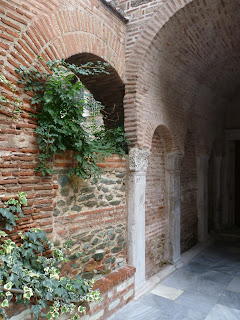
just one church to visit: Aheiropietos. It was built in the fifth century AD on
the ruins of Roman baths, and decorative mosaics dated from then. Until the
fourteenth century, it was the Great Church of the Holy Virgin. Inside, it was
splendid: an airy hall with two rows of marble columns on two floors. In 1430
when the city fell to the Ottomans, it was the first church to be converted to
a mosque. After liberation in 1912, restoration began but from 1922 to 1923 it
hosted refugees from Asia Minor. This was during the population exchange after
the Greco-Turkish War, when Muslims were repatriated in Turkey and Christians
in Greece, displacing two million people. Aheiropietos became a Christian
church again in 1930. The name means ‘not made by hands’.


Dashing back to the hotel, I
stopped at a juice shop and got a detoxing concoction for two euros. My flying
visit of 24 hours in Thessaloniki had been a pleasure. I’d come back for the
shopping and the nightlife and food, and next time I’d visit some of the art
galleries and museums and see more historic monuments. And maybe I wouldn’t
come straight from Frankfurt. Maybe I’d convince the boss to send me to
Thessaloniki Book Fair instead.


