‘These may be the last days of
the taverna.’ It was a text from Minas on 10 September.
What?
This was the taverna where I
lived in north Karpathos, helping him out for a couple of years. Anemos
Sunrise: anemos meaning wind; the sunrise from behind the church of
Ayios Minas. I’d been there early in the summer, delivering copies of Taverna
by the Sea, and had hoped to visit again in September. When Minas explained,
it came as a shock.
Since the area is protected, Minas
had created the taverna from an existing agricultural building, re-making everything
inside literally from floor to ceiling, filling it with the necessary equipment
and working to ensure it met every restaurant regulation, some of them hard to
believe. More importantly, he had also created countless memorable meals, sung
countless songs, drunk countless beers and painted countless pictures, making Anemos
magic.
But the owner of the property wanted
to end the lease.
Minas said a spitaki was
free for me to stay in since his summer helpers had left. Leaving Lisa happily
at home with two of her favourite people – it was still hot for her to be going
on adventures – I left a few days later.
The big ferry loomed into view shortly before 1 a.m. and was due to arrive in Diafani in the north of Karpathos just an hour and a half later. I’d told Minas I was happy to spend the night on the beach there since he was running the taverna on his own and needed his sleep. He said it would be windy and insisted on coming to pick me up. He set two alarms… but the phone wasn’t charged. I reverted to plan A, put on an extra layer of clothes, borrowed a cushion from a nearby cafe and managed a few hours’ sleep before voices woke me. I saw a red glow on the horizon before the sun rose from the flat, rippling sea.


In the bright early morning, I
hopped on the bus up to Olympos with a small contingent heading to school. The
light on the pine forest and limestone crags as we ascended restored me, as did
the sight of Olympos, and of Sophia in her café at the entrance to the village making pites in
her kitchen, slender and neat in her dark kavai dress and headscarf. She
made me a perfect coffee with a glass of cool water.

Her husband Mike appeared, and we chatted about a mutual teacher friend who had lived in their upstairs rooms. Mike said there were now just a few students at the secondary school, and only one child in junior school, so it’s unlikely they will remain open much longer. He showed me a picture on the wall from the big class of 1953, when Olympos had a thousand residents; now there are no more than seventy. But I was pleased to see Sophia and Mike healthy and smiling. As Minas arrived to pick me up. I tried to pay for my coffee and a pie from Sophia, but she refused. ‘Next time!’
Minas placed my backpack and box
of books in the cleanest part of the car and we drove away from Olympos. His
hotel there, Anemos, has now expanded to three rooms, plus staff accommodation
– no need for that commute I used to do. But it was good to drive the route
that was so familiar: each bend in the road, each view of mountain slopes and
the sea far below, the smell of the pine trees at the top of the track, the
spring water seeping across the dusty track, the bumps and twists…
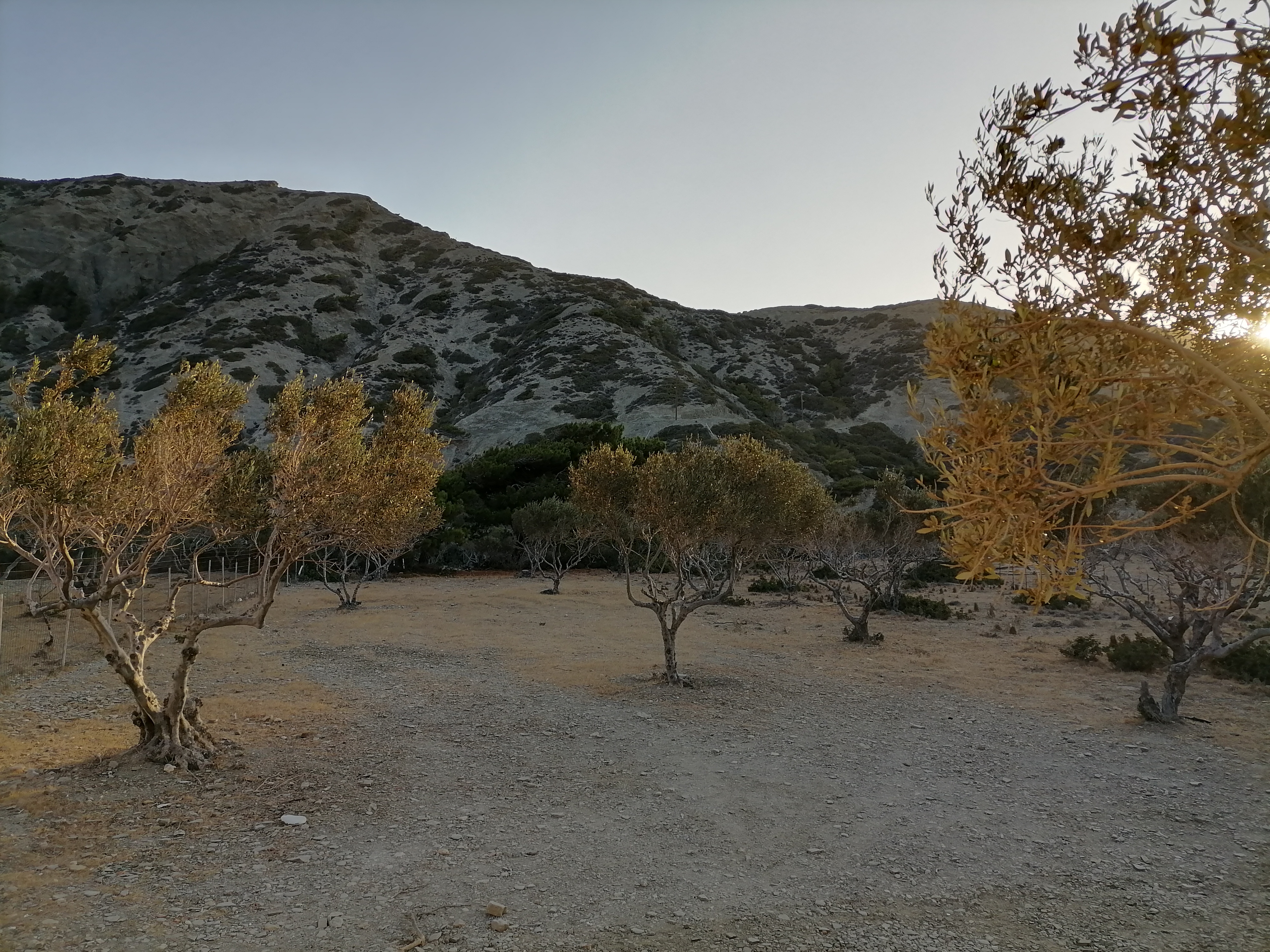
And finally down to the valley at Ayios Minas, where a young dog called Voula – sleek black coat, floppy ears and bright eyes – was very excited to see us. I’d met her in June. Minas’ uncle Nick had saved her from the street in Rhodes when she was a pup. She’s the only thing keeping the wandering goats away from the olive trees, Minas said, especially in September, the driest time of year; the goats had torn the bark off the fig trees beside the taverna, destroying them. The olive trees had been ravaged, lower branches bare.
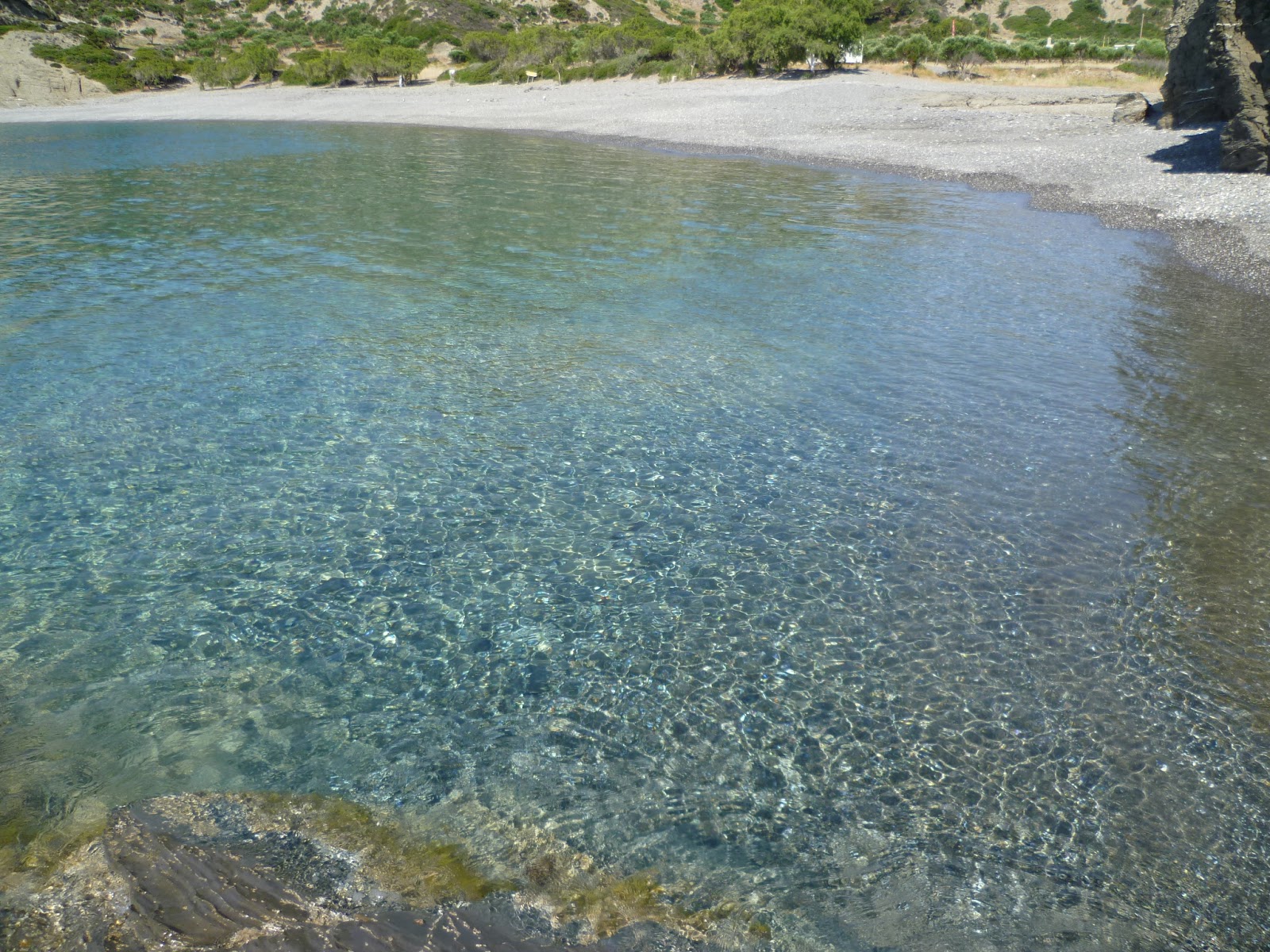
He left again to drive to Spoa to fix a couple of refrigerators, his other profession. I walked through the parched field to the beach – still beautiful despite taverna signs and an island of sunbeds and umbrellas. The sea was exquisitely clear and blue. There's still a bit of me that belongs here.
I swam, then unpacked in the spitaki and slept for a while on a comfortable soufa bed.


When I returned to the taverna after another swim, Minas made me lunch of local sausages with fried potatoes and tzatziki. An Austrian couple had walked down from the road and were eating a grilled fish and salad. Another couple came up from the beach, ordered a carafe of wine and started a game of backgammon. It was very good to be back. I walked Voula and she went wild sniffing out the goats in the valley, leaping and barking at them as I strained to keep hold of her lead and not be pulled over.
In the evening, after everyone
left, we ate dinner and drank wine and talked about what was happening to the
lease, and what it meant for Minas. He seemed sanguine, full of new ideas.
Running the taverna was almost a labour of love, and he could make more money
doing other things. But it wasn’t about that. He talked to me about some of the
special experiences of the summer: mostly about music, friends visiting, connections
with people.
The taverna was about Minas. If
he had to leave, the Anemos magic would go with him.

*
In the morning when I woke up, the only sound was a sighing wind in the chimney; the wind was unusually loud for September, building to a crescendo as it blew through the trees, then falling again.
This little house – different
from the one I’d stayed in before – had a platform bed with carved wooden
balustrade, paper tablecloths serving as curtains to hide the olive-harvesting
equipment underneath; brightly coloured flower patterns on the laminated
cupboards; icons and a souvenir mug from Symi; and – Minas’s addition – a huge,
heavy battery for solar power.


He had driven to Pigadia for
supplies and I was alone in the valley except for Voula, her big eyes watching
me, tail wagging faster and faster as I approached. She picked up her toy and
started pulling out the stuffing with determination.
I’d forgotten how hot it gets in
the taverna kitchen. I quickly made breakfast with some of Vasilis’ goats’
cheese, then when Minas returned I walked to one of my favourite nearby beaches,
a wild place, peaceful, blissful. Voula waited impatiently tied in the shade of
a tree while I swam with my mask, seeing large lionfish. On the way back, she
pulled me up the hill, finding goats.
Down in the valley, the taverna
looked more like a home with its water tanks on the roof, a washing machine out
the back and stacks of bamboo from the dismantled teepees, another old Lada in
the field. In fact, it was a home when I lived there, and it still was a home.
For how much longer?
When I got back, fish was
grilling, there were a couple of tables of Czech guests, and a German couple
had bought my book, and Minas was drawing his picture of the bay in it - his special signature. I made
a couple of coffees and did a little washing up – unnecessarily, but it felt
odd doing nothing – then went for another swim. Minas made me a fish cake for
lunch, filled with cod and whole shrimp, and seasoned with fresh parsley and
roasted red pepper, served with crusty bread.
By the afternoon, several tables of good-humoured Austrians were in the taverna, some already reading and enjoying the book, buying copies for friends – what a treat for me to hear that in the wonderful place where it all happened, and still be friends with Minas.


*
The next evening, I got a ride up
to Olympos with Irene from the village. I’d realised at the last minute that I
would freeze wearing shorts, and thankfully Minas had a clean pair of jeans and
I still fit into them seven years later.
It had been a beautiful day. An Australian couple I’d met in Tilos last year had decided to visit the taverna after reading my book and were surprised to find me there. We talked, Minas showed a video of a song he’d written and recorded at the taverna, then he changed into his rock star attire and sang live for them.

His friend Pavlos also visited, and it was great to see him again. In the afternoon I'd taken Voula for a walk up the dry riverbed among the pine trees, the energetic
dog pulling me back into memories and emotions from so many similar
walks. I tried taking a selfie with her before I left.


I was staying in the upstairs room at Anemos, and arrived in time for sunset. I was giving an
informal talk to an Italian walking group about my books and life on Tilos and
Karpathos. The guide, Paola, had invited me to dinner with them at Drosia, the taverna
run by Evgenia and Sophia, Minas’ cousin and aunt. The group had walked 12
kilometres and were hungry and tired; wrapped up in trousers and jackets and
scarves, they shivered to see me in a sleeveless top. ‘We are Italian, not
British, we feel the cold…’
Preparing to speak while they
tucked into their salads and starters, I quipped, ‘I am British, not Italian, I
need a glass of wine…’


Later, when the group departed, I made my way back to the square, ducking into Parthenon for a quiet drink, to relax on my own in the corner while the local men watched football on TV. A message from Ian at home reassured me that Lisa was happy, walking with him and chasing mice and eating plenty. The football match over, everyone got up and left, and I did the same, repairing to my upstairs room at Anemos, where I found the booklet I made to welcome guests years ago.


I woke to clouds, but sunshine was coming. After a short walk, passing Kalliopi’s traditional bakery with its wood-fired outdoor oven and waving at her working in her kitchen, I landed at Archontoula’s for coffee, and told her I’d written about her.
‘What did you write, that I’m
mad?’ Archontoula in her Olympos dress ushered me to the balcony, indicated the
flight of steps off the alleyway below she’d fallen down that summer. Taken to
hospital in Rhodes, she’d had to spend months recuperating at her sister’s house
there and I assumed the café must have closed – but no, of course not, her
husband had kept it open. After sitting outside with her for a while, I got up
to leave and tried to pay but she refused. I reminded her she’d refused payment
for ouzos in June, and if she never took any money, how would she live? She hid
a smile, then allowed me to leave money on the counter for a few of the plaited
strings she makes to pass the time.
I walked over to see Minas’ mum,
who was watering her flowers. Minas had made a pergola for the bougainvillaea,
which was thriving more than ever. She’d sold a few of my books and wanted to
pay me, but I said I’d prefer something she’d made herself. It was also
important to me to buy a few crafts from the village, to show appreciation and
support for the people who did and do the same for me. I left with a few bags
she’d put together with bright, cleverly matched fabrics, and I realised how
much creativity Minas inherited from his mother.
I’d intended to spend my last day
in the village and walk down to Diafani early the next morning for the boat.
But Minas was coming up to the hotel to repair a bed and light fixture broken
by guests (‘I hope they had a good time…’) and could drive me back down to the
beach. The villagers would be busy all day anyway. He'd finish the repair work and wait for me at the car park.
I returned to the room for my bag, then saw my friends Georgia and Yianni at Zephyros café. Georgia, Evgenia’s sister, was now officially engaged to Yianni, a local artist, poet and film maker, and it gave me a thrill to see them together in her café. I admitted I’d be going back down to Ayios Minas, then leaving the next day.
‘Do you go to the island?’ asked Yiannis. ‘Or does the island come to you?’
Georgia
said she’d managed to have a few swims that summer. She looked happy, and the
café attractive with new tablecloths and Yiannis’ paintings.
From the square, I made my way down the alley already brimming with visitors and received a warm welcome as always from my other painter friend Yianni, with his wife Rigopoula. I carefully dedicated one of my books to give to them, knowing that as a former head teacher he would gently correct my Greek if I got something wrong. I bought a colourful cotton blanket from them, and Yiannis gave me a wooden icon of Saint Gerasimos of Jordan he’d painted, telling me he’d chosen it for me as an animal lover because the saint removed a thorn from a lion’s paw. He had once given me a painting of Odysseus and reminded me that when the hero returned home after so many years, the only one to recognise him was his dog.
Minas was waiting for me at the
car, but I needed another stop to see Maria whose little house at Ayios Minas
I’d used years ago. I kissed her and she slipped a piece of homemade soap in my
bag. I bought a little hand-embroidered bag and she gave me a mati to
deflect the evil eye.
Waving goodbye, I made one last
dash into Sophia and Mike’s café to buy some dried makarounes, the local
handmade pasta, to take home. Thinking to use up change, I asked for a slice of
delicious-looking walnut cake – but Sophia refused to take any money. Laughing,
I found the clean space in the back of Minas’ car – on top of a sack of
charcoal – for my bag, now packed full of good things to remind me of Olympos.
To remind me not only of the beautiful place, but of the hearts of the people;
to be more Olympitissa.
It was an unexpected bonus to
return to Ayios Minas: the hills so green and untouched and dramatic, the aroma
of pine trees, the quiet of the valley. Voula looked with hopeful eyes. The sea
was bright blue, white ripples surging across the bay. Minas was soon cooking
fish and calamari, people were relaxing with wine, good music was playing, the olive
trees waving in the wind. It was hard to imagine it might not always be like
this.
I swam around the headland, lay
on the smooth flat pebbles for a while, and when I slid into the sea again with
my mask I saw a dozen long, thin cornetfish. A pale blue one looked up at me,
its body straight, eye wide and careful, then reversed slowly, its tail like a
needle. Continuing around the rocks I saw mayiatiko with a jaunty slash
across the eye, and hundreds of little fish like electric blue dashes.
After the sun went down behind
the hill leaving the beach in shadow, I had a last swim and spotted an octopus
peering out of a pebbly nest, and a pale grouper, then three large lionfish
lingering among the rocks, their colouring varied from reddish-brown to black,
their tails so delicate and dotted with decoration; I dived down towards one to
see coral-pink tips of its mane-like ‘feathers’ rippling like silk in a breeze.
A walk up the hill was thwarted
by gusts that threatened to knock me over, but as dusk approached the last light
was beautiful on the friable, khaki-coloured rock flecked with dark green
mastic bush. The pale blue sky was tinged a peachy pink. A jet-black dog
appeared in the gap in the field wall, looking, her ears blowing in the wind.
Minas cooked us dinner and we sat
drinking wine and talking. We set our alarms for early the next morning.

And soon enough the light was touching the tops of the hills, the wind shaking the dry olive trees, the sun gradually appearing behind the chapel on the cliffs. Just another Anemos Sunrise. With my backpack and a box of goats’ cheese, soon we’d be bumping up the dusty track, disturbing goats from where they were sitting, pine and mastic on either side and the breathtaking view to the clear blue sea.
Three weeks have now passed, and it’s
clear that despite his best efforts, there’s no chance of extending the lease.
It’s really over. It makes me sad to write that Taverna Anemos Sunrise at Ayios
Minas will almost certainly close this year. But the taverna is Minas; and he’s
got a few songs still to write.
And more than ever, I'm glad I told the story of our experiences those years I lived there.

(Minas standing on the step...)