Showing posts with label Easter. Show all posts

Hoopoes and Swallows, Asparagus and Taramosalata...


When Lisa wants to go for a morning walk, all winter I’ve been used to piling on whatever warm clothes come to hand, a woolly hat over unbrushed hair. But this morning I ran into several neighbours, two of them dressed smartly in black for church. It’s the start of Easter week and more people are back on the island.

Also back are the lovely hoopoes – I’ve seen several, not noticing the medium-sized brown birds until they take off in flight and show their flamboyant black-and-white-striped tail feathers. I’ve heard the whistling sound of bee-eaters – it seems early for them – but not seen one yet. Much more evident are the swallows, swooping low and fast, midnight-blue plumage on top and snow-white underneath, tail like two long, fine tines of a carving fork.

Yesterday morning, four young goats were playing on the old drystone wall in front of my house, two of them trotting over the rocks and head-butting each other. Despite the abundance of fresh vegetation everywhere, they stand at my fence and look greedily at the garden.

Goat farmers are much in evidence too, guarding their stock and fattening them up. ‘Don’t let the dog out of the car here!’ snarled one when, having seen him with his flock, I stopped to ask where it was OK to walk. We’re avoiding Plaka and Lethra until Easter is over, when there’ll be a lot of confused mother goats saying, ‘I haven’t seen young Johnny for days…’ ‘Meh, and my Matilda’s disappeared too… And what’s happened to that nice man who kept bringing treats?’

Livadia and Megalo Horio will also be off-bounds for the next week while firecrackers are exploding – I heard the first yesterday, while in between downpours we walked along Livadia seafront. More rocks had been washed up by powerful wind and waves from the south recently. As we walked around the bay, the pebbles looked brilliant white against a clear aquamarine sea and a brooding sky. Lisa, of course, went in for a swim.

We’ll stick to places far from firecrackers, the fields in the Eristos valley where Lisa loves to sniff for rabbits, occasionally making one leap out of a bush and safely away, while I keep an eye out for other prizes. Perhaps because we’ve had plenty of rain, or perhaps I’ve got better at looking for them, I’ve found more fresh wild asparagus than ever before, and more exquisite orchids – sending photos to my orchid-ID gurus Eleftheria and Gerry. And in the hillside terraces closer to home, I look out for tiny fragments of old pottery with an unusual pattern or glaze. Yesterday afternoon, I found a little of everything so didn’t mind that my feet were squelching in my boots from walking through wet grass. Lisa had a wonderful time, enjoyed a huge dinner and watched neighbours walk by while I pulled up weeds from the garden, enjoying the evening sunshine. By the time I lit a fire for a cosy evening, she was in a deep sleep.


I’ve been using the excuse of Lent and long walks to eat halva every day. My favourite from Drapetsona in Piraeus was made with carob syrup. During the ‘fasting’ periods leading up to Easter when some give up meat, certain traditional foods appear. After eating delicious white taramasalata at tavernas in Rhodes and then Astypalea during trips last month, I decided to try making my own. The pink packaged stuff is terrible in Greece compared to good supermarket taramosalata in the UK. For the first time, I bought the salted roe from the minimarket and got instructions: mashed potatoes (or bread), olive oil, lemon. Mine tasted bland until I added finely chopped onion. The ladies at the minimarket said not everyone likes it with onion.

Before this last rainy week, we had weeks of dry weather, good swims, even lying in warm sun. But the heavy rainfall this winter has been a blessing for the island.


Now big leaves have now grown back on my fig trees, and sparrows are knocking down the hard green figs, discarding them when they find they can’t eat them, looking instead for other things to eat in the soil, taking baths in Lisa’s water bowl.

For the last months, I’ve been working on revisions of the new manuscript. It’s something I was writing on and off for ages, and finally felt driven to finish last year. With the help of an excellent editor, I hope I’ve knocked it into shape. It’s about my adventures on Tilos with Lisa since we moved to this house at Ayios Antonis with its fig trees and vines, surrounded by mountains and sea, life in an amazing place with an amazing dog, woven in with stories of island life past and present. Maybe AN ISLAND HOME AND A SALTY DOG?

Ahem, says Fishbags, aren’t you forgetting someone?

The amazing salty dog just came to look at me through the open kitchen door, suggesting it might be time for another walk or another breakfast. Ah, and the power’s just gone off again – for about the tenth time in two days – so this will have to wait until later…


Lambri Triti in Olympos, Karpathos


The biggest day of Easter in Olympos is Lambri Triti, Bright Tuesday. In the morning, the bells start to ring and a few men carry the large icons out of the church and around the village, stopping at different chapels with the priest before gradually making their way down to the cemetery. There, he'll bless the family graves. The women wear their best traditional dress, bright stiff skirts and puffy sleeves in an almost Elizabethan style with much sparkling trim; it's a striking scene, a big draw for photographers. Last year, when I followed the procession I felt very conscious that we small group of tourists looked like scruffy papparazzi.

There again, as I said to Raymond from northern France yesterday evening, the locals take photographs of their cultural events just as much as the outsiders do. Raymond, carrying a fairly big camera, had been expressing similar concern about the number of photographers jostling for position. Yet all the village kafeneia have their walls covered in photos from years and decades past, a document of village life. There were mobile phones aplenty recording the musicians playing in the square, and at one point we laughed as a local young woman in full traditional dress held two mobile phones to record the proceedings – capturing footage of us in the process.

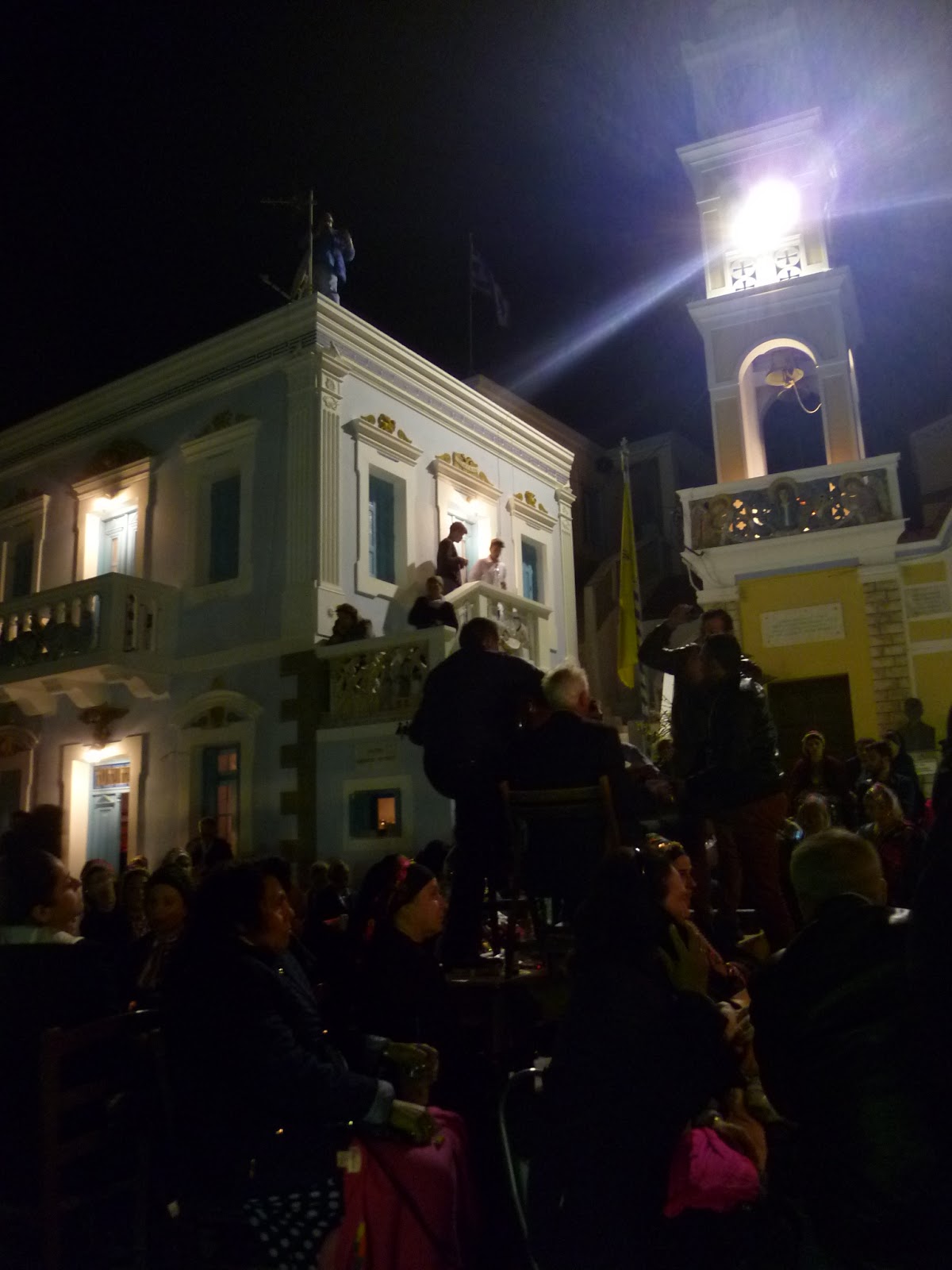
Last year, it had been too cold for the music to happen in the square in the evening – it was moved to a hall at the edge of the village and happened very late – so it was a treat to experience yesterday. In the afternoon someone was playing tsambouna, the goatskin bagpipe, in the Zografidis kafeneio. A little later, tables were set up outside and a small group of men old and young sang mantinades, improvised verses, to music played on laouto and lyra. Every now and then a fresh whisky bottle appeared on the table. The mantinades, the few I could understand, tended to be about how they appreciated one another’s company and how good it was to celebrate together.


Gradually more and more people gathered around the company to listen, as the sun went down and the night wore on. A cold wind blew off the sea and the mountain but the musicians were kept warm by the crowd gathered around, and perhaps the Johnny Walker. The men on the lyra and laouto were replaced by younger men, whose fingers never left the instruments - one of the nearby men placed cigarettes and cups of whisky to their lips. 
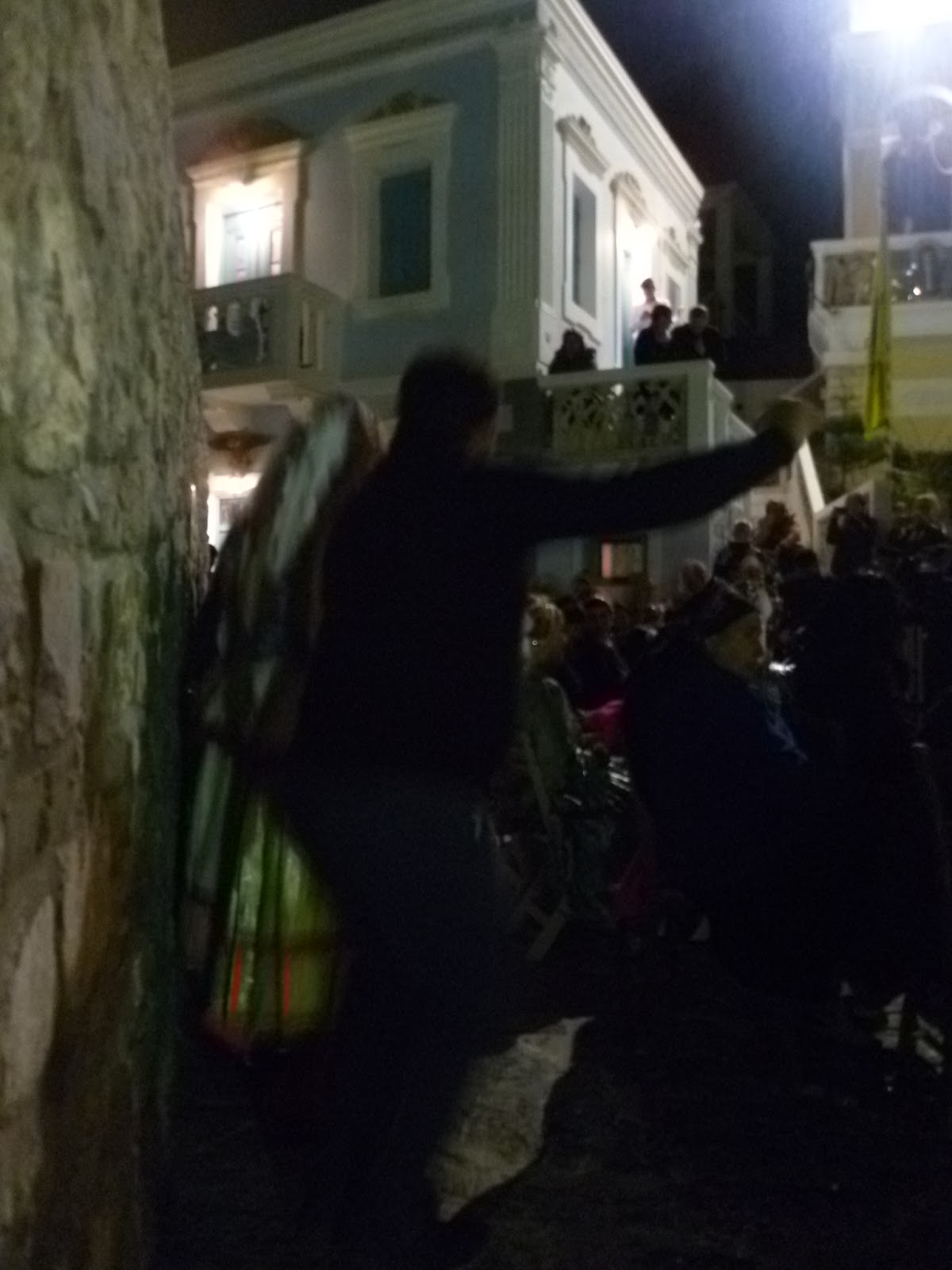
A few men and then women began to dance – less of a dance than a very slow shuffle around the table. More hours passed. Finally, after midnight, came the moment we’d all been waiting for, and everyone moved up the steps to the square in front of the church, where there was more room for everyone to join in the dancing.


The men who led the dance displayed some flamboyant leaps and moves. For most of the rest of the circle clasping hands, it was the same tiny, subtle, bouncy steps for what seemed like hour upon hour, though towards the end there was a break towards something livelier. Then the party broke up around 4 a.m., and the village went to sleep.

Check out photographs from last Lambri Triti by my friend Michael Pappas:

Happy Easter

Today’s been a lazy, quiet day, after a splendid Easter Sunday here at Ayios Minas – around a year since I first came here. 
In the last six weeks, much has happened. In March we spent a hot, sunny day in Avlona, Lisa and I walking the footpath from Olympos while Minas and his uncle trimmed their vines, then we all drove on to a valley beyond there to see the peonies.


One of the first guests of the year staying at our studios in Olympos arrived at the end of March just as a huge thunderstorm came with a deluge of rain. It knocked out the power temporarily, and left roads broken and covered in rockslides. I was amazed by the noise of streams rushing down the mountains in Olympos. The riverbed turned to a gushing river, which changed the colour of the sea. Gorgeous waterfalls appeared in the valley. When the sun came out again, the air was so clear and the light intense. Thankfully, Juliette had chance that week to sit in sunshine on the terrace.
Here down at Ayios Minas, the riverbed also turned into a river, the banks thick with flowers, bordered by fragrant pine trees and olive trees. Lisa loved the rock pools and I sat and listened with happiness to little temporary waterfalls. Thanks to all the rain this winter, the abundance of flowers has been breath-taking. So many flowers, different types every day in every colour in the lush green fields and deeper green hills.

In early April, we took the opportunity to visit some places in the south of the island where I’d not been yet, including Amoopi with its pretty pale sand beaches. 
Lately we’ve seen the occasional hoopoe, Bonelli’s eagle, peregrine or kestrel. One day, Lisa barked at something in the next field. We looked and there was what looked like a heron, but more colourful than the grey herons I'd seen before. It seemed tired and didn’t fly far. That day, I walked down to the beach for a swim, and I hadn’t got very far out when a fishing boat appeared around the headland. I thought it was probably passing but it turned into the bay, and lo and behold it was Stamatis, his first visit to us since September. He handed us a keep-net full of flapping menoula. We put some tables together and grilled the fish on the barbecue. It was another sign that summer’s almost here.
On Easter Saturday, I went up to Olympos with Minas, who was helping his uncle Nick for a few evenings at Geia Mas taverna. Immediately I arrived, I said hello to a French man and an English man sitting at a table and they invited me to drink some wine with them. They were visiting Olympos for the first time and had just met that evening in one of the other hostelries. We all got along, the evening flying by. We could hear traditional music coming from next door at Parthenon taverna, and see the people going into church, and hear the firecrackers, and when the service ended we went outside to greet friends with Christos Anesti.
Over the course of the evening we’d met a young woman from Athens who came in looking for a cigarette, and when she said she and her partner were off to Kafeneio Kriti to meet some other friends, Minas and I decided to join them to give Easter greetings to Archontoula and Philippas too. We all sat down to eat together.
Greeks are used to eating mayeiritsa on the night of Easter Saturday. A soup made with green vegetables and the intestines of the goat, it’s the first meat dish to break the fast of Lent, intended to prepare you for the goat feast the next day. But this was patsa, morsels of goat’s stomach cooked in an egg-and-lemon broth, and they nervously pushed bits of tripe around the plate. Something about seeing the city folk squirm – plus, to be fair, the large quantity of wine I’d drunk – made me dig in with gusto. Minas did too, and we found it pretty tasty. 
And so, after being up until 3 a.m. drinking wine and eating goat-stomach soup, I was feeling not quite at my best the next morning when we got up not long after 7 to start preparing for the day. But no matter. The weather couldn’t have been more beautiful: not a breeze or a cloud to bother the blue sky. I kneaded bread dough and left it to rise while Minas lit the charcoal and attached the whole goat to the spit. It had been slaughtered at the top of the valley a couple of nights earlier when he went to pick up the goat’s cheese. He’d made tzatziki and melitzanosalata, aubergine salad. We cleaned and organised, then relaxed as the meat roasted. I went to the beach for a swim, and the pebbles and sand were too hot to walk on – first time this year.
Lisa announced the first guests with some loud barking. Over the winter so few people come down to Ayios Minas, it’s handy to have a Distant Early Warning Signal when a vehicle appears. But yesterday, Lisa’s vocal cords and our ears were tested. Our Swiss visitors were walking down the track, and her barks accompanied them all the way.
By early afternoon, the sea was flat calm, and everyone seemed happy to enjoy the beach while waiting for the meat to be ready. After a long swim, I went for a walk up the riverbed and noticed the little yellow pom-poms of the overhanging trees had overnight been shed, leaving the ground dusted with gold, and to compensate, the yellow broom flowers were now smelling so sweet – I picked a few, and we decided to decorate the tables with them.

The food was ready just as the sun began to drop towards the hilltops, and everyone joined the tables together to eat.

The story of how I became lost...


It’s bright and early in the village of Aperi, and the cafes on either side of the bridge are closed. One has been closed for a while and is looking for a new owner. Another should be open soon, says a man who’s taking a break from painting a wall to talk to a handful of men outside the pharmacy. He gives me a koulouri biscuit and says I can keep them company while I wait. The other men say that then he’ll never finish painting the wall.


Not wanting to interrupt the redecoration of the Aperi bridge, I ask if the spring water is drinkable and it is, so I fill my bottle, return to the road and start walking. When I made my way up from Ahata beach it was still cool, but it’s warming up. Minas, who has the hotel Anemos which I’ve booked into for three days, has arranged for a friend of his to pick me up on their way to Olympos around 9 a.m. There are few cars, considering this is the main road linking the south of the island with the north; it’s beautiful and peaceful but the hill is tough. I’ve put my heavy backpack down and rested a couple of times when a flatbed truck stops to offer me a lift as far as Spoa.
An old man, who introduces himself as Vasilis, gets out and removes a recently slaughtered lamb or goat from the front; it’s just before Easter and several goat-shaped packages were being loaded on the ferry when I left Tilos. He puts it in the back with my backpack beside a pile of leafy branches. Mere minutes after we set off, we crest the hill I’ve been struggling up for the best part of an hour and start gently descending, and I’m mildly disappointed that I didn’t keep walking to the top, especially since I’ve now missed the chance for some stupendous photos of a sheer rock face dotted with pine trees falling away to deep blue sea and a crescent of brilliant white beach. Vasilis tells me it’s Apella.

We chat and he tells me a lot of Karpathos people live in America and Australia and return every summer. As we speed along a winding cliff-edge road with stunning views, he asks if I mind if he stops to feed his animals and something else which I don’t understand. I say of course I don’t mind, hoping it’s something innocuous. We turn off up a dirt track into forest. He tells me to stay in the car as he pulls the branches off the back of the truck and feeds them to the goats, then disappears. When he returns, he puts a covered plastic tub by my feet, and I realise he was milking the goats.

 
We stop briefly again while he checks his beehives and a few minutes later we’re arriving in Spoa, halfway to Olympos, where he insists on treating me to a coffee at the kafeneio. We sit at a table on the road with a tree for shade, and I notice the name above the door is Koumpanios; it turns out Michalis, the owner, is related to the Koumpanios family in Tilos, the people whose house I rented.
A white van is parked outside selling dairy products from the tyrokomeio or cheese factory of Kasos, the neighbouring island. The owner and his daughter sit with us for a while and I buy half a kilo of strong, creamy graviera. They also have butter, dhrilla (a type of cream) and sitaka, a rich, buttery cream which is cooked for over twenty hours – like staka in Crete, but made without flour.


I update Minas at the hotel with my whereabouts so that the friend who’s offered a ride can look out for me; apparently they’ve been delayed. Then I set off along the road again, around the edge of a steep mountain. The sky’s covered with thin cloud but there are lovely views of peaks and old terraces and the sea below. Cars pass from time to time and eventually I give up on the arranged ride and accept one from a very friendly family in a truck. It already looks packed to the gills but Poppy, whose father is driving, insists I will fit and moves around some stuff, and I squeeze into the back seat with her two young girls and a little black dog.
They’re from Olympos but usually live in Rhodes, and they’ve taken the Blue Star ferry today to come home for the Easter holidays and open up their restaurant, Milos. I chat and laugh with the two young girls, who practice their English and tell me their village is just around the next corner… Oh no, maybe the next corner… Oh, no, maybe the next! And then, suddenly, there it is: Olympos.


Minas is waiting for me at Sophia’s café by the car park; he invites me to sit down with his cousin for a few minutes and then leads me through the village to my room. There’s a strong wind blowing and an amazing view out over the sea. I check if the water is OK to drink. ‘More than OK.’ The bed is a soufa, a mattress on a raised platform made of carved wood, with cupboard space underneath. It’s lovely.

The last thing I want to do is work, but a project has taken much longer than expected and I have to get online; I take my laptop and go to find a suitable café. A few minutes’ walk along a little alley I first meet Archontoula. She’s a tiny woman, seventy-something, wearing a thick black long-sleeved dress with a colourful apron and a black scarf tied around her head. She’s sitting outside a traditional kafeneion with framed photographs taking up most of the wall space, and simple tables arranged around the sides of the room. After we’ve chatted for a while she invites me in. I apologise and say I need to find somewhere with internet.

‘Den sou leo psemmata,’ she says firmly in a voice built for shouting more than whispering. ‘I won’t lie to you. I don’t have internet.’ I’m not at all surprised and I’m embarrassed that I need it. ‘But you might be able to pick up the community internet from the church. Go inside and try if you like.’

So I sit down in the corner and it works. I order a beer and it comes with a plate of dark green olives, some good bread and a plate of mousmoula, a soft orange-coloured fruit. Archontoula sits in the corner with a bag of wool threads in different colours which she plaits into a string. When I ask her about it, she gives me a necklace with a tassel at the end. You can keep your keys on it, she says. Her headscarf keeps slipping down and she continually has to re-tie it around the top of her head.

A man arrives, tall, hefty and chestnut-skinned with a luxuriant moustache and twinkling eyes. Archontoula introduces her husband, Philippas. She tells him who I am and that she didn’t call me in, I came in of my own accord; it seems an important point. The kafeneio is called Kriti, or Crete, because Philippas’ father lived in Crete for a long time; also because Venizelos was from there.

Eventually I ask if there’s anything more to eat and she gives me bean soup and a tomato and cucumber salad with bread and olives. The price is minimal, and when I protest she says it’s ‘because we got to know one another’. She says I should stay for Easter if I can. I’ll have to look into the boats and connections tomorrow. Her husband says they’ll find me a ride to Pigadia whenever I need to leave.

This is the start of the story of how I became lost in Olympos.


Next morning, I’m back at Archontoula’s for breakfast, working again at my computer. While I work, she’s trimming artichokes, angenares, ready for cooking and I eat a good hard local cheese with bread and a dollop of thick, flavoursome, opaque honey. People come and go and Archontoula talks with a couple of young men who are doing some work for her on a house. She sounds forceful but fair, and every now and then she erupts into cackling laughter. She tells me that she and her husband pay for the costs of the kafeneio out of their pensions.

A Greek couple arrive, visitors from Patras, and Archontoula gives them a shot of raki. She offers one to me too.

‘I can’t,’ I say, ‘I’m working.’

‘Just one!’ she says.

When I leave around lunchtime, it’s suddenly so windy I can hardly stand up. The supermarket is closed, but someone tells me the lady who owns it has just gone across the street to the pharmacy, so I wait and sure enough she opens up again, so I buy coffee and a notebook and toothpaste. As I leave, a man’s hat blows off and we laugh. He asks me if I arrived on foot yesterday – he saw me as he went past. He says if I want a ride I need to do ‘auto-stop’, otherwise people think you prefer to walk.

That afternoon, sitting in Parthenon café surrounded by more old photographs, I finish the piece of work that has gone on and on. Then I go for a walk. I’m sure it’s partly relief at finishing that project, but I’m practically in tears as I walk around Olympos village, out to its edges on the mountains and down into the valley.

The physical setting, with the sheer mountains rising up, and the way houses and windmills cling to the slopes and ridges. Can there be a more beautiful place? Sometimes it reminds me of Santorini (but before it was discovered); sometimes I feel I’m in the Himalayas or Machu Picchu. Everywhere I turn, there is something surprising and spectacular. The colours of the stone itself – green, brown and white – and the houses – white, blue, yellow – and the way they are decorated. The terraces with olives and figs and vines; from across the valley I looked back to the village and saw a boy leading a goat by a rope; a woman in black picking fruit from a tree; another sitting in a field with her goats. And I love the beautiful dress of the women, black with bright embroidery, black headscarves and high leather boots; and the way they smile. The angles of the steps, the sun setting into the sea.

Arriving back in the room I glimpse myself in the mirror looking rosy-cheeked and windswept. I crawl into my very comfy bed on its raised wooden platform with a window out to the sea, and fall happily asleep for a while. When I wake, relaxed, it’s evening and I hear the church bell close by. The big church is lit up for the service, and inside are old frescoes and gilded wood and huge, brilliant chandeliers, the sound of chanting and the smell of incense.

Archontoula heats up artichokes and potatoes for me, the food I watched her prepare in the morning; with herbs and olive oil in tomato sauce with that hard, white, salty local cheese, and olives and bread and a glass of cold water. There’s no fuss; it’s all just done simply and beautifully.

I’m so happy to be here.