Showing posts with label fishing. Show all posts

Raki and Fish

Image result for stratis vogiatzis raki and fish
Raki and fish... Sounds almost as good as octopus and ouzo, doesn't it? 

'All my life, in whatever city I visit, I've always found myself in search of fish markets,' writes Tan Morgul in the Beirut chapter of this luscious book. Tan, a journalist from Istanbul, is the writer and Stratis Vogiatzis, from the Greek island of Chios in the Aegean, is the photographer. Together, over several months in the winter of 2013, they travelled to 11 cities around the Mediterranean sampling variations on the simple and exquisite combination of raki and fish, and they put together this book that is a feast for the eyes. It resonates with 'the sound of the waves and the smell of the sea'. 

It's not just a cookbook, and not just a travel book, but an opinionated and lively exploration of the Mediterranean passion for seafood, capturing a snapshot of the geography, the mythology, the poetry, the stories of each place. It opens in Istanbul, where 'fish is caught not with net or rod, but with raki' according to Ara Guler - and last night I travelled with them through Beirut and Alexandria... 

We learn the Turkish saying: 'If my own father came out of the sea, I'd eat him!' We learn about the fish themselves along the way, from monkish to sardines, as well as how they are eaten locally. We learn about serving roasted grouper with tahini sauce, and about marinating bonito (small tuna, called palamitha here on Tilos) in garlic, olive oil, onion, lemon juice and soy sauce. 

We learn about salads with slices of cured fish roe, dressed in thyme, onion, lemon, salt and olive oil - all things we can source locally here - and I'd love to try making a dish with dandelion greens sauteed with calamari in lemon and olive oil - perfect for winter on Tilos when all those things are fresh and in season. We learn about fish felafel, tabbouleh with tuna, hummus with fish confit - Beirut is big on pairing fish with grains and legumes. 

I was also fascinated to read that the word raki has its origins in the word 'araq', which means 'sweat' - the drops that collect as it emerges from the still. Arabs originated the tradition of distilling drinks in Lebanon.

The photographs are not only of food but of kitchens, of fishing boats under stormy skies in inky waves, of steam and ripe tomatoes and spices, of the wet paving stones of old markets, of expressions captured on faces.

Tan laments the damage inflicted on our seas by pollution, and the damage inflicted on the Mediterranean shores by bland development. Some of the places were experiencing economic crisis, political and social upheaval, even revolution, but as Tan writes, 'in these tense times... we went in search of a warm conversation'. This book is a wonderful celebration of Mediterranean culture and I can't wait to continue the journey through Tunis, Tangier, Lisbon, Barcelona, Marseille, Genoa, Dubrovnik, Athens.

The book can be ordered from Amazon.com but if you have problems please feel free to get in touch. You can find a small selection of Stratis' beautiful photographs along with an introduction to the book by Tan here: 
http://www.stratisvogiatzis.com/projects/mediterranean-sea-food-odyssey

Thanks to the guys for sending me a copy.


At Kos Town

Juicy and messy… No, not my life, just an afternoon snack of big Greek tomatoes, eaten whole. A taste I’ve missed.
Now, evening. The smell of a harbour. Sound of palm leaves rustling, mopeds haring by on the road below, a high-pitched church bell clanging. Sitting on my balcony overlooking Kos harbour, I’ve already eaten handfuls of peanuts, their pink papery skins encrusted with salt, as I sip on a glass of buttery, fruity, local white wine.
I’ve been gone too long from Greece, but it’s allowed me to experience everything afresh. I’m arriving at the same time of year I did four years ago, when I came to stay, that new beginning. When the cab driver from the airport today asked me if I was staying many days in Greece, I said a definitive ‘nai’, yes, and laughed.
It’s a wonderful time to arrive in the islands of the South Aegean. As we landed in Kos – that dramatic landing, veering away towards the island of Nisyros, low over the quarried pumice islet of Yiali, then swooping back low over the blue sea to land across a narrow, flat piece of the island – the land looked green. The cab driver said there had been a lot of rain but now for a week, kalokairi – summer. Tourists just started arriving this week; in two weeks’ time, he said, the island will be full. And what of the economic problems? ‘Here, we don’t bother ourselves with that,’ he said, half-joking. ‘We have tourism.’ When I ask him about Greece leaving Europe he says, ‘They won’t let us. And we shouldn’t.’ I am, by the way, chatting to him in Greek. It’s been a shaky first day, forgetting how to say things, but as always the Greeks are complimentary of any attempt to speak Greek.
We passed olive groves, vineyards, all a bit ramshackle; wandering cows; bakeries. The cab driver waved hello to other drivers. It’s that familiar start-of-season, start-of-summer optimism that you get, especially on the big islands. There was warm sunshine and a breeze, green not yet burned to summer brown.
I arrived too early to check in to my room, so sat with a frappe and iced water on the terrace of the grandly named Kosta Palace (where I am paying a grand total of fifteen pounds, including breakfast), taking it all in: the pale blue sparkling water, across which were the minarets and blue domes and palm trees of the town against a backdrop of mountain ridge. Pop music was blaring. The cab driver had been playing music too. I missed music.
After my coffee, I didn’t have to wander far to find a bakery with a good cheese pie, and next door was a ticket office where I bought my ticket to Tilos for tomorrow, while at the café-bar opposite, groups of young people sat around sipping coffees, enjoying the sunshine. I walked back to the harbour and watched the fishing boats with their blue trim and hand-painted names: Kapetan Tasos, Giorgos, Maria. A wiry old man a with deeply tanned, lined face, wearing rubber boots and old clothes, was telling his young helper to leave his work mending nets on the boat with the cross painted on its prow, the Panayia Kastrou, Our Lady of the Castle. Ela! As to… 
Many of the boats had dark blue circular talismans against the evil eye. Another young man was threading bait onto hooks, listening to music. ‘Eh Yiorgo, ti ora eineh?’ he shouted at a man who was strolling from one boat to another. An old man put a cigarette in his mouth, tossed the cellophane from the new pack over his shoulder into the water. He stood to talk to Yiorgo, gestured with his arm outstretched and his thumb and forefinger twisted in a question, lamented the state of affairs compared to the old days when he would make such-and-such ‘kathara’, take-home. Then he sat again with a mobile phone to his ear.
I asked another fisherman on shore about the threading of bait onto lines. He was cutting up fresh fish and threading the pieces onto lines arranged around the rim of a bowl-shaped bucket. He said it was called ‘paragadhi’, and you trail the lines behind the boat one by one.
Later, I wandered around as a cool evening wind blew off the sea. I stopped to look in a cheese shop, and the man inside smiled in welcome. I passed a tiny chapel with ancient white marble revealed beneath the modern exterior. The roots of olive trees were pushing up the concrete slabs of the pavement. A man on a motorbike was laughing with some tourists standing at an ATM: ‘Money, OK! Today. Next month, maybe no money!’ There was a tantalising smell of grilling meat as I passed neighbourhood tavernas, and little houses covered in pot plants.
Now it’s dusk, and a fishing boat is chugging in to shore. The sun has gone from the mountain opposite, and the water has turned pale, a few streaks of cloud tinged pink. I’ve finished my wine and eaten far too many peanuts. Lights are beginning to come on around the harbour, and the fishing boats are bobbing on rough water.

I have a ticket for the ferry to Tilos leaving tomorrow lunchtime. I hope the wind dies down a little. But nothing, not the prospect of seasickness or delays, can quell my happiness at being back in Greece. It’s a year since I first went to Australia; Yiannis has to stay there for now to look after his mother. I still have the tiny bag of sand from Skafi beach that I took with me when I left, which I’ll scatter back where it belongs very soon.

Tilos: The Mending of the Nets


For the last couple of days, a mastoras or craftsman has been on the island helping the fishermen to mend their nets. Early this morning, I went down to Livadia to watch him at work.


It was likely to take all day, so Lisa the pup and I went for a walk around the harbour.


In the small harbour on the other side of the bay, they were rubbing bundles of freshly-caught octopus on the ground, to ready them for eating.


We continued up the hill and found lots of kiklamena, wild cyclamen.


 When we got back to the main harbour, the cats had gathered around the fishing boat as Stelios was cleaning dog fish, or small sharks. Where there are dog fish being cleaned, there are cats, and where there are cats there are dogs...


The mending of the nets continued...


... but we had to say goodbye


Paradise with Power Cuts

It's summer in Tilos.
Yesterday I was in the village shop, and an old lady was saying she doesn't go in the sea until summer. 'What's this?' exclaimed Rena, pointing out the door. 'It's summer!' It may be early May, but it's 28 degrees and though the water's a little cold, it's beautiful plunging into the deep blue... As I've been doing at my favourite pink sand beach since my last post.
I also know it's officially summer because the mayor of Livadia (dressed pretty cool in embroidered jeans and All Stars) told me the young kids weren't allowed to play football in the school playground before 5pm because 'kalokeriazei', it's turning to summer, and people would now be taking a siesta between 2.30 and 5. The older kids now have exams coming up anyway and the young ones just want to be outside. It's no time to be cooped up in school.

Towards the end of April, one evening just as I was ready to fall asleep (after work, swimming, teaching, then drinking a glass of wine while watching Stelios cooking little red crabs in exploding hot oil), Stelios called Georgo to wish him and Georgia 'Khronia Polla' for their name day, and they invited us over. I had no energy to go out - I should have had a midday sleep myself. But it was fantastic: a big friendly gathering at which Georgia celebrated her name day by working non-stop to keep everyone supplied with plates of wonderful roasted goat, cheese pie, salads and then cheesecake. The youngest family member, Antonis, was already asleep covered in coats on the couch, while the oldest was well into a bottle of Cutty Sark. 


Next morning, we were up at 4.30 a.m. Stelios had agreed to take me out on the fishing boat. As we left behind the lights of the village, there was a dark sky full of bright stars above. A faint glimmer of reddish light on the horizon showed where day was on its way. It was calm, the sea rippling lightly. Then suddenly I spotted a pod of dolphins - within moments they were leaping in front of the boat, silhouetted against the silver-grey sea.


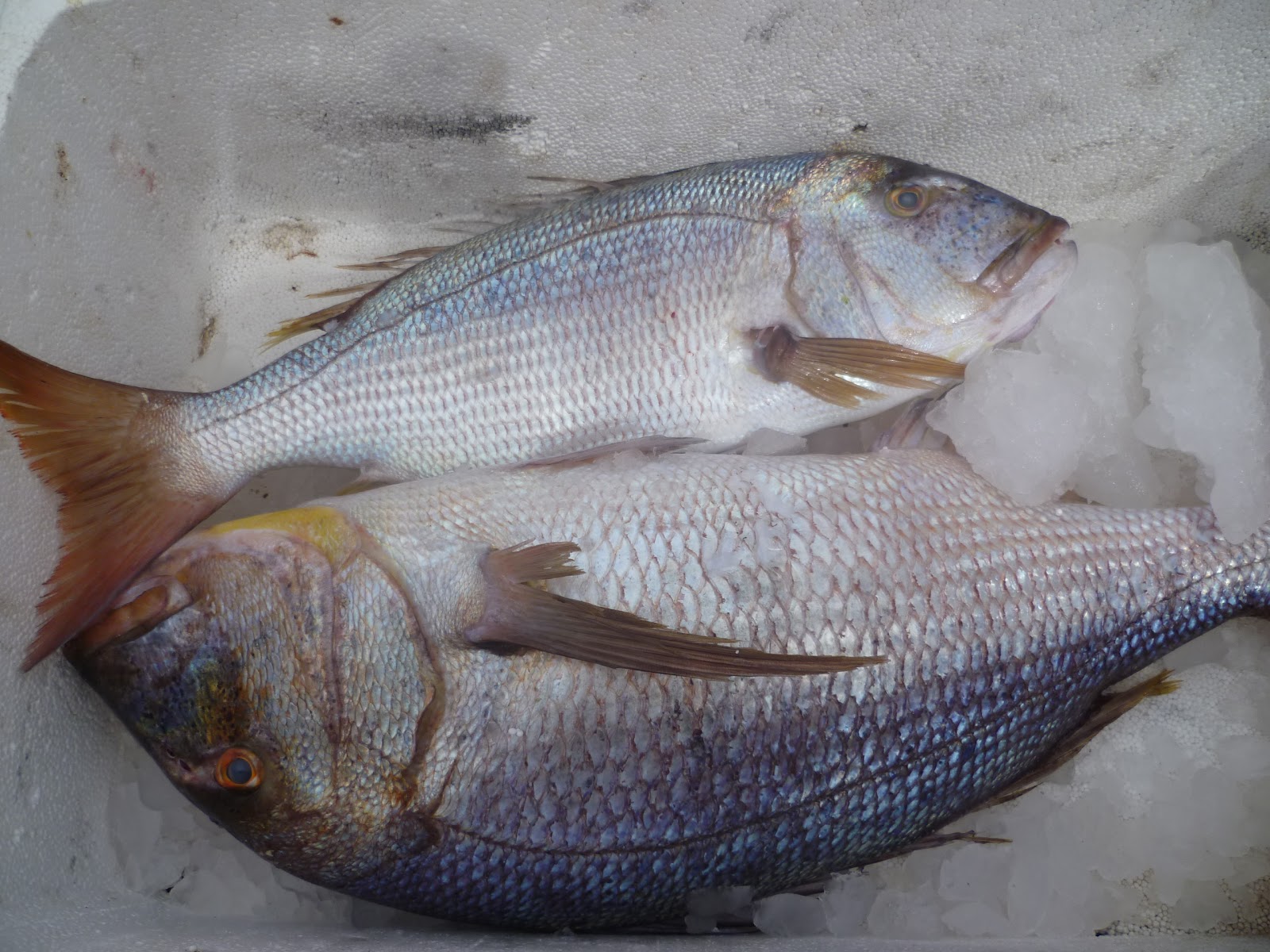
We went south round the sheer steep cliffs to Ayio Sergi, past the deserted rocky islet of Antitilos. They caught two sinagrithes – king of fish - one of them weighing four kilos. There were melanouria, and the small tuna called palamithes, and lobsters.
Not many fish, as a couple of nets were attacked by a seal, which we saw rolling around in the water, but enough to make it worthwhile. For me, the best part was being allowed to steer the boat for a while - a bit terrifying when close to the cliffs. My reward was a fouska, also called spinialo, a bit like an oyster (perhaps a kind of sea squirt) with soft yellow flesh that tastes like the sea.
A few days later, they caught 40 kilos of melanouria, and another day 500 tunas.

We had a week or two when the power went off for about an hour twice a day. No fun when Stelios has to get up at four in the morning and get ready to go out on the boat all morning, and there's no power for a coffee. But we seem to be back to normal. Ktipa xilo, touch wood.
Then it was Protomayia, First of May, also a sign that summer is beginning, as were the first oleander flowers blooming; and the Ayia Irini festival,with dancing in the afternoon down in Eristos valley - all reminding me that I've been living here for a year now.


Now that I've been writing notes on this blog for a year, I've started to receive messages from people who've found it, maybe looking for information on Tilos. I picked up a couple of walkers the other day and gave them a lift into Livadia, and when we got chatting, the English man said: 'Have I been reading your blog?' I've met a woman who used to be the rep for Laskarina here. And someone who was at a football match I went to last year, who sent me a wonderful message saying:

'One of the many things my regular visits to Greece has helped me to learn is that the "simple life" is very good indeed. Trouble is too many folk think you can only get it in Greece but if you try it is quite possible (if not always easy) to live the simple life back home too.'

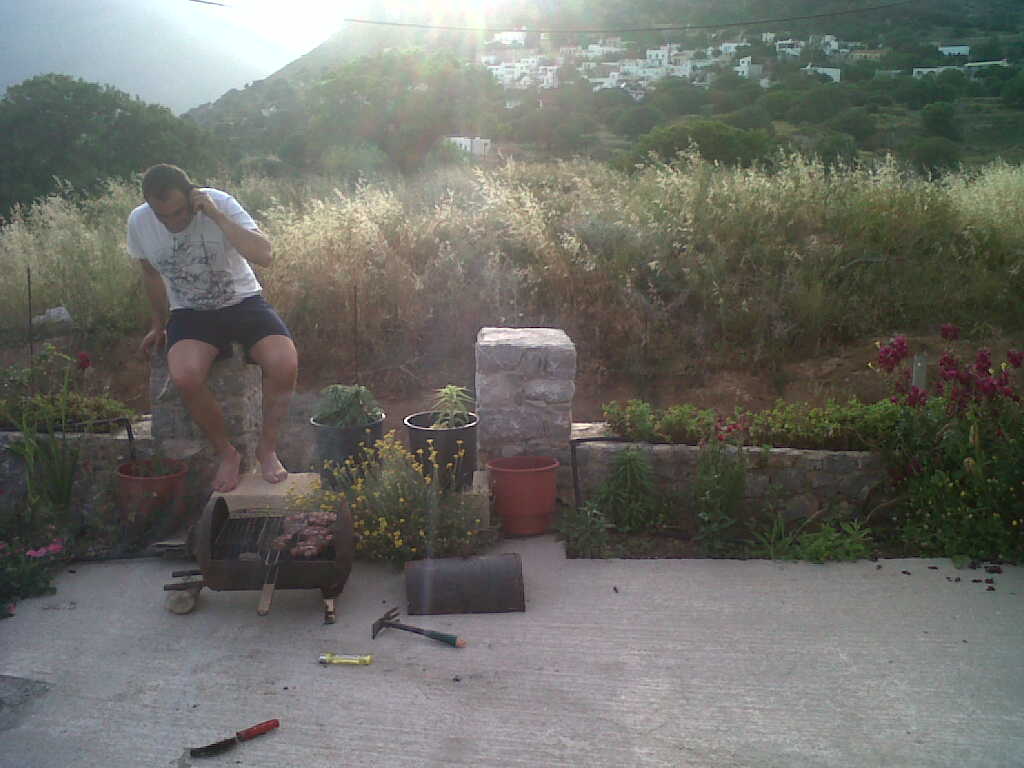
Beautifully put. Some things, of course, are only Normal for Tilos. Stelios assures me that everyone makes barbecues out of old hot water tanks in Tilos:


I've been endlessly confused recently between tha psisoume (we’ll grill meat - what you do with a barbecue) and tha psifisoume (we’ll vote). The elections happened here on Sunday, and Tilos was busy with people coming back home to vote. Funny, if voting was on a Sunday in May in the UK, how many people would do it, and how many would be on a cheap break to somewhere in Europe...?
The voting has sent a strong message that ordinary people are unhappy with being made to give up their future and their pensions for what their government has allowed to happen. (Last night I heard of a young locum doctor who is now on 500 euros a month, not enough to feed his family, and will have to look for work abroad...) There's much talk of France also saying they've had enough of their arrangement with Europe. Exciting times... Thankfully, not nearly as exciting here as the British newspapers seem to convey. Life goes on as normal in Tilos.

Finally, Eleftheria invited me to look around the studios she has overlooking the bay in Livadia last week, so I could help her create a text in English for prospective customers looking for more information. The studios are in a quiet part of the village, but only five minutes walk from the beach, with a spectacular view, and are good value, so if you're looking for a place to stay, they are worth checking out: http://www.michalis-studios.gr/

I always start these blogs thinking this should be a quick one as I haven't been doing much, and not much happens on Tilos... Right? 

Late October on a Tiny Greek Island

Fishing boat in Livadia on Monday

Cat on the steps

Donkey on the walk down to Eristos

Someone is making charcoal

Football on Tuesday

Finally, got the beach to myself again (yesterday, mid-afternoon)

Yep, definitely empty...

Benefits of having a boyfriend who's a fisherman, #162.
Old fishing nets available to cover up the new plants.

Other benefits include eating fish practically every day. What else am I eating? Most days it starts with some combination of muesli, milk, yoghurt, tahini and honey (food of the gods, I assure you); an orange; half a pomegranate; and maybe an onion, a tomato, a zucchini and a green pepper fried or roasted in olive oil with some fresh herbs, and some fresh fish. Oh, plus some dark chocolate. I've been editing a book this week called 50 Things You Can Do Today to Manage Stress. My diet is a textbook example of the anti-stress diet.

It is very exciting to see oranges ripening on the trees! I admit i raised my eyebrows a little when I handed over 17 euros last week for spinach, rocket and oranges. But I couldn't help it: the rocket (well, roka, which is a bit like watercress) was still growing in the garden when he picked it. The oranges were still on the tree. Zero food miles except the mile I walked home. And with mounds of spinach, that's pretty much all I needed all week.

And if that wasn't enough to make me healthy, I've walked to and/or from Livadia (four miles) three times this week. Twice to teach my English classes, once to celebrate Dimitris' Name Day. It was beautiful walking home late at night under the stars (I saw maybe three cars the whole way). But am not sure I'm being a very good teacher; it didn't feel like I handled the little ones very well on Friday.

Feeling full of doubt as to whether it is possible to work four days a week as an editor, revise my book, do blogging for Korea and teach English six hours a week, not to mention all the prep time and the bits of online journalism I do, and look after my garden, I relaxed totally yesterday with a very good book, a walk and a swim, followed by good food and a glass of wine with a tired but smiling man who'd just spent twelve or more hours on a fishing boat.

And guess what? As I sit here in the kitchen writing, my ankles are getting a sun tan. Life is sweet when you live next to the honey factory.

A Box full of Lobsters

It’s a late September Sunday, about seven a.m. In summer we'd be out earlier: the fishermen go out when the sun’s coming up, as that’s when there are fish. 

I say hello to Nikos and meet his brother Stelios; I’ve been invited by the third fisherman, Stelios L., who’s been fishing with them for more than ten summers. The three change into orange overalls and rubber boots. A teenager, young Alexandros (‘the great’), sits at the back in shorts and t-shirt to steer the boat. I’m given a seat in the middle where I can see everything.

NB: Most of the photos to go with this blogpost won't load this morning, so please view them on my Facebook page!
http://www.facebook.com/media/set/?set=a.10150385941285803.403889.646565802#!/media/set/?set=a.10150385941285803.403889.646565802&type=1


The wooden boat heads first to the headland to the south of Livadia bay. It’s a nice calm morning, cool, a few wisps of cloud on the hilltops. On this side, the water is still a grey. It’s one of the last weeks before they change the boat over to a different kind of nets, when the season opens for trata.

We arrive at the first spot. One of the guys hooks the float out of the water using a wooden pole, reels in the rope, then a motor winches the net over a series of three wheels that keep it coming continuously. Nikos leans over the side, watching to see what’s coming in.
‘Good skaros, take it,’ he shouts to his brother who pulls the net off the wheels, winding it into a heap and at the same time pulling out the fish and tossing them into a bucket of sea water. Stelios L. winds the empty nets into a pile at the back of the boat and helps pulling out the fish when needed. Nikos shouts instructions to Alexandros on the rudder to keep the boat in the right place. ‘Mpros!’ Forward. ‘Anichta!’ Away from land. ‘Isia!’ Straight.
The first fish to come over the side include some spiky orange skorpio (scorpion fish), and some yermano (Germans – they came to the area during the Second World War) with poisonous spines that can give a very nasty sting. All these Stelios extracts from the nets with his bare hands. For a while there’s nothing, and then about six good-sized fish all at once. And then a karavitha, like a reddish-brown lobster with no pincers or feelers but a big, powerful tail that curls and snaps back. And a sinagritha, two kilos at least, the ‘king of fish’, blue-ish silver with pink around the mouth. All this in the first half hour: a good start. When eventually there’s nothing more coming up on the nets but weeds, it’s time to move swiftly on. Feegeh! Go! The lobster was a good find. Lobster is worth up to forty euros a kilo.
Crossing the bay to the north side allows a brief break for a cigarette and fresh coffees. A sudden panic: no more coffees! The great coffee crisis ensues and searches are conducted for the disposable plastic frappe cups. A brief despondent lull, knowing there’s no more coffee this morning.

The island looks different from the sea; the sun is coming up now over the side of the mountain and brightening all the colours. We skirt the shore where the cliffs and the coves are a rich red, reflecting in the still water. We pass Donkey Island, then stop at the next net and start pulling it up. Tiny fish have to be extricated and thrown back, but soon the fish bucket starts filling up. There’s a flurry of excitement when a couple of strange-looking fish appear, blue-green spots on top, bright white belly: lagokefalos. Poisonous.
The belly of one is puffed out, bloated, and Nikos stabs it in the head with a knife before throwing it overboard. Clearly you have to know your fish; you can’t just catch and eat anything.
Then someone finds a seahorse in the net, an alogaki tis thalassas, or ippocampos. They put it in my hand. ‘Take this home. It’s beautiful for the house!’ It’s beautiful, of course, a tiny perfect grey dragon-like creature. But it’s alive, and it doesn’t want to die. Its mouth forms an ‘o’ as it gasps for air and it flexes its body and curls its tail in and out. I keep it in my hand and try to ignore it while we celebrate the arrival of a nice catch of reddish-white barbounia, red mullet, a good fish to sell.
‘To ena alogo, eineh mavro… ’ sings Stelios at the front of the boat, a popular old song about a white horse and a black.
It’s horrible watching a seahorse die. It is taking forever. It doesn’t want to die, its little body stretching out in what looks like agony. I look at the sad thing in my hand, wrapping its tail around my pen (figurative blood on my hands), and Stelios assures me, ‘There are lots of them.’ And it hits me of course that all the fish we’re catching are meeting the same fate, so why do I feel this way about the damn seahorse?

The first lot of fish are moved from the bucket to a box, sluiced down with fresh sea water and covered with wet hessian in the shade. We continue past the pretty beach of Lethra, accessible on foot, the valley filled with green pines, another little island and mineral-blue rocks that drop sheer into the sea until we reach turquoise water, where on a slither of pale beach a couple of goats are coming down the rocks to drink. It’s amazingly beautiful.
‘How can the goats here drink salt water?’ I ask.
‘I don’t know. There’s nothing else in the summer. It’s evolution!’ says Stelios L. (He’s posing a little at the side of the boat, one arm casually hanging off the roof, showing off his muscles: forget firemen’s calendars, girls, how about a fishermen’s calendar?)
We stop, and the routine begins again, Nikos directing, the other guys gathering the net as it comes in again, unsnagging knots, pulling off rocks and plants, sometimes singing a little to pass the time. There are no fish for a while, and they all look a little edgy. Then suddenly, we know why. Fokia. A seal.
The big grey seal flips over in the sea nearby, does a taunting turn or two – or maybe it’s just looking to see what’s going on – and then disappears again.
‘This is why we take no fish here.’ The seals eat the fish from the nets. They actually eat through the nets to get at the fish – the guys show me the holes. It’s an easy feast. The seal surfaces again on the other side of the boat.
‘That was a small one,’ says Nikos. ‘They get bigger.’ No wonder if they eat that many fish. The net here is empty, alas. Quietly, curses probably kept under breath because of my presence, we take off in a more sombre mood south again but further out. The jagged rocks of the islands silhouetted black and grey look like Thailand. Two cormorants stand on some low rocks. The seal comes up again, eating a fish. They’re not afraid: it’s illegal to harm them. Stelios adds the few fish from that net to the boxes and covers them in ice.
Next time, we’re fishing a little deeper. The winch winds up rope for a while before the net. And soon up over the side is a lobster, an astrako this time with pincers and feelers, purple with orange markings. There’s also a cuttlefish, soupia. And because we’re fishing deep, there are lots of rocks too, or clumps of compacted earth and weeds that get caught in the nets and have to be stamped out flamenco-style, leaving a big mess in the boat. But on the upside, there are lots of fish coming up, keeping Stelios busy extricating fins and gills, while Nikos struggles to untangle the lobster.
It’s hard working deeper, stamping out all the chunks of dirt. Winding all those nets into piles, standing up for hours leaning over to pull out the fish, it’s got to be tiring – when I think of how tired I get after an hour’s gardening. They wind the nets twice over a wooden pole to clean out all the dirt, and then sweep and sluice the deck. All the rope and net and spiny fish and salt water every day – it must take a while to toughen your hands up for that.
But the result is several big lobsters which must be worth a fair bit. Nikos places them carefully under the wet hessian sack – ‘ipno!’, sleep – although when another one goes in they all wake up and start thwacking their tails powerfully.
‘That was a good net.’ Seals don’t eat lobsters, thankfully.
When they’re getting good fish, no-one complains about the work as it’s good money. But it’s the same work whatever comes in. And you never know exactly what will come in. The currents can move the nets from where you place them: in summer they didn’t see any lobsters as the currents move the nets. Occasionally a fish caught in the net has been eaten away by something else before the fishermen get to it, and they still have to extricate the remains and throw it overboard. With all that winding in and cleaning and sorting for each net – and winding them out again at night – no wonder they don’t like it when the catch gets stolen, and no wonder there’s excitement at a good catch.
Even though the deck has been cleaned to ship shape, we’re preparing to pull in another deep net again. This one’s coming from 140 metres, outside the mouth of Livadia harbour in view of the town. I’d forgotten we were so close. This net brings in a smerna, a moray eel, glistening brown and yellow. Nikos give it a swift blow to the head with his boot to kill it quickly, as if it smells blood or food (the other fish) it can be dangerous. We get a large scorpion fish and a starfish, among mounds of dirt. And then the small sharks or dog fish, galeos, start to come in, one after another, five or six of them. They do look like miniature sharks, with very smooth, silky, dark grey skin and extraordinary blue glassy marbles for eyes. I notice Stelios L. opening a shell – a scallop shell. He hands me a fresh scallop to eat.
As it gets closer to lunchtime, the sun gets hotter overhead and since the boat is continually moving around, they need to make sure the fish in the middle of the boat stay cool and wet. Those overalls and rubber boots also seems a little warm at this time – imagine what it was like in July and August.
As we start to chug back towards Livadia, Nikos gets a call.
‘Yes? I’ve got lobster – d’you want a lobster? And dogfish. I’m coming.’
Nikos has been doing this since he was twelve – thirty years – and he works continuously as a fisherman, summer and winter. In the summer season, he sells direct to the restaurants in Livadia: Armenon, Michalis, Naftilos. In winter, when restaurants in Tilos are closed, the catch goes to Rhodes and to Athens. Of course, things have changed over the years and there aren’t as many fish. The water has warmed up too, so there are more fish from Africa like yermanos and the poisonous lagokefalos and no more mackerel.
It seems like a good day’s work to me: a few boxes of fish large and small, a box of lobsters, a few cuttlefish, a box of sharks. (Not to mention the sea horse and starfish.) I ask whether it was a good day.
‘Not a bad day – fine,’ says Niko, shrugging. ‘Not as good as yesterday – not as many skorpio or barbouni.’
‘The seal ate them all!’ says Stelios L.
I wonder how much of the takings go to fuel and maintenance of equipment?
‘The takings are divided into five,’ says Stelios L. ‘Three parts for the fisherman, and two parts for the boat.’
The cleaning work continues as we head back, and there’s a little more singing while the hard work of winding and sorting progresses. I’ve never seen three Greek men smoke so few cigarettes: there’s no time.
There are so many details I’d never have thought about. I’d somehow always imagined fish would fall effortlessly out of nets – but not with this kind of fishing. I’d never have imagined so much cleaning was involved the clumps of sea-earth that have to be smashed and then shaken out of the nets, swept up and washed out.
‘We finish quickly if we fish shallow water. When we go deep, we get lots of dirt.’
I have also learned there are few sexier things than watching a man pull a shark (OK, a very small shark) out of a net. And that you can eat good fresh fish and lobster in Tilos and watching it being caught makes me want to eat more.
Just when you think it’s over, back in harbour, there is more work to do: Stelios L. has to clean and wind nets into neat piles ready for the evening, while Nikos sells a few lots of fish and fillets the dogfish. I think of doing all this work day in, day out. It's one thirty, over six hours since we went out.
‘Got any skarous?’
‘No big ones. I can give you two kilos of these for 15 euros…’
A man comes down to buy and leaves followed by a posse of cats.