Paradise with Power Cuts

It's summer in Tilos.
Yesterday I was in the village shop, and an old lady was saying she doesn't go in the sea until summer. 'What's this?' exclaimed Rena, pointing out the door. 'It's summer!' It may be early May, but it's 28 degrees and though the water's a little cold, it's beautiful plunging into the deep blue... As I've been doing at my favourite pink sand beach since my last post.
I also know it's officially summer because the mayor of Livadia (dressed pretty cool in embroidered jeans and All Stars) told me the young kids weren't allowed to play football in the school playground before 5pm because 'kalokeriazei', it's turning to summer, and people would now be taking a siesta between 2.30 and 5. The older kids now have exams coming up anyway and the young ones just want to be outside. It's no time to be cooped up in school.
Towards the end of April, one evening just as I was ready to fall asleep (after work, swimming, teaching, then drinking a glass of wine while watching Stelios cooking little red crabs in exploding hot oil), Stelios called Georgo to wish him and Georgia 'Khronia Polla' for their name day, and they invited us over. I had no energy to go out - I should have had a midday sleep myself. But it was fantastic: a big friendly gathering at which Georgia celebrated her name day by working non-stop to keep everyone supplied with plates of wonderful roasted goat, cheese pie, salads and then cheesecake. The youngest family member, Antonis, was already asleep covered in coats on the couch, while the oldest was well into a bottle of Cutty Sark. 


Next morning, we were up at 4.30 a.m. Stelios had agreed to take me out on the fishing boat. As we left behind the lights of the village, there was a dark sky full of bright stars above. A faint glimmer of reddish light on the horizon showed where day was on its way. It was calm, the sea rippling lightly. Then suddenly I spotted a pod of dolphins - within moments they were leaping in front of the boat, silhouetted against the silver-grey sea.


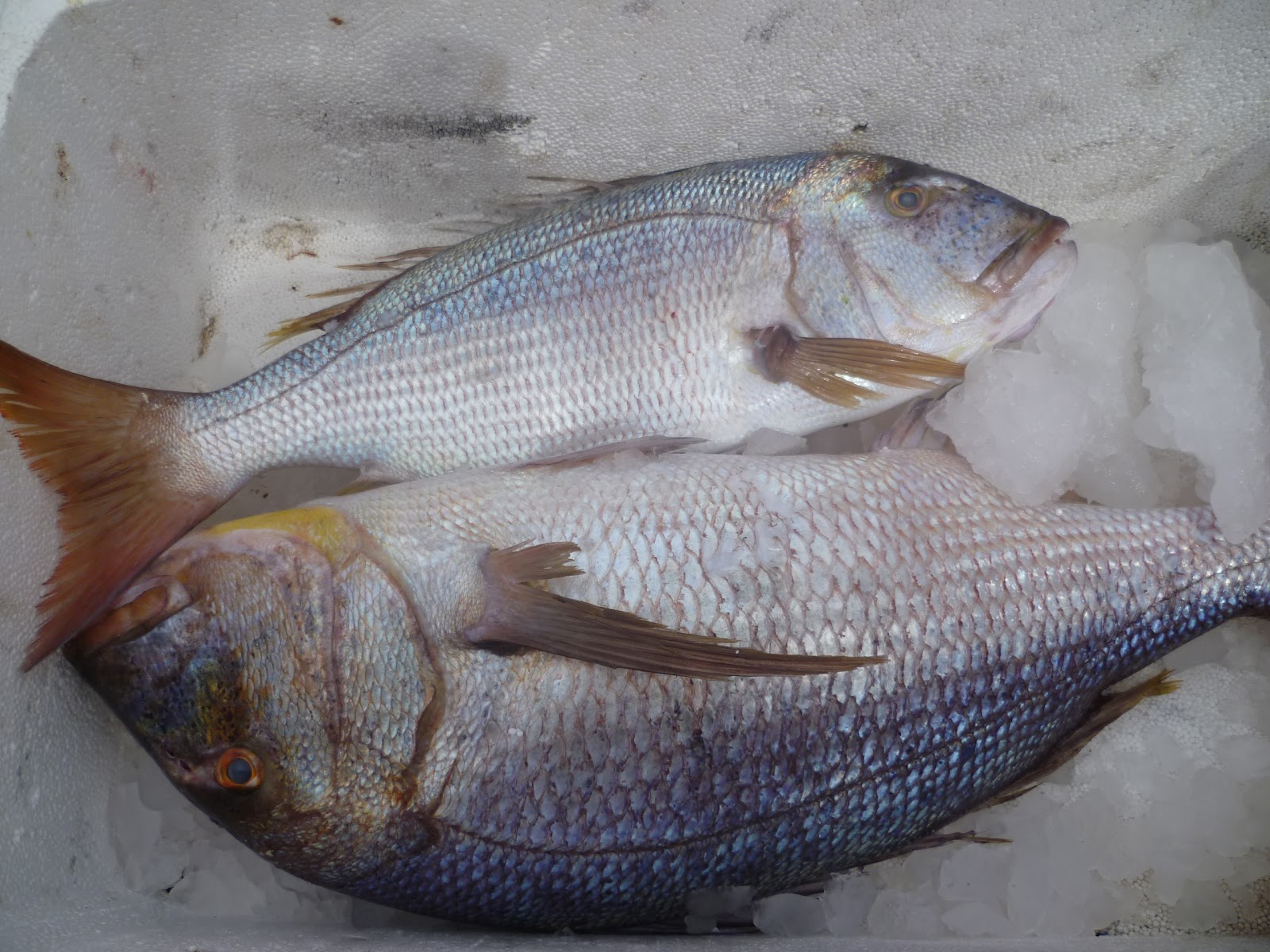
We went south round the sheer steep cliffs to Ayio Sergi, past the deserted rocky islet of Antitilos. They caught two sinagrithes – king of fish - one of them weighing four kilos. There were melanouria, and the small tuna called palamithes, and lobsters.
Not many fish, as a couple of nets were attacked by a seal, which we saw rolling around in the water, but enough to make it worthwhile. For me, the best part was being allowed to steer the boat for a while - a bit terrifying when close to the cliffs. My reward was a fouska, also called spinialo, a bit like an oyster (perhaps a kind of sea squirt) with soft yellow flesh that tastes like the sea.
A few days later, they caught 40 kilos of melanouria, and another day 500 tunas.
We had a week or two when the power went off for about an hour twice a day. No fun when Stelios has to get up at four in the morning and get ready to go out on the boat all morning, and there's no power for a coffee. But we seem to be back to normal. Ktipa xilo, touch wood.
Then it was Protomayia, First of May, also a sign that summer is beginning, as were the first oleander flowers blooming; and the Ayia Irini festival,with dancing in the afternoon down in Eristos valley - all reminding me that I've been living here for a year now.


Now that I've been writing notes on this blog for a year, I've started to receive messages from people who've found it, maybe looking for information on Tilos. I picked up a couple of walkers the other day and gave them a lift into Livadia, and when we got chatting, the English man said: 'Have I been reading your blog?' I've met a woman who used to be the rep for Laskarina here. And someone who was at a football match I went to last year, who sent me a wonderful message saying:

'One of the many things my regular visits to Greece has helped me to learn is that the "simple life" is very good indeed. Trouble is too many folk think you can only get it in Greece but if you try it is quite possible (if not always easy) to live the simple life back home too.'

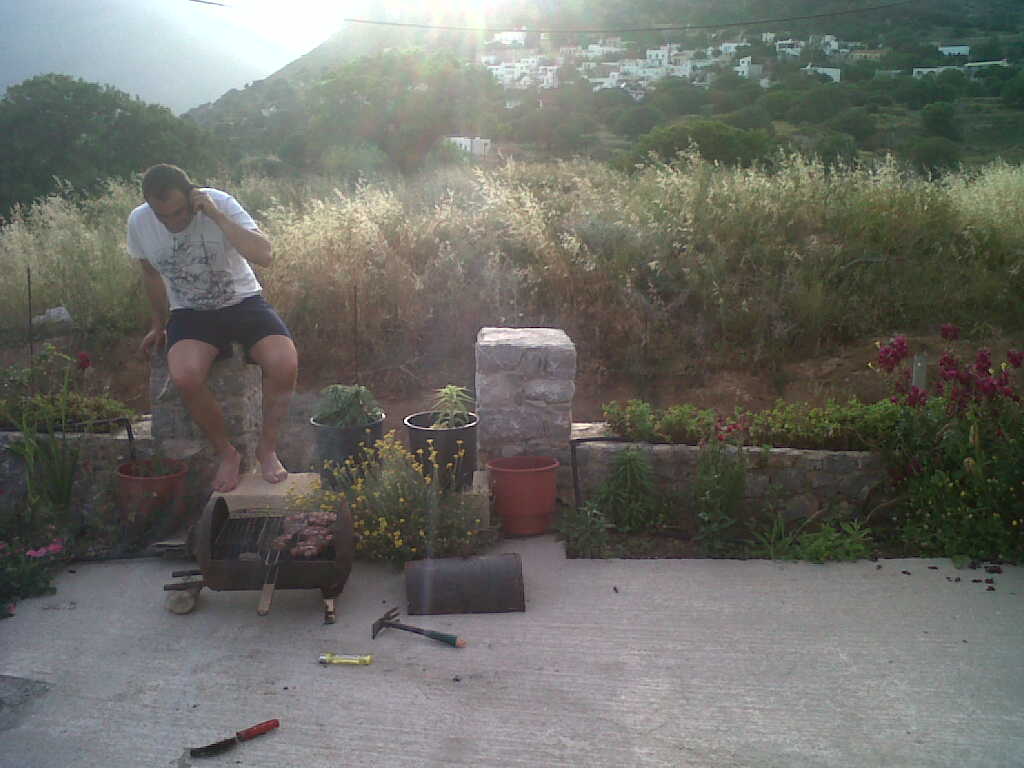
Beautifully put. Some things, of course, are only Normal for Tilos. Stelios assures me that everyone makes barbecues out of old hot water tanks in Tilos:


I've been endlessly confused recently between tha psisoume (we’ll grill meat - what you do with a barbecue) and tha psifisoume (we’ll vote). The elections happened here on Sunday, and Tilos was busy with people coming back home to vote. Funny, if voting was on a Sunday in May in the UK, how many people would do it, and how many would be on a cheap break to somewhere in Europe...?
The voting has sent a strong message that ordinary people are unhappy with being made to give up their future and their pensions for what their government has allowed to happen. (Last night I heard of a young locum doctor who is now on 500 euros a month, not enough to feed his family, and will have to look for work abroad...) There's much talk of France also saying they've had enough of their arrangement with Europe. Exciting times... Thankfully, not nearly as exciting here as the British newspapers seem to convey. Life goes on as normal in Tilos.

Finally, Eleftheria invited me to look around the studios she has overlooking the bay in Livadia last week, so I could help her create a text in English for prospective customers looking for more information. The studios are in a quiet part of the village, but only five minutes walk from the beach, with a spectacular view, and are good value, so if you're looking for a place to stay, they are worth checking out: http://www.michalis-studios.gr/

I always start these blogs thinking this should be a quick one as I haven't been doing much, and not much happens on Tilos... Right? 

Today has been Friday

Left my desk at 3pm today and wandered to Ayios Antonis, had a swim, then kept walking to Plaka. These are the photos - look at them and just imagine the only sound is the waves far below and the occasional bleat of a goat, or cry of a peacock, and the tread of your feet on the road...

A few lines from a poem came into my head from years ago, and I've just managed to track it down - it's by Canadian poet Gwendolyn MacEwen and I read it once on the subway and memorised it (http://zocalopoets.com/category/featured-poets/gwendolyn-macewen-featured-poets/). She was cycling across one of my favourite parts of Toronto on a Friday in the poem, 'Sunlight at Sherborne and Bloor', and I hope it's OK to quote a couple of lines here since I couldn't get them out of my head!

You will never do anything more vital, more profound, more perfect or more
Necessary than what you are doing right now.


Dry Biscuits and Earplugs: Greek Easter in Tilos


In England, Easter is heralded by the arrival of chocolate eggs of all shapes and sizes in the shops. In Tilos, we don’t have that many shops but none of them had chocolate eggs. When I did my last English lesson with the little kids before Easter, I asked them to draw pictures of what Easter meant to them so we could write English captions. All of them drew churches, some with candles and biscuits, and little Yorgos drew a big crucifixion with a crowd watching. This was my first indication that Easter might be a bit more serious here.
This would be my first Greek Orthodox Easter in Tilos. I moved here just shy of a year ago.
Easter biscuits are called koulourakia. Wikipedia tactfully describes their taste as ‘delicate’. Have you ever heard anyone say when you are feeling sick that you should nibble on dry biscuits? I was musing on this phrase not long ago, wondering exactly what it meant. I mean, certainly it sounds better than nibbling on a wet biscuit. I concluded it probably meant a biscuit without any goodies in it like raisins or chocolate. Just a very plain, simple, pastry-like biscuit. Well, that’s koulourakia. Not quite as exciting as chocolate Easter eggs, but at least you won’t feel sick.
The week before Easter was the week I started going on long walks again, and spotted my local farmer pulling the intestines out of a dead goat hanging from a tree. Leaves and figs were appearing on the fig trees. Seals were seen chasing fish into the harbour, I disturbed a big flock of migrating birds at Skafi, and I found a huge turtle washed up on the beach. Our garden was thriving with potatoes and onions, peas and rocket and raddichio. The fields were blooming. As, apparently, was love among the lizards. At least, I think that's what these two were up to...

Megali Pempti (Big Thursday)
The Big Thursday church service started in the evening. After we heard the bell ringing, we got ready, left our little country house in the dark and took the motorbike down the dirt track. It was a cool and windy night.
The little church was smoky with incense, crowded with chandeliers and censers and crosses woven from grass hanging from the ceiling, the dark old painted wood of the altar screen leaning inwards, the haunting chant of the priest rising and falling. We lit candles, and Stelios kissed the icon. A cross painted with Jesus crucified was decorated with garlands of flowers. Five minutes later, Stelios went to stand outside with a group of other men; other people arrived, young and old. I stood and watched all the people I knew, and listened. It felt very strange. And mournful.
The last time I went to a church service was here in Megalo Horio four years ago on my first trip to Tilos, on a Sunday morning, and a very old and frail woman told me off for wearing a dress that showed some leg above the knee. Actually she didn’t speak, but glared and prodded a bony finger and made the sign of the cross. This time, I knew jeans were OK. In fact, many of the young women were sporting super-tight trousers and five-inch spike heels.
I went outside for a while, but it was cold. This was a long service, several hours, during which a candle would gradually be lit for each of twelve Evangelists. I found a place inside again, watched people coming and going, and gradually the trance-like effect of listening to a sung service started to feel comforting.

Unable to follow the words or make the sign of the cross or kiss the icons, it became a time for a kind of meditation. Two weeks ago, I was three months pregnant. They had been thrilling moments back in January when we found out I was pregnant, and horrific moments in late March when we found out I wasn’t any more. It had been the only thing really on my mind, and the only thing I coudn't really write about here. Since the surgery that left me feeling so empty inside, I’d finally come to feel positive and OK again thanks to family and friends who helped me realise this was a common part of the process of making a child. But a little space for thinking was in fact just what I needed.

Megali Paraskevi (Big Friday)
Friday night's service took place around the Epitaphio, the symbolic funeral bier of Christ, which stood in the middle of the church, covered in flowers. Children held candles at either end.
Then the priest led a procession. Men carried the bier by its poles. We followed it up the steps behind the church and along a dark alleyway through the village. Now I know why the steps in villages are whitewashed at the edges: so you can see where you’re going in the dark. We passed the ancient wall with its huge stones, and then made our way down towards the cemetery, passing a field where donkeys – my neighbours this time last year – ran around in a panic.
When we reached the graveyard, families dispersed and I realised why there had been a frenzy of candle-buying during the service: the priest went around to each family and said a prayer for their departed loved ones. This part of the Easter ceremony, this remembrance of the dead, took me by surprise and when I heard others crying it made my own tears flow briefly for our own recently departed loved one, and Stelios and I had a silent hug in the darkness.
It was a sad but beautiful occasion, which ended with the rain falling and the repetition of a phrase ‘remembrance of ages’ or ‘aeons’. We all followed the bier slowly back up to the church, and the men held it high above the doorway so we could enter the church underneath it.

Easter Saturday
Everything starts so much later than I expect here. When I’d asked Stelios what time we’d be going to church today, he said to vrathi, meaning evening. In fact, the church bell calling us to the service started ringing at eleven p.m.
I’d noticed some interesting candle fetishism at various stages over the last few days; the priest’s helper chopping candles into small pieces, which ladies at the back of the church stuffed into their handbags. Tonight I noticed for the first time that the priest’s helper, overseer of candles and revenues, was keeping an eye on the little candles we’d lit on the way into church, and snuffing them out as they reached their last couple of inches and throwing them in the box below. Out, out brief candle… Tonight’s candles were white and red at either end, marking the celebration of Christ’s rising again.
Something else had changed tonight: the profusion of vomves, bombs or firecrackers. Stelios had been complaining about the lack of vomves this year, and indeed to him part of the appeal of standing outside the church is setting off of vomves. Older folks coming outside to complain from time to time just adds to the fun. I’m afraid Stelios and I don’t see eye to eye on this one. To me, the utter charmlessness of a thing that simply makes a loud bang cannot be overstated, especially when being somewhat sensitive in the hearing department, even the screech of Tube trains makes me cover my ears. I finally fled the church when a loud crack echoed in the doorway, and found a safe spot in a dark part of the village from which to watch the fireworks at midnight.
As everyone left the church and greeted one another with Christos Anesti (Christ is risen) and Alithinos Anesti (He is truly risen), they went home to break the fast with a meat soup called mayiritsa. But this was only the beginning of the evening: the next step was for us all to drive down to Bozi, the club at the edge of Livadia, park the car so close to the entrance that would be impossible for anyone but a Greek to retrieve it several hours later when hemmed in from all directions, and celebrate this solemn religious occasion by drinking and dancing for several hours…

Easter Sunday
It was a breezy but sunny morning and I worked in the garden for a couple of hours, clearing away weeds to find hidden tomato plants and forgotten shoots.
A whole lamb was turning on the spit over a bed of coals when we arrived for lunch with Stelios’ aunts and uncles and cousin down in Eristos.
‘Ela Jenni! Here, try this,’ said Nikos, ‘entera.’ Intestines, he said, urging me to take a piece – but they looked surprisingly appetising plaited and barbecued. I took a bite and the taste was salty but not unpleasant.

‘Is that liver?’ I asked, pointing to the darker pieces on the plate; I like liver.
‘Yes!’ said Nikos. My hand had already reached for a piece when he added, ‘ – and lung, heart…’
The round table in the garden at the edge of the orchard was spread with marinated wild greens, salad, cheese, tzatziki and bread and fried potatoes. And a huge oven dish packed with Flintstones-style portions of lamb – big bones with hunks of meat, rib cages, an accusing eye and what I realised was a row of teeth. This wasn’t the lamb roast I was used to from English kitchens, which Nikos acknowledged by jokingly insisting I must be fed, and putting a joint of meat suitable for a medieval warriors’ banquet onto my plate.

Thankfully a flagon of golden home-made wine appeared from under the table with increasing frequency. Pameh! Roufa! shouted Nikos – let's go, gulp it down!
The girls finally got up from the table with some difficulty and took ourselves (and a pan full of Greek doughnuts in honey) to the beach at Plaka, where the water was clear and deep blue. Perhaps this is what Christmas in Australia feels like. I walked part of the way home in the sunshine, passing only goats. Live ones.
The church bell rang in early evening, when it was still warm and sunny. The service would be in the other church at the top of the village. Stelios said maybe I shouldn’t come as there would be lots of vomves, but I had an idea. Earplugs. I grabbed the set I keep in my suitcase.
As we followed the little alleyways and reached the courtyard in front of the church, the views over the still-sunny valleys and hills and sea were beautiful. There was our little house down in the distance, with only bare mountainside beyond. Everything was so much greener than the last time I came up here, during summer. As I saw the cheeky grins of a couple of boys preparing to light and throw firecrackers, I stuffed the orange plugs into my ears and grinned. They dulled the noise just perfectly.

For an hour or so, I listened to the comforting singing of the service and breathed in the incense, with a view of our house just visible through the open doorway. I looked around. Everyone seemed happier now that Christ had risen. The cracks and bangs of vomves outside grew more insistent, as if we were being besieged by an invading army. There was a little confusion over some readings and a mistimed ringing of the bell outside, but the priest just smiled. Soon, we followed the priest outside, and it was time to burn Judas.