It’s bright and early in the village of Aperi, and the cafes
on either side of the bridge are closed. One has been closed for a while and is
looking for a new owner. Another should be open soon, says a man who’s taking a
break from painting a wall to talk to a handful of men outside the pharmacy. He
gives me a koulouri biscuit and says
I can keep them company while I wait. The other men say that then he’ll never
finish painting the wall.

Not wanting to interrupt the redecoration of the Aperi bridge,
I ask if the spring water is drinkable and it is, so I fill my bottle, return
to the road and start walking. When I made my way up from Ahata beach it was still
cool, but it’s warming up. Minas, who has the hotel Anemos which I’ve booked
into for three days, has arranged for a friend of his to pick me up on their
way to Olympos around 9 a.m. There are few cars, considering this is the main
road linking the south of the island with the north; it’s beautiful and
peaceful but the hill is tough. I’ve put my heavy backpack down and rested a
couple of times when a flatbed truck stops to offer me a lift as far as Spoa.
An old man, who introduces himself as Vasilis, gets out and
removes a recently slaughtered lamb or goat from the front; it’s just before Easter
and several goat-shaped packages were being loaded on the ferry when I left
Tilos. He puts it in the back with my backpack beside a pile of leafy branches.
Mere minutes after we set off, we crest the hill I’ve been struggling up for the
best part of an hour and start gently descending, and I’m mildly disappointed
that I didn’t keep walking to the top, especially since I’ve now missed the
chance for some stupendous photos of a sheer rock face dotted with pine trees
falling away to deep blue sea and a crescent of brilliant white beach. Vasilis
tells me it’s Apella.
We chat and he tells me a lot of Karpathos people live in
America and Australia and return every summer. As we speed along a winding
cliff-edge road with stunning views, he asks if I mind if he stops to feed his
animals and something else which I don’t understand. I say of course I don’t
mind, hoping it’s something innocuous. We turn off up a dirt track into forest.
He tells me to stay in the car as he pulls the branches off the back of the truck
and feeds them to the goats, then disappears. When he returns, he puts a
covered plastic tub by my feet, and I realise he was milking the goats.
We stop briefly again while he checks his beehives and a few
minutes later we’re arriving in Spoa, halfway to Olympos, where he insists on
treating me to a coffee at the kafeneio. We sit at a table on the road with a
tree for shade, and I notice the name above the door is Koumpanios; it turns
out Michalis, the owner, is related to the Koumpanios family in Tilos, the
people whose house I rented.
A white van is parked outside selling dairy products from the tyrokomeio or cheese factory of Kasos,
the neighbouring island. The owner and his daughter sit with us for a while and
I buy half a kilo of strong, creamy graviera. They also have butter, dhrilla (a type of cream) and sitaka, a rich, buttery cream which is
cooked for over twenty hours – like staka
in Crete, but made without flour.

 I update Minas at the hotel with my whereabouts so that the
friend who’s offered a ride can look out for me; apparently they’ve been
delayed. Then I set off along the road again, around the edge of a steep
mountain. The sky’s covered with thin cloud but there are lovely views of peaks
and old terraces and the sea below. Cars pass from time to time and eventually
I give up on the arranged ride and accept one from a very friendly family in a
truck. It already looks packed to the gills but Poppy, whose father is driving,
insists I will fit and moves around some stuff, and I squeeze into the back
seat with her two young girls and a little black dog.
I update Minas at the hotel with my whereabouts so that the
friend who’s offered a ride can look out for me; apparently they’ve been
delayed. Then I set off along the road again, around the edge of a steep
mountain. The sky’s covered with thin cloud but there are lovely views of peaks
and old terraces and the sea below. Cars pass from time to time and eventually
I give up on the arranged ride and accept one from a very friendly family in a
truck. It already looks packed to the gills but Poppy, whose father is driving,
insists I will fit and moves around some stuff, and I squeeze into the back
seat with her two young girls and a little black dog.
They’re from Olympos but usually live in Rhodes, and they’ve
taken the Blue Star ferry today to come home for the Easter holidays and open
up their restaurant, Milos. I chat and laugh with the two young girls, who
practice their English and tell me their village is just around the next
corner… Oh no, maybe the next corner… Oh, no, maybe the next! And then,
suddenly, there it is: Olympos.
Minas is waiting for me at Sophia’s café by the car park; he invites
me to sit down with his cousin for a few minutes and then leads me through the
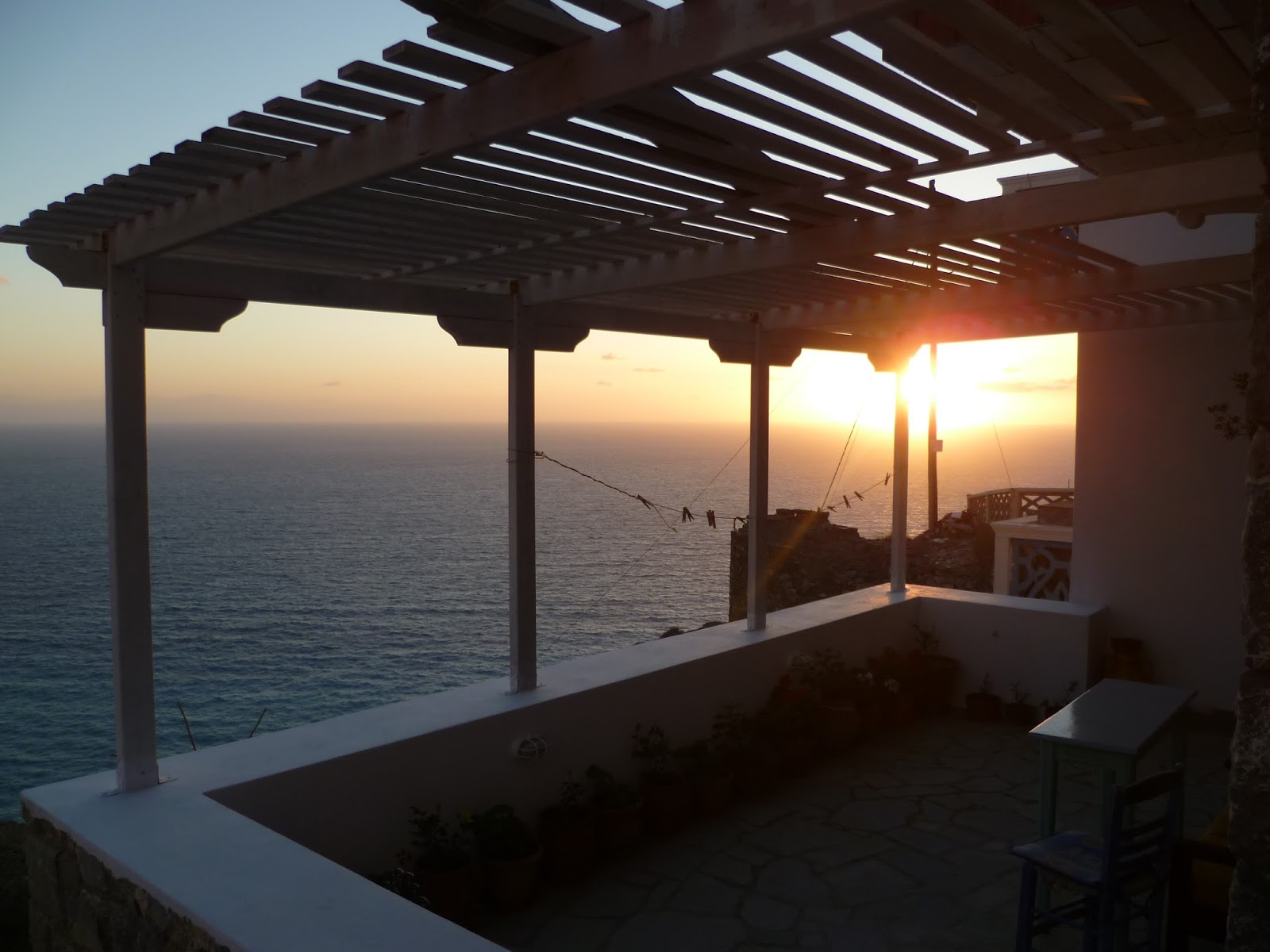
village to my room. There’s a strong wind blowing and an amazing view out over
the sea. I check if the water is OK to drink. ‘More than OK.’ The bed is a soufa, a mattress on a raised platform
made of carved wood, with cupboard space underneath. It’s lovely.
The last thing I want to do is work, but a project has taken
much longer than expected and I have to get online; I take my laptop and go to
find a suitable café. A few minutes’ walk along a little alley I first meet
Archontoula. She’s a tiny woman, seventy-something, wearing a thick black
long-sleeved dress with a colourful apron and a black scarf tied around her
head. She’s sitting outside a traditional kafeneion with framed photographs
taking up most of the wall space, and simple tables arranged around the sides
of the room. After we’ve chatted for a while she invites me in. I apologise and
say I need to find somewhere with internet.
‘Den sou leo psemmata,’
she says firmly in a voice built for shouting more than whispering. ‘I won’t
lie to you. I don’t have internet.’ I’m not at all surprised and I’m
embarrassed that I need it. ‘But you might be able to pick up the community
internet from the church. Go inside and try if you like.’
So I sit down in the corner and it works. I order a beer and
it comes with a plate of dark green olives, some good bread and a plate of
mousmoula, a soft orange-coloured fruit. Archontoula sits in the corner with a
bag of wool threads in different colours which she plaits into a string. When I
ask her about it, she gives me a necklace with a tassel at the end. You can
keep your keys on it, she says. Her headscarf keeps slipping down and she continually
has to re-tie it around the top of her head.
A man arrives, tall, hefty and chestnut-skinned with a
luxuriant moustache and twinkling eyes. Archontoula introduces her husband,
Philippas. She tells him who I am and that she didn’t call me in, I came in of
my own accord; it seems an important point. The kafeneio is called Kriti, or Crete, because Philippas’
father lived in Crete for a long time; also because Venizelos was from there.
Eventually I ask if there’s anything more to eat and she gives
me bean soup and a tomato and cucumber salad with bread and olives. The price
is minimal, and when I protest she says it’s ‘because we got to know one
another’. She says I should stay for Easter if I can. I’ll have to look into
the boats and connections tomorrow. Her husband says they’ll find me a ride to
Pigadia whenever I need to leave.
This is the start of the story of how I became lost in
Olympos.
Next morning, I’m back at Archontoula’s for breakfast, working
again at my computer. While I work, she’s trimming artichokes, angenares, ready for cooking and I eat a
good hard local cheese with bread and a dollop of thick, flavoursome, opaque
honey. People come and go and Archontoula talks with a couple of young men who
are doing some work for her on a house. She sounds forceful but fair, and every
now and then she erupts into cackling laughter. She tells me that she and her
husband pay for the costs of the kafeneio out of their pensions.
A Greek couple arrive, visitors from Patras, and Archontoula
gives them a shot of raki. She offers one to me too.
‘I can’t,’ I say, ‘I’m working.’
‘Just one!’ she says.
When I leave around lunchtime, it’s suddenly so windy I can
hardly stand up. The supermarket is closed, but someone tells me the lady who
owns it has just gone across the street to the pharmacy, so I wait and sure
enough she opens up again, so I buy coffee and a notebook and toothpaste. As I
leave, a man’s hat blows off and we laugh. He asks me if I arrived on foot
yesterday – he saw me as he went past. He says if I want a ride I need to do
‘auto-stop’, otherwise people think you prefer to walk.
That afternoon, sitting in Parthenon café surrounded by more old
photographs, I finish the piece of work that has gone on and on. Then I go for
a walk. I’m sure it’s partly relief at finishing that project, but I’m practically
in tears as I walk around Olympos village, out to its edges on the mountains
and down into the valley.
The physical setting, with the sheer mountains rising up, and
the way houses and windmills cling to the slopes and ridges. Can there be a
more beautiful place? Sometimes it reminds me of Santorini (but before it was
discovered); sometimes I feel I’m in the Himalayas or Machu Picchu. Everywhere
I turn, there is something surprising and spectacular. The colours of the stone
itself – green, brown and white – and the houses – white, blue, yellow – and the
way they are decorated. The terraces with olives and figs and vines; from
across the valley I looked back to the village and saw a boy leading a goat by
a rope; a woman in black picking fruit from a tree; another sitting in a field
with her goats. And I love the beautiful dress of the women, black with bright
embroidery, black headscarves and high leather boots; and the way they smile.
The angles of the steps, the sun setting into the sea.
Arriving back in the room I glimpse myself in the mirror
looking rosy-cheeked and windswept. I crawl into my very comfy bed on its
raised wooden platform with a window out to the sea, and fall happily asleep
for a while. When I wake, relaxed, it’s evening and I hear the church bell
close by. The big church is lit up for the service, and inside are old frescoes
and gilded wood and huge, brilliant chandeliers, the sound of chanting and the
smell of incense.
Archontoula heats up artichokes and potatoes for me, the food
I watched her prepare in the morning; with herbs and olive oil in tomato sauce
with that hard, white, salty local cheese, and olives and bread and a
glass of cold water. There’s no fuss; it’s all just done simply and
beautifully.