The Place To Be

‘Are you the Octopus lady? Back from Australia?’ asks the Englishman walking down the steps in Megalo Horio. Lisa is wagging her tail as if he’s a long-lost friend until he confesses he's not really a dog person. Well, I suppose I am the Octopus Lady, though it sounds like a circus freak, in the same way that Kyria Vicky became the Elephant Lady by association with the museum.
I have been reprimanded for not writing a blog since my return to Tilos, but who has time? There’s been fresh bread to bake, capers and oregano to gather and prepare, migrating birds to spot, a tan to top up... The verticality of Megalo Horio took a bit of getting used to all over again after nine months away, and I’m just getting my breath back. In fact, after so many months without my own home, I wanted to take time to enjoy the simple pleasure of moving back into my old house in the village.
There’s been the bright moonlight to admire, and the lemon-yellow morning sunshine that creeps across the mountains, illuminating the lines of old terraces, and the warm afternoon sun that brings out the brilliance of yellow flowers on the hillside. Clear blue sea to dive into. The quiet at night in the village, when all you can hear is a Scops owl’s haunting call, gentle footsteps as someone passes along the alley. Mornings of soft birdsong and bees buzzing and sheeps’ bells.
Lisa seemed to remember me, though she had been perfectly happy and well cared for in my absence thanks to Stelios and his parents, and house-sitters Guillaume and Natacha. But she gratifyingly made a fuss, licking me, grabbing hold of me with her front paws, rolling over for the belly-rub. And we're back to our routine of walking to the beach every day.
Stelios messages from his house one day to check I don’t need the car. We have an informal car-sharing scheme in place, and he has some stuff to move. A few minutes later he walks by the house carrying a fridge on his back. Lisa wants to go with him so I follow him down to the car, helping to push the seats forward so he can put it in the boot.
‘Prosekeh to jami,’ I say – mind the window. The back of the car is a different colour because the window had to be replaced after an accident last summer. ‘Etsi egineh?’ Is that how it happened, I ask, grinning, knowing how much stuff gets carried around in the car over the summer when the kantina is working.
‘Kapos etsi,’ he says, grinning back. ‘Something like that.’
The young kids play football outside the house in the afternoon. Itinerant salesmen advertise their wares – from flowers to live turkeys – over the loudspeaker as they stop on the road below: ‘Come ladies, we’re in your neighbourhood for a few more minutes’. I hear a voice that sounds like Grigoris calling my neighbour to do some work, and a few hours later when I’m walking Lisa to Eristos, I see them riding a tractor stacked with hay bales, and they wave hello. I’ve missed the easy friendliness and intimacy of the village, from the morning when we’re rubbing sleep out of our eyes to the warm evening when Rena and her family are sitting outside the shop.
There have been impromptu dinners with friends old and new, too...
‘Echo psaria,’ says Michalis, stopping at the gate to stroke Lisa. I have fish. He doesn’t need to say they’re fresh: some things go without saying. He invites me to come and eat in the evening at the house of Ian and Margarita, an English-Polish couple who have been living just a few doors away for a month’s holiday with their beagle Lola, and are constantly insisting I join them for dinner or just a glass of wine and some aubergine salad. Margarita, like me, has happy memories of childhood holidays in Greece, only being from Poland her family used to drive to Greece with the car loaded up with all their food, even potatoes.
‘I can’t tonight, I have work,’ I protest. But later Margarita comes by and repeats the invitation. So although I’m hardly sensible after a long day, I grab a half-empty bottle of plonk and head over, and we laugh sitting out on the terrace and are happy to be a long way from the UK election.
Another evening a group of us go to Livadia to the apartment of John Ageos Daferanos, resident of Tilos since late last summer, to see his photographs. I talk to him about the images over coffee. ‘They’re my interpretation of the island, my attempt to penetrate the mystique of the place, to capture its spirit. In this isolated place there is peace and silence but also a wildness inside.’ (See the ‘Island Life’ page of this blog.)
The oleander flowers are just coming out, I notice as I start to walk to Livadia. A car driving towards me slows down, and Savvas from the post office says hello. ‘Come two packets of food for Lisa,’ he says. I ordered the Friskies she likes online. He’ll deliver them soon. ‘The next time I come in Megalo Horio.’ I thank him and walk on, beaming at how much I love life on a small island. Next morning, I receive it with a hole in the top of the bag: the clever crows spotted something that looked like food on the top of Yorgos Orfanos’ truck.
It’s almost three weeks since I got back, but people are still stopping to say hello and welcome me. They ask how long I’m staying, and I say, ‘I’m staying.’
Some who have been reading this blog since last year will want to know if I’m back here alone after following Ian to Australia. The answer is that he will stay there and continue looking after his mother, who has Alzheimer’s; I had to come back home for a while - left Australia two months ago to see family and for work - and once I got back to Greece, I knew I was staying. We didn’t have an easy time of things, having barely spent a month alone together while I was there. We decided to let go, get on with our lives separately and remain just friends for now. 
I’m glad I had courage to lose sight of the shore, but now I’ve trusted and followed my heart back to Tilos, the source of so much happiness for me. Greece was still waiting. Lisa was well. I returned here at the same time of year, late April, that I first moved here four years before. My lemon tree, cut back over the winter, is already flourishing with fresh green leaves. Time to plunge into the island's deep waters and lie on its hot sands again.
 

At Kos Town

Juicy and messy… No, not my life, just an afternoon snack of big Greek tomatoes, eaten whole. A taste I’ve missed.
Now, evening. The smell of a harbour. Sound of palm leaves rustling, mopeds haring by on the road below, a high-pitched church bell clanging. Sitting on my balcony overlooking Kos harbour, I’ve already eaten handfuls of peanuts, their pink papery skins encrusted with salt, as I sip on a glass of buttery, fruity, local white wine.
I’ve been gone too long from Greece, but it’s allowed me to experience everything afresh. I’m arriving at the same time of year I did four years ago, when I came to stay, that new beginning. When the cab driver from the airport today asked me if I was staying many days in Greece, I said a definitive ‘nai’, yes, and laughed.
It’s a wonderful time to arrive in the islands of the South Aegean. As we landed in Kos – that dramatic landing, veering away towards the island of Nisyros, low over the quarried pumice islet of Yiali, then swooping back low over the blue sea to land across a narrow, flat piece of the island – the land looked green. The cab driver said there had been a lot of rain but now for a week, kalokairi – summer. Tourists just started arriving this week; in two weeks’ time, he said, the island will be full. And what of the economic problems? ‘Here, we don’t bother ourselves with that,’ he said, half-joking. ‘We have tourism.’ When I ask him about Greece leaving Europe he says, ‘They won’t let us. And we shouldn’t.’ I am, by the way, chatting to him in Greek. It’s been a shaky first day, forgetting how to say things, but as always the Greeks are complimentary of any attempt to speak Greek.
We passed olive groves, vineyards, all a bit ramshackle; wandering cows; bakeries. The cab driver waved hello to other drivers. It’s that familiar start-of-season, start-of-summer optimism that you get, especially on the big islands. There was warm sunshine and a breeze, green not yet burned to summer brown.
I arrived too early to check in to my room, so sat with a frappe and iced water on the terrace of the grandly named Kosta Palace (where I am paying a grand total of fifteen pounds, including breakfast), taking it all in: the pale blue sparkling water, across which were the minarets and blue domes and palm trees of the town against a backdrop of mountain ridge. Pop music was blaring. The cab driver had been playing music too. I missed music.
After my coffee, I didn’t have to wander far to find a bakery with a good cheese pie, and next door was a ticket office where I bought my ticket to Tilos for tomorrow, while at the café-bar opposite, groups of young people sat around sipping coffees, enjoying the sunshine. I walked back to the harbour and watched the fishing boats with their blue trim and hand-painted names: Kapetan Tasos, Giorgos, Maria. A wiry old man a with deeply tanned, lined face, wearing rubber boots and old clothes, was telling his young helper to leave his work mending nets on the boat with the cross painted on its prow, the Panayia Kastrou, Our Lady of the Castle. Ela! As to… 
Many of the boats had dark blue circular talismans against the evil eye. Another young man was threading bait onto hooks, listening to music. ‘Eh Yiorgo, ti ora eineh?’ he shouted at a man who was strolling from one boat to another. An old man put a cigarette in his mouth, tossed the cellophane from the new pack over his shoulder into the water. He stood to talk to Yiorgo, gestured with his arm outstretched and his thumb and forefinger twisted in a question, lamented the state of affairs compared to the old days when he would make such-and-such ‘kathara’, take-home. Then he sat again with a mobile phone to his ear.
I asked another fisherman on shore about the threading of bait onto lines. He was cutting up fresh fish and threading the pieces onto lines arranged around the rim of a bowl-shaped bucket. He said it was called ‘paragadhi’, and you trail the lines behind the boat one by one.
Later, I wandered around as a cool evening wind blew off the sea. I stopped to look in a cheese shop, and the man inside smiled in welcome. I passed a tiny chapel with ancient white marble revealed beneath the modern exterior. The roots of olive trees were pushing up the concrete slabs of the pavement. A man on a motorbike was laughing with some tourists standing at an ATM: ‘Money, OK! Today. Next month, maybe no money!’ There was a tantalising smell of grilling meat as I passed neighbourhood tavernas, and little houses covered in pot plants.
Now it’s dusk, and a fishing boat is chugging in to shore. The sun has gone from the mountain opposite, and the water has turned pale, a few streaks of cloud tinged pink. I’ve finished my wine and eaten far too many peanuts. Lights are beginning to come on around the harbour, and the fishing boats are bobbing on rough water.

I have a ticket for the ferry to Tilos leaving tomorrow lunchtime. I hope the wind dies down a little. But nothing, not the prospect of seasickness or delays, can quell my happiness at being back in Greece. It’s a year since I first went to Australia; Yiannis has to stay there for now to look after his mother. I still have the tiny bag of sand from Skafi beach that I took with me when I left, which I’ll scatter back where it belongs very soon.

Water Dragons and Mr Browne

 
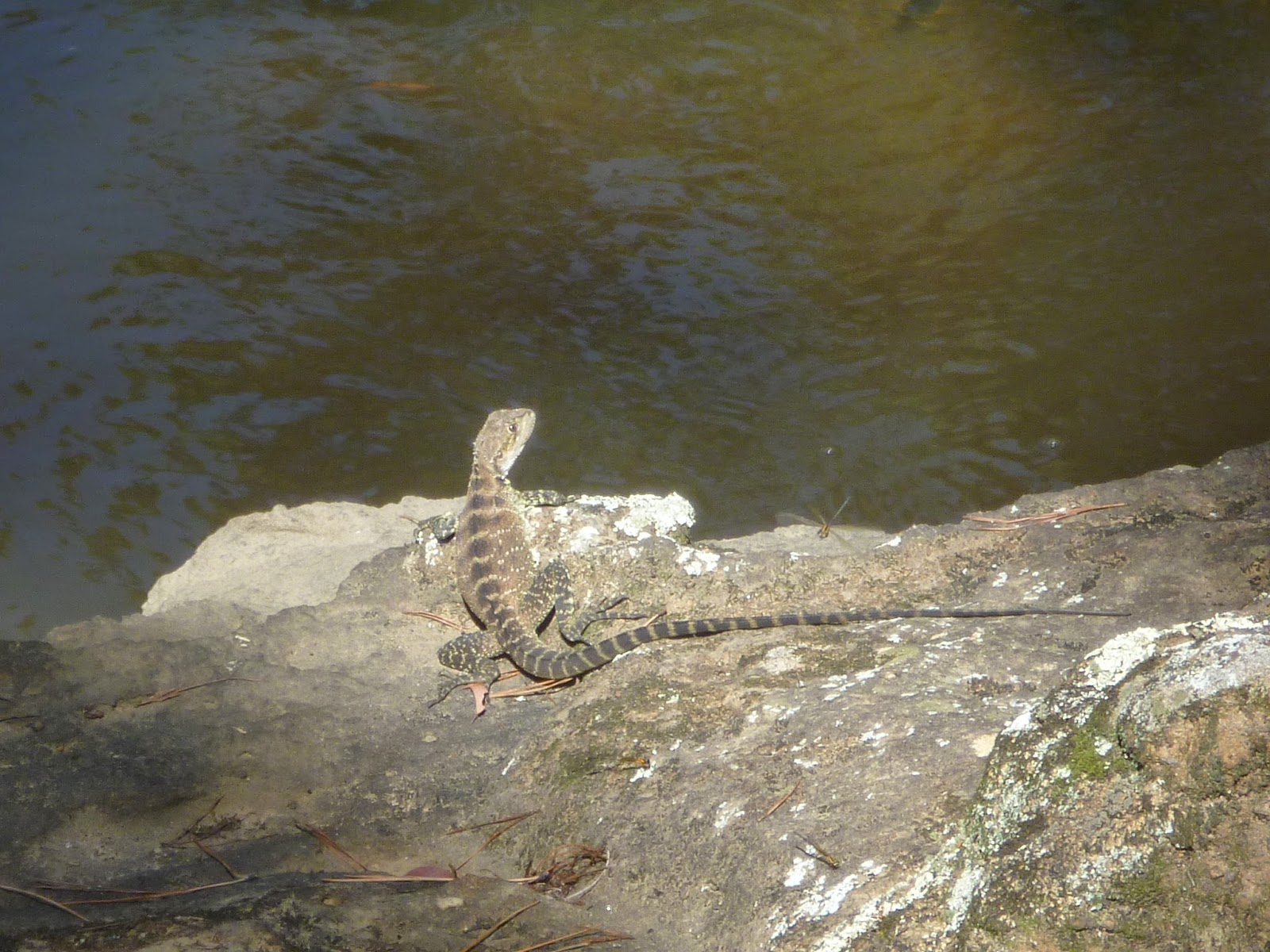
I was on the lookout for duck-billed platypus in the Wingecarribee River, but all I could see so far on the calm, mud-brown water were some duck-billed ducks, which were nice but not quite as exciting. As I looked down at the trail I spotted a shiny lizard, about as long as my hand, wriggling fast into the undergrowth - then another, and another, leaping from the rocks to hide. It was about four o’clock, and there was nobody else about, so probably they were basking in the heat from the sun on the boulders. Then a little further on I saw a couple of bigger ones, different, and as I stopped still, so did they.
These were over a foot long, pale green-grey with ridged backs and black stripes across their tails. They kept their eyes glued on me for the ten minutes or so that I watched them then reached slowly in my bag for my camera. I later learned that they were water dragons, native to eastern Australia, and they must have got used to people as the trail was close to the village. I’d only continued a few more steps when I heard a splash in the river below and saw something swimming like a wiggling arrow across the surface, before pulling itself up on the rocks. Sure enough, another water dragon.
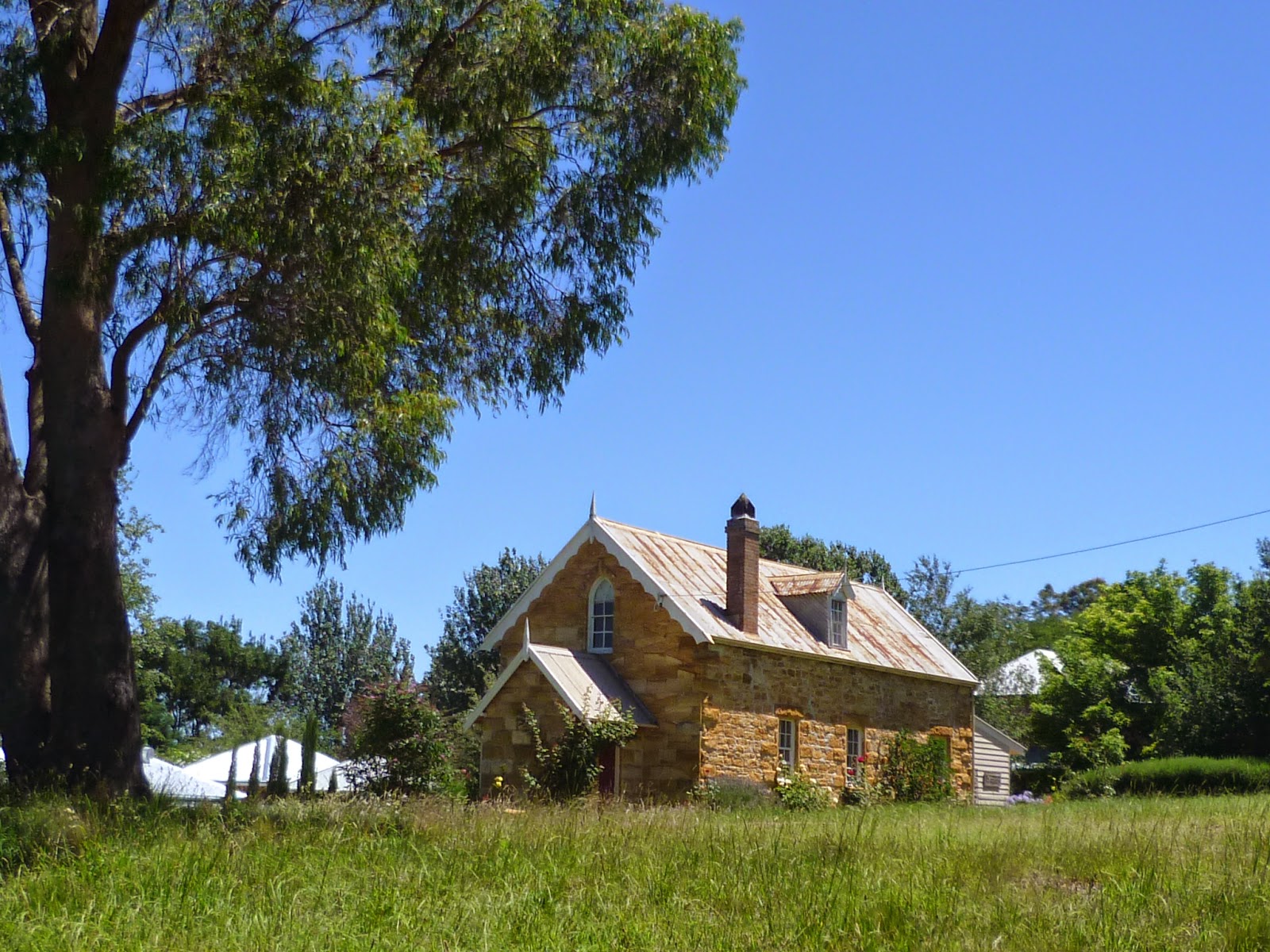
The trail was just at the back of the village, and soon I was looking at a church that made me feel I was back in Britain, except for the towering pines surrounding it. This was the Anglican church, built in a Gothic revival style from stone quarried where I'd been walking. 
Down at the bottom of the hill and across the bridge over the river, meanwhile, was the Catholic church with its golden statue set in the ochre stone, which – especially with the deep blue sky above, and the heady scent of more pines – reminded me of the south of France. Behind it was a loo where the management had thoughtfully placed a sign, presumably for the edification of the waiting. Father William McGinty had arrived in Australia, it said, in 1847 from Dublin, Ireland, and was appointed first pastor of Berrima district. St Francis Xavier church, designed by Augustus Pugin, opened in 1851. Then it seems McGinty deemed his mission in Berrima complete, as by the following year he was pastor of Ipswich, Queensland. 


Berrima is in the heart of the lush Southern Highlands of New South Wales and today just 400 people live in the historic village in the curve of the Wingecarribee. It was rather grandly laid out in the 1830s in great confidence that it would become a county capital, and at one time had some dozen inns catering to horse-drawn traffic; there were bakeries and a market place and a military barracks. But it was by-passed, first by the railroad – the closest stop is Moss Vale, 9km away – and then by the freeway, which sadly is still audible at the quiet times of day, though hidden by dense forest.
Being by-passed was Berrima’s saving grace, for the sedate village now enjoys a status as one of Australia’s best preserved colonial pioneering settlements, strewn with pretty Georgian sandstone cottages with steep corrugated tin roofs. 
It has only one inn left, but a good one: Australia’s oldest continuously licenced inn, dating from 1834. It was first licenced to James Harper, a son of convicts who married a convict and became a police constable, set up the pub and then built himself a brick house now called Harper's Mansion, one of the most visited National Trust properties in the state. Perhaps Berrima's most famous building, though, is the gaol, completed in 1839 and still serving as a minimum-security prison. The second ever trial by judge and jury was held at the courthouse here, and the first man hanged at the gaol was the unfortunate Paddy Curran.
 
All of this, coupled with the fact that the Southern Highlands is a wine-making region and wineries abound nearby, makes Berrima a draw for tourists, with Sydney only an hour and a half away by car. Every other building seems to be a fancy ‘patisserie’, tea room or upmarket gift shop. The old general store has, like most, been turned into a café. My mission to buy food – since we’re lucky enough to be house-sitting here - was in vain. If we’d wanted to buy some hand-stirred jams, a wooden duck in boots or something made from alpaca wool, we’d have been all right.
I was making my way around the park after my water dragon encounter, past the old bank and bakery (above), when I saw an ‘artist’s studio’. Through the open door I glimpsed what appeared to be a VW beetle painted with emus… I poked my head inside and was encouraged to come and look around. And thus I had my unforgettable encounter with artist Peter Browne. 
The paintings that covered the walls transported me out of leafy green Berrima - with its willows overhanging the lazy river - and into an outback Australia of searing heat, bare skinny gum trees and scrubland, with wooden shacks, lanky farmers, lankier horses and curious animals. The details made me laugh aloud, especially when I saw one called ‘Early Boat People’ showing a first encounter between Aboriginals and strangely dressed colonials clutching those rabbits that would go on to wreak such havoc.
(c) Peter Browne Fine Art
‘Well, you survived that!’ said the man at the table, who I guessed might be the artist, as I moved on from the first room into the second. We got talking, and he said some people asked him if he had any paintings of Berrima. ‘Why would I paint Berrima?’ he said. ‘It’s all English trees, English houses – what’s Australian here?’ He’d spent most of his time as an artist in the tiny settlement of Silverton, near Broken Hill out west, a place I’d tried to get a house-sit but had been thwarted by transport difficulties. I told him about the water dragons I’d seen on the trail.
‘Did you see the wombat poo?’ I laughed and said no, but then I wouldn’t really know what it looked like. He Googled it for me. ‘Look! They're cubes.’ I looked. Remarkably, they were. ‘And they like to leave it in little piles on rocks. Kind of puts you off lamingtons,’ he said, referring to the cube-shaped Aussie chocolate cakes.
After that, we talked about lots of things, mostly related to the sense of the absurd that shows up as detail in his paintings. He told me about the bush poet Banjo Patterson, who wrote Waltzing Matilda – ‘funny that we have a national anthem about a sheep thief’ – and how Spike Milligan lived for a while in Woy Woy and joked about his cork hat (for keeping off the flies), that ‘the bottles must have fallen off’. He told me he had noticed the news stations were excitedly reporting a shark ‘lurking’ off the coast – how do we know it was lurking? Was it loitering with intent? Maybe it was just swimming. The cute baby seal found on the steps of the opera house, though, wasn’t ‘lurking’, it was ‘basking’. 
Most visitors who came to the studio, said Browne, if they hadn’t come especially to see his work, were tourists who had only a few minutes to spend in each shop and were more in the market for a pot of jam. He was thinking of setting up a jam stall to cater to them too. Too many people only wanted to look at things they could buy. ‘Mall-itis,’ he called it.
His banter about Australian culture, especially that of the Silverton area, was full of references that sounded to me wonderfully colourful and somewhat surreal, such as a Turkish ice cream man who shot at a train and started a war. And the wonderfully colourful and somewhat surreal, or eccentric, of outback Australia was all around me on the walls of the studio.